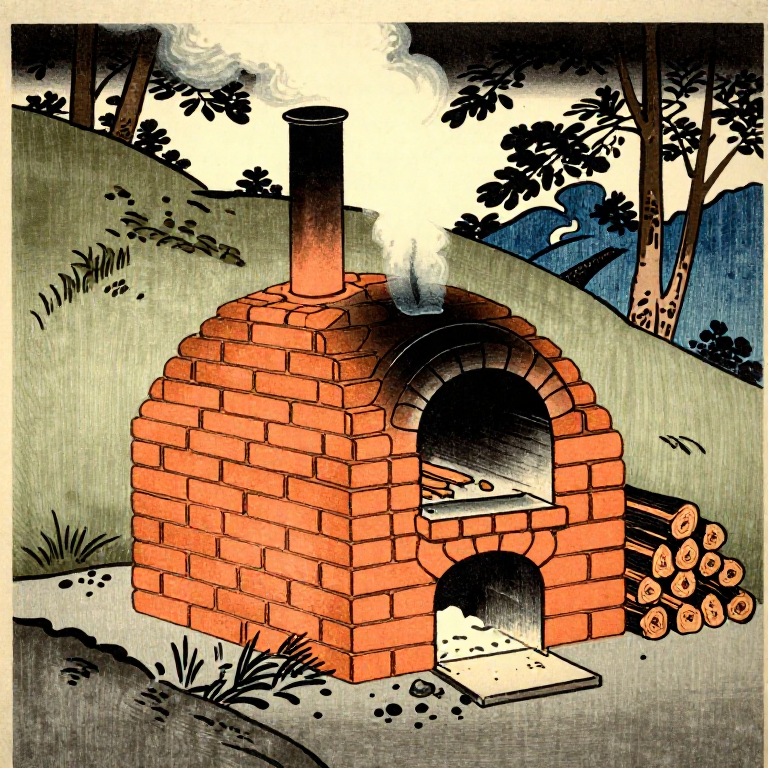


Building a Small Anagama Wood-Fired Kiln — Single-Chamber Climbing Kiln
নির্দেশাবলি
Select and Prepare the Site
Select and Prepare the Site
An anagama requires a slope of approximately 15-20 degrees to create natural draft. The firebox sits at the bottom of the slope and the chimney at the top, so heat and flame travel uphill through the ware chamber. Select a site with good drainage and position the kiln so prevailing winds blow toward the chimney, aiding draft. Excavate a level trench into the hillside approximately 2.5m long, 1m wide, and 0.5m deep for a small anagama. The trench floor should follow the slope angle. Compact the soil firmly and lay a bed of dry sand or crushed firebrick as a foundation. Ensure the site is well away from structures and overhanging branches, as multi-day firings produce continuous smoke and sparks.
Lay the Floor and Firebox
Lay the Floor and Firebox
Lay hard firebrick on the trench floor in a running bond pattern (offset joints) using refractory mortar. Hard firebrick is necessary for the floor because pottery is loaded directly onto it, and soft insulating brick would crumble under the weight. The firebox occupies the lowest 60-80cm of the kiln length and should have a grate (either iron bars or a row of bricks on edge with gaps between them) to allow ash to fall through and air to enter from below. Build the stoke hole opening at the very bottom end — approximately 25cm wide and 30cm tall, framed with angle iron for durability. This opening is where wood is fed into the firebox during firing.
Build the Walls and Arch
Build the Walls and Arch
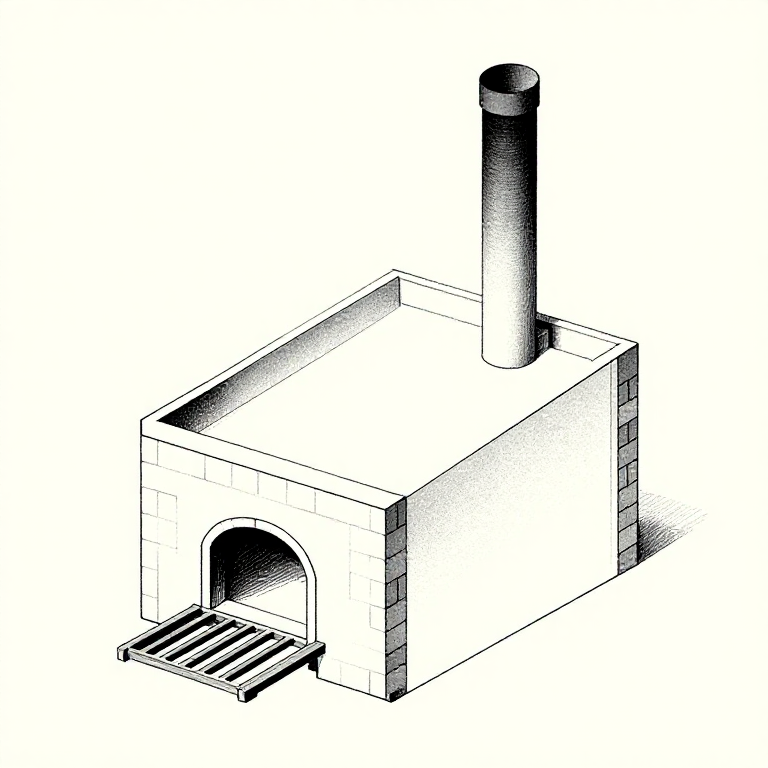
Stack insulating firebrick walls on either side of the trench, building them inward to form a catenary arch (the natural curve a hanging chain makes, inverted). A catenary arch distributes weight evenly without requiring a steel frame. The interior width should be approximately 60-80cm and the interior height at the crown approximately 60cm — large enough to stack several shelves of pottery. Use refractory mortar between all bricks, keeping joints as thin as possible (3-5mm) to minimize weak points. Build a temporary wooden form (a plywood arch template) to support the bricks as the arch closes at the top. Remove the form after the mortar sets. Leave one or two small peephole gaps in the walls for observing cone packs during firing.
এই ধাপের উপকরণ:
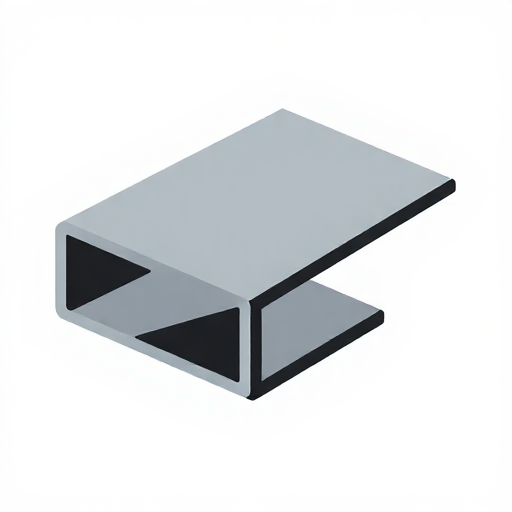 নরম ইস্পাতের কোণ-লোহা2-3m m
 সিরামিক তন্তুর কম্বল5-10 square metres টুকরা
Build the Chimney and Door
Build the Chimney and Door
At the upper end of the kiln, construct a chimney from firebrick, approximately 1.5-2m tall and 25-30cm square internal dimension. The chimney height determines draft strength — taller chimneys pull more air through the kiln. Include a damper slot near the base of the chimney (a gap where a flat brick or steel plate can be inserted to partially block the flue). Adjusting the damper controls the atmosphere inside the kiln: fully open creates oxidation, partially closed creates reduction. At the lower end, build a removable brick door in front of the stoke hole. The door is bricked up and mortared each firing, then broken open to unload. Leave gaps in the door bricks during firing to feed wood through.
এই ধাপের উপকরণ:
নরম ইস্পাতের কোণ-লোহা2-3m mসিরামিক তন্তুর কম্বল5-10 square metres টুকরাCure the Kiln with a First Firing
Cure the Kiln with a First Firing
Before loading any pottery, cure the new kiln with a slow first firing to drive moisture from the mortar and bricks. Start with a very small fire in the firebox and increase the temperature by no more than 50 degrees C per hour for the first 8-10 hours. Rapid heating causes steam pressure to crack mortar joints and spall brick faces. Bring the kiln to approximately 500 degrees C and hold for several hours, then allow it to cool naturally over 24-48 hours. Inspect all mortar joints and repair any cracks before the first pottery firing. A well-built small anagama typically fires to cone 10-12 (1280-1340 degrees C) during 3-5 day firings, consuming 2-4 cubic metres of split hardwood per firing.
উপকরণ
7- 2-3m mপ্লেসহোল্ডার
- 5-10 square metres টুকরাপ্লেসহোল্ডার
- 200-300 bricks টুকরাপ্লেসহোল্ডার
- 50-80 bricks টুকরাপ্লেসহোল্ডার
- 25-50 kg টুকরাপ্লেসহোল্ডার
- প্লেসহোল্ডার
- প্লেসহোল্ডার
প্রয়োজনীয় সরঞ্জাম
5- প্লেসহোল্ডার
- 1 vendor sell this, none ship to you yetপ্লেসহোল্ডার
- প্লেসহোল্ডার
- প্লেসহোল্ডার
- Brick saw or masonry sawপ্লেসহোল্ডার
CC0 পাবলিক ডোমেন
এই ব্লুপ্রিন্ট CC0-এর অধীনে প্রকাশিত। আপনি অনুমতি ছাড়াই যেকোনো উদ্দেশ্যে এটি অনুলিপি, পরিবর্তন, বিতরণ ও ব্যবহার করতে পারেন।
মেকারের ব্লুপ্রিন্টের মাধ্যমে পণ্য কিনে তাঁকে সমর্থন করুন, যেখানে তিনি আয় করেন মেকার কমিশন বিক্রেতাদের নির্ধারিত, অথবা এই ব্লুপ্রিন্টের একটি নতুন সংস্করণ তৈরি করে নিজের ব্লুপ্রিন্টে সংযোগ হিসেবে যুক্ত করে আয় ভাগ করুন।