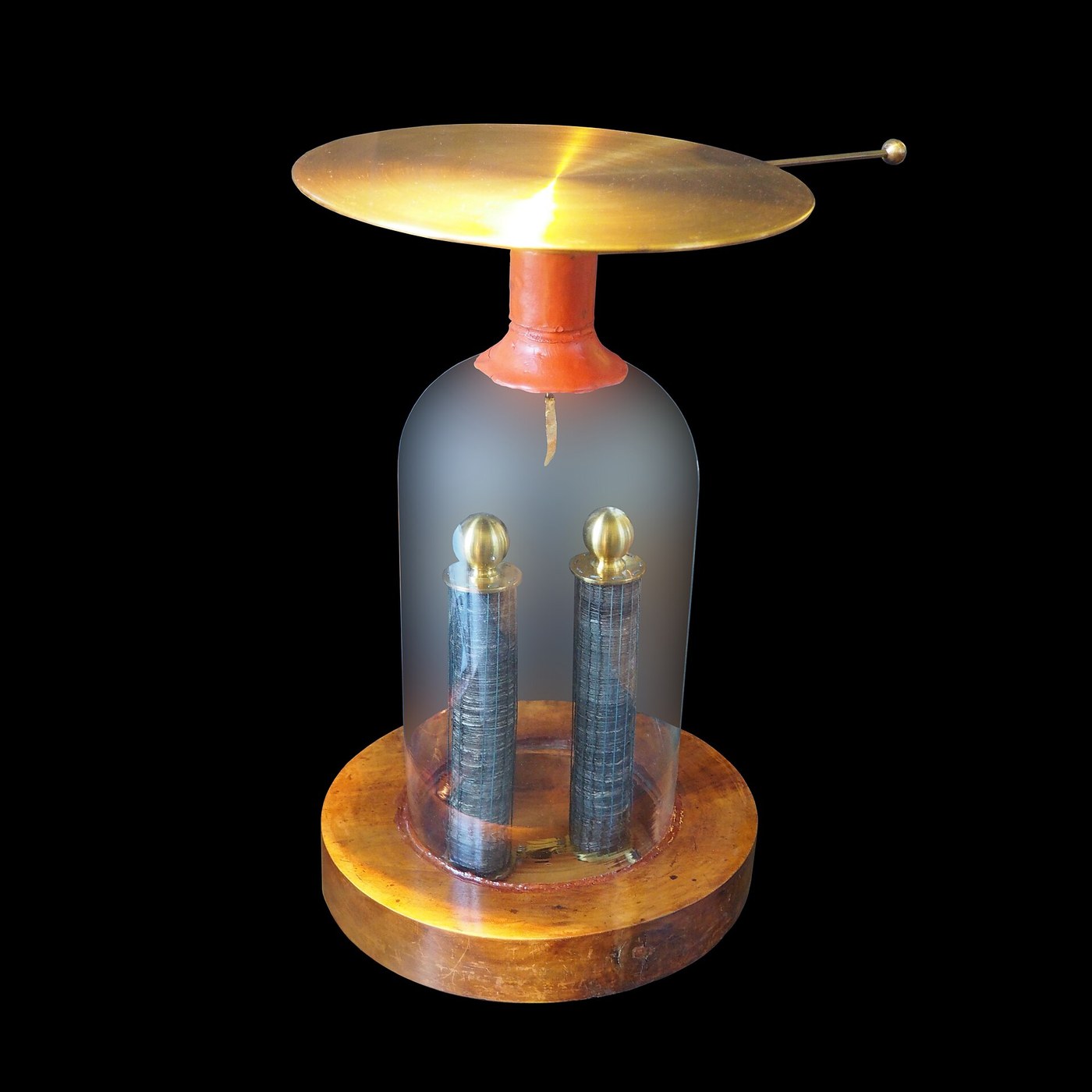


Gold-Leaf Electroscope
নির্দেশ
Prepare the jar and lid
Prepare the jar and lid
The jar is the working part, not decoration: it stops draughts moving the leaves and keeps humidity off them.
- Take a clear glass jar with a wide mouth and dry it thoroughly, inside and out.
- Cut a disc of stiff insulating material to fit the mouth as a lid, and drill a hole through its centre for the rod.
এই ধাপের উপকরণ:
 কাচনলের কিট1 কিট
Make the rod and collecting plate
Make the rod and collecting plate
Straighten a length of stiff copper wire for the rod. Flatten a small disc of copper sheet and fix it to the top as the collecting plate.
- Pass the rod through the lid so most of its length hangs inside the jar.
- Seal the rod in the lid so it is held firmly and insulated from anything else.
- Bend a small hook or flatten a tab on the lower end for the leaves to hang from.
এই ধাপের উপকরণ:
 তামার তার1 length
 তামার পাত1 শিট
Hang the gold leaf
Hang the gold leaf
Gold leaf will not survive being handled with fingers — it tears on contact and clings to skin.
- Cut two identical strips on the backing paper, a few millimetres wide.
- Lift each with a dry soft brush or the backing itself and lay it over the hook so both hang flat and touch each other along their length.
- Work in still air. A breath will move them across the room.
এই ধাপের উপকরণ:
 সোনার পাত1 book
Charge it and read it
Charge it and read it
Rub a plastic rod with wool, or a glass rod with silk, and bring it near the plate without touching.
- The leaves diverge while the rod is near and fall when it is withdrawn — that is induction, and no charge has been transferred.
- Touch the rod to the plate instead and the leaves stay apart after it is removed — the instrument is now charged by contact.
- The angle of divergence indicates how much charge, not how many volts.
Discharge, and find out why it leaks
Discharge, and find out why it leaks
Touch the plate with a finger and the leaves fall — you are the path to earth.
- Time how long a charged electroscope holds its divergence on a dry day, then on a damp one.
- Warm the glass gently and try again.
History and context
History and context
Abraham Bennet, a Derbyshire clergyman, described the gold-leaf electroscope in Philosophical Transactions in 1787. It was not the first electroscope — pith-ball and straw versions came earlier — but gold leaf was so much lighter that it responded to charges the others could not detect at all.
Its descendants did serious work. Adding a scale and a known charge turned it into the electrometer. In 1900 Julius Elster and Hans Geitel used carefully insulated electroscopes to show that even sealed, shielded vessels leaked charge steadily — an anomaly nobody could explain. That leak was ionisation from what we now call background radiation, and following it upwards in a balloon led Victor Hess to cosmic rays in 1912.
What we do not claim: the electroscope does not measure voltage. Divergence depends on charge, geometry and leaf mass together, so two instruments will not agree with each other in any absolute sense. It is a comparator and a detector, and it was never anything else.
CC0 পব্লিক ডোমেন
এই ব্লুপ্রিন্ট CC0-এর অধীনে প্রকাশিত। আপনি অনুমতি ছাড়াই যেকোনো উদ্দেশ্যে এটি অনুলিপি, পরিবর্তন, বিতরণ ও ব্যবহার করতে পারেন।
মেকারের ব্লুপ্রিন্টের মাধ্যমে পণ্য কিনে তাঁকে সমর্থন করুন, যেখানে তিনি আয় করেন মেকর কমীশন বিক্রেতাদের নির্ধারিত, অথবা এই ব্লুপ্রিন্টের একটি নতুন সংস্করণ তৈরি করে নিজের ব্লুপ্রিন্টে সংযোগ হিসেবে যুক্ত করে আয় ভাগ করুন।