

Hammond Organ
A pipe organ makes a note by blowing air through a pipe, and the pipe's character comes from which harmonics it happens to produce. You cannot change that. If you want a different voice you install different pipes — thousands of them, in a building constructed around them.
Hammond turns the problem inside out. Instead of finding tones and accepting their harmonics, he generates pure tones — one per frequency, from a spinning toothed wheel beside a magnet — and lets the player add harmonics deliberately, in whatever proportions they choose. The timbre is not a property of the instrument. It is a setting.
Every tone of the same frequency comes from one wheel. That is the detail that makes it work: a harmonic borrowed by two different keys is the same current from the same source, so the notes never beat against each other the way independent oscillators would.
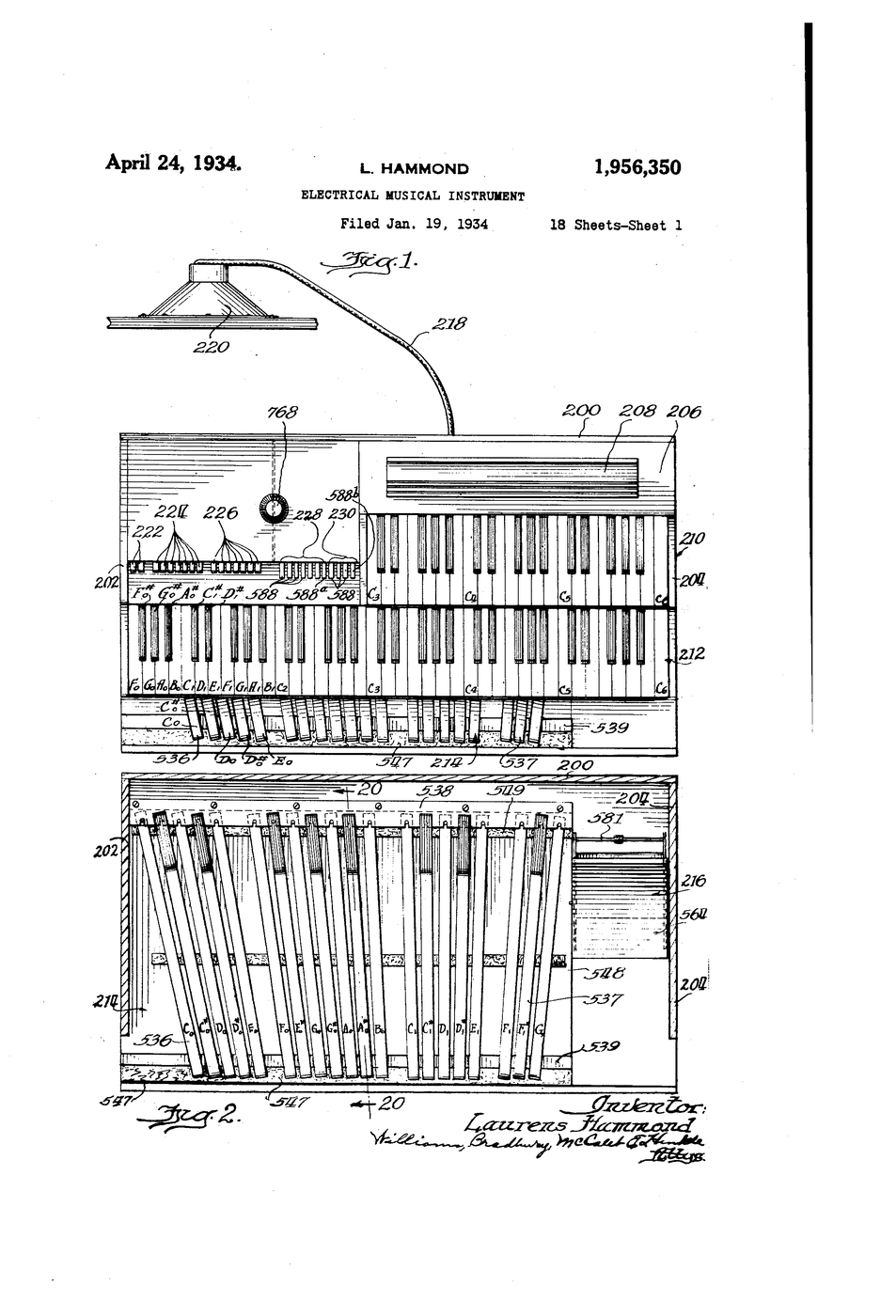
US Patent 1,956,350, "Electrical musical instrument", filed 19 January 1934 and granted 24 April 1934 to Laurens Hammond — three months from filing to grant.
নির্দেশাবলি
Read US 1,956,350 and find the common source
Read US 1,956,350 and find the common source
Hammond insists that "all of the electrical current of the same frequency ... is derived from a common source". One wheel per frequency, shared by every key that needs it.
Listen to a pure tone and a real instrument
Listen to a pure tone and a real instrument
Play a sine tone, then any acoustic instrument at the same pitch. The sine sounds thin and hollow. Harmonics are what make a sound interesting, and Hammond starts with none.
Cut a toothed tonewheel
Cut a toothed tonewheel
Cut a disc about 80 mm across with 16 evenly spaced teeth or bumps around its rim. Even spacing matters more than tooth shape — irregular teeth make a rough tone.
এই ধাপের উপকরণ:
 বাল্টিক বার্চ প্লাইউড1 শিট
Wind a pickup coil on a magnet
Wind a pickup coil on a magnet
Wind several hundred turns of fine enamelled wire around a small permanent magnet. Mount it so the teeth pass close to its pole without touching.
এই ধাপের উপকরণ:
 এনামেল-মোড়া তামার তার1 রোল
প্রয়োজনীয় সরঞ্জাম:
 চ্যাপ্টা মুখের সাঁড়াশি
Spin the wheel and listen
Spin the wheel and listen
Turn it steadily and amplify the coil's output. A tone appears. Each passing tooth changes the magnetic circuit and induces one cycle of current.
প্রয়োজনীয় সরঞ্জাম:
 ছোট স্পিকার ৮ ওহম ২ ওয়াট
Work out the frequency
Work out the frequency
Frequency equals teeth times revolutions per second. 16 teeth at 27.5 rev/s gives 440 Hz. Pitch is set by geometry and shaft speed, nothing else.
প্রয়োজনীয় সরঞ্জাম:
 ডিজিটাল মাল্টিমিটার — স্বয়ং পাল্লা, প্রকৃত RMS
Vary the speed and hear the pitch drift
Vary the speed and hear the pitch drift
Speed up and slow down. The note slides. This is why Hammond drives every wheel from one synchronous motor — the whole instrument must share a single speed or it detunes itself.
Build a second wheel at twice the teeth
Build a second wheel at twice the teeth
Make a 32-tooth wheel on the same shaft with its own pickup. On one shaft, it produces exactly double the frequency — the octave, locked in permanently.
Mix the two outputs
Mix the two outputs
Sum both coils through resistors into the amplifier. The tone thickens noticeably. You have added the second harmonic to a pure fundamental.
Make the mix adjustable
Make the mix adjustable
Replace the resistors with two variable ones so you can set how much of each reaches the output. These are drawbars, and this is the instrument's whole voice control.
Sweep the second harmonic from zero to full
Sweep the second harmonic from zero to full
Turn the octave up gradually while listening. The pitch never changes, only the character. Timbre and pitch have been made independent.
Add a third wheel at 48 teeth
Add a third wheel at 48 teeth
Add the third harmonic on its own drawbar. With three sliders you can already move between hollow, reedy and full without touching anything mechanical.
Feed one wheel into two separate outputs
Feed one wheel into two separate outputs
Take the same wheel to two mixes at once, as two keys sharing a harmonic would. There is no beating, because it is literally the same current — Hammond's common-source claim in practice.
Switch a wheel in abruptly and listen for the click
Switch a wheel in abruptly and listen for the click
Connect a wheel sharply mid-tone. A click comes with it — the waveform jumps. The patent lists eliminating key-click among its aims, and it never fully succeeded.
History & Context — a clock company's organ
History & Context — a clock company's organ
The patent. US 1,956,350, "Electrical musical instrument", filed 19 January 1934 and granted 24 April 1934 to Laurens Hammond. Three months from filing to grant is unusually fast even for the period.
Hammond was not a musician, and the instrument came out of clocks. His business made electric clocks driven by synchronous motors — motors whose speed is locked to the frequency of the mains supply rather than to load or voltage. That is exactly what a tonewheel generator needs: if the shaft speed wanders, the whole instrument detunes, and step 7 shows how quickly that becomes intolerable. An organ is a hard problem for a musician and a straightforward one for someone who already sells constant-speed motors. He is said to have relied on his company treasurer to test the thing, on the grounds that a man with no musical training was the right judge of whether it sounded like an organ.
Additive synthesis, decades before anyone called it that. Almost every instrument produces a fixed harmonic recipe and lets you pick which recipe by choosing an instrument. Hammond generates the ingredients separately and hands the recipe to the player: nine drawbars, each admitting more or less of one harmonic, giving a continuous space of tones from one machine. The idea reappears in every additive synthesiser since, and the reason it worked in 1934 with no electronics to speak of is that the hard part — generating stable, precise, independent frequencies — was solved mechanically, by cutting different numbers of teeth into discs on a common shaft.
It was sold as a substitute and survived as an instrument. The commercial pitch was a cheap church organ: a few hundred kilograms instead of a building, at a fraction of the cost of pipes. It was pipe organists who objected, and the US Federal Trade Commission actually intervened in the late 1930s over how far it could be advertised as equivalent. What kept it alive was not churches but gospel, jazz, blues and rock, where players wanted precisely the things that made it a poor pipe imitation — the percussive attack, the drawbar sweeps, the overdriven amplifier and the rotating Leslie speaker that Hammond himself disliked.
The flaw that became the sound. Step 14 is the key-click the patent set out to eliminate. Because a key connects a continuously running generator, it connects mid-waveform, producing a transient. Hammond treated this as a defect and spent years reducing it; players treated it as the attack that gives the instrument its bite, and later electronic organs had to add it back deliberately. It is a good reminder that the engineer's list of aims and the musician's list of virtues are not the same document.
উপকরণ
2- প্লেসহোল্ডার
- প্লেসহোল্ডার
প্রয়োজনীয় সরঞ্জাম
3- প্লেসহোল্ডার
- প্লেসহোল্ডার
- প্লেসহোল্ডার
সম্পর্কিত ব্লুপ্রিন্ট
এই ব্লুপ্রিন্টগুলি জ্ঞান ভাগ করে — কৌশল, উপকরণ বা নীতি

CC0 পাবলিক ডোমেন
এই ব্লুপ্রিন্ট CC0-এর অধীনে প্রকাশিত। আপনি অনুমতি ছাড়াই যেকোনো উদ্দেশ্যে এটি অনুলিপি, পরিবর্তন, বিতরণ ও ব্যবহার করতে পারেন।
মেকারের ব্লুপ্রিন্টের মাধ্যমে পণ্য কিনে তাঁকে সমর্থন করুন, যেখানে তিনি আয় করেন মেকার কমিশন বিক্রেতাদের নির্ধারিত, অথবা এই ব্লুপ্রিন্টের একটি নতুন সংস্করণ তৈরি করে নিজের ব্লুপ্রিন্টে সংযোগ হিসেবে যুক্ত করে আয় ভাগ করুন।