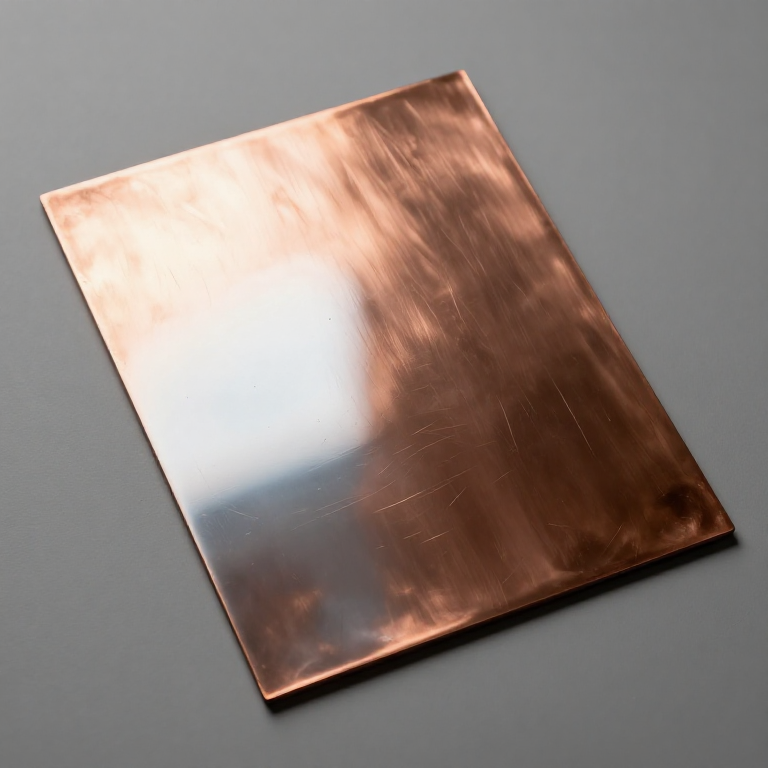


Electropolishing
Every other process in this batch adds something or converts something. This one takes metal away — and makes the surface smoother by doing it, which is not obvious. Dissolving a surface ought to roughen it, the way acid etching does.
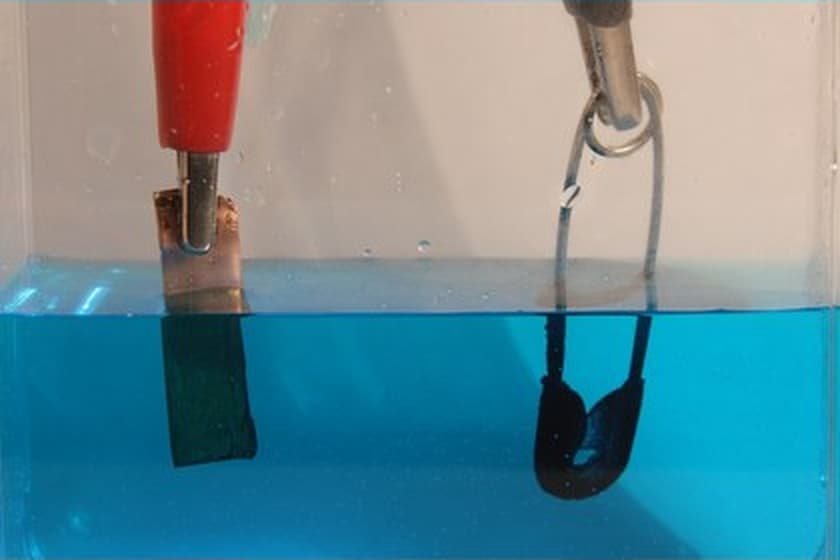
Electropolishing is electroplating run backwards. Make the work the anode in a viscous electrolyte and metal dissolves off it. The trick is that a thick, sluggish liquid film builds up against the surface, and that film is thinner over peaks than over valleys. Thinner film means less resistance, means more current, means faster dissolution. High points therefore dissolve fastest, and the surface levels itself. Left long enough it goes beyond smooth to mirror-bright, because it removes the microscopic scratch structure entirely rather than folding it over the way mechanical polishing does.
It also leaves no embedded abrasive, no smeared surface layer and no directional scratch pattern — which is why it became the standard preparation for looking at metal under a microscope, and later the standard finish for pharmaceutical and food equipment where a mechanically polished surface hides bacteria in the scratches.
Pierre Armand Jacquet found it in 1929 by reversing the polarity of a plating cell, and patented the electrolytic polishing of copper and brass as French patent 707,526 (1930). He published the theory for copper in phosphoric acid in 1936, and in 1937 exhibited high-purity aluminium polished "by a method involving neither rubbing nor abrasives".
নির্দেশ
Make the viscous electrolyte
Make the viscous electrolyte
Mix 3 parts phosphoric acid (85%) to 1 part distilled water — about 600 ml total. Goggles and nitrile gloves.
The viscosity is the mechanism, not an incidental property. A thin, watery electrolyte will etch the surface dull instead of polishing it. Do not dilute this further to make it easier to handle.
এই ধাপের উপকরণ:
 ফসফরিক অ্যাসিড (৮৫ %)450 মিলি
 পাতিত জল150 মিলি
আবশ্যক উপকরণ:
 কাচের বিকার
 কুয়াশা-রোধী নিরাপত্তা চশমা
 একবার ব্যবহারের নাইট্রাইল দস্তানা
Prepare a deliberately scratched sample
Prepare a deliberately scratched sample
Take the copper sheet and sand half of one face with abrasive paper in one direction, leaving clear parallel scratches. Leave the other half as it is.
Degrease and handle by the edges.
Polishing a piece that is already smooth teaches you nothing. The scratched half is the experiment.
এই ধাপের উপকরণ:
 তামার ১১০ পাত ০.৫ মিলিমিটার1 টুকরা
Wire it as the anode
Wire it as the anode
Copper sample to the positive (+). A second copper or stainless sheet to the negative (−), facing it, about 30 mm away and parallel.
Positive is the reversal Jacquet made. In electroplating the work is negative and metal arrives; here the work is positive and metal leaves.
আবশ্যক উপকরণ:
 স্টেনলেস স্টিলের পাত - ৩০৪
 কুমির-ক্লিপ পরীক্ষার তার
 টেবিল DC বিদ্যুৎ সরবরাহ
Find the polishing plateau
Find the polishing plateau
Raise the voltage slowly from 0 and record current at each step. Plot current against voltage.
You are looking for the plateau — a range, typically 1.5–2.0 V for copper in phosphoric acid, where current stops rising as voltage increases.
Below the plateau the surface etches dull. Above it, gas evolves and pits the surface. Only on the plateau does it polish. That plateau is the viscous film governing the reaction instead of the voltage, and finding it is Jacquet's actual contribution — before this, results were luck.
Hold on the plateau for 5–10 minutes.
আবশ্যক উপকরণ:
 পরীক্ষাগার-মানের ডিজিটাল মাল্টিমিটার
Compare the two halves
Compare the two halves
Rinse in running water, then dry.
Expect: the scratched half is now brighter than the half you left alone. The scratches have been levelled, not filled — nothing was added.
Look at it at a glancing angle. Mechanical polishing leaves fine parallel lines whichever way you work; an electropolished surface has no directional structure at all, because dissolution has no direction.
History & Context
History & Context
The patent. French patent 707,526, 1930, covering the electrolytic polishing of copper and brass, following his 1929 discovery — made, by his own account, by reversing the polarity of a plating cell. Jacquet published the phosphoric-acid copper theory in 1936 and demonstrated polished high-purity aluminium in 1937.
Why a metallographer cared. To look at a metal's grain structure you need a flat, undamaged surface. Mechanical polishing always leaves a smeared, work-hardened layer — the Beilby layer — that hides the very structure you are trying to see. Electropolishing removes material without touching it, so what is left underneath is the real metal. It became standard specimen preparation and remains so.
Where it went commercially. Pharmaceutical, dairy and semiconductor equipment. Not for looks: a mechanically polished stainless surface has microscopic scratches and folded-over metal that trap product and bacteria and cannot be cleaned out. Electropolished stainless has neither, which is why it is written into hygienic-design standards.
The honest limit. Electropolishing levels, it does not flatten. It will remove scratches and micro-roughness beautifully and will do almost nothing about a dent, a wave or a lack of geometric accuracy — those are long-wavelength features and the viscous film simply follows them. A part that must be flat still has to be ground or lapped first.
সামগ্রী
3- 450 মিলিপ্লেসহোল্ডর
- 150 মিলিপ্লেসহোল্ডর
- 1 টুকরাপ্লেসহোল্ডর
আবশ্যক উপকরণ
7- প্লেসহোল্ডর
- প্লেসহোল্ডর
- প্লেসহোল্ডর
- প্লেসহোল্ডর
- প্লেসহোল্ডর
- প্লেসহোল্ডর
- প্লেসহোল্ডর
কনেক্টেড ব্লূপ্রিংট সামগ্রী

সম্পর্কিত ব্লুপ্রিন্ট
এই ব্লুপ্রিন্টগুলি জ্ঞান ভাগ করে — কৌশল, উপকরণ বা নীতি
CC0 পব্লিক ডোমেন
এই ব্লুপ্রিন্ট CC0-এর অধীনে প্রকাশিত। আপনি অনুমতি ছাড়াই যেকোনো উদ্দেশ্যে এটি অনুলিপি, পরিবর্তন, বিতরণ ও ব্যবহার করতে পারেন।
মেকারের ব্লুপ্রিন্টের মাধ্যমে পণ্য কিনে তাঁকে সমর্থন করুন, যেখানে তিনি আয় করেন মেকর কমীশন বিক্রেতাদের নির্ধারিত, অথবা এই ব্লুপ্রিন্টের একটি নতুন সংস্করণ তৈরি করে নিজের ব্লুপ্রিন্টে সংযোগ হিসেবে যুক্ত করে আয় ভাগ করুন।