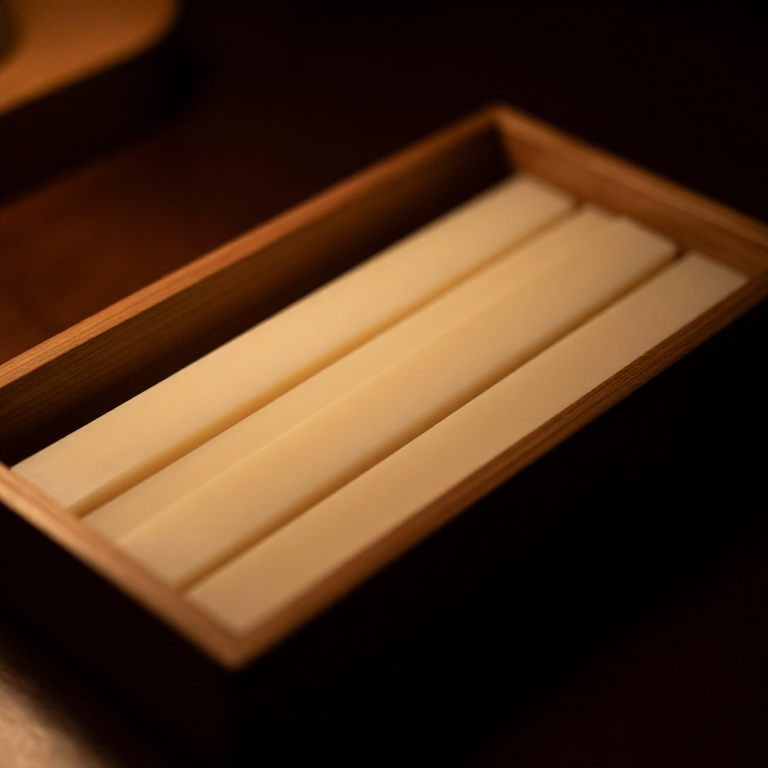


Napier's Bones
নির্দেশাবলি
Make the rods
Make the rods
Ten strips, each holding one column of the times table.
- Cut ten card strips and divide each into nine cells.
- Draw a diagonal across every cell, from lower left to upper right.
- On rod n, write n×1 to n×9, putting the tens digit above the diagonal and the units below.
এই ধাপের উপকরণ:
 কার্ডস্টক1 প্যাক
 রুলার1 টুকরা
Multiply by a single digit
Multiply by a single digit
Lay out the number, read one row, add along the stripes.
- Set out rods 4, 6, 8 side by side to represent 468.
- Look along row 7.
- Add the digits within each diagonal stripe, carrying left where a stripe exceeds 9.
- Read off 3276.
এই ধাপের উপকরণ:
 গ্রাফ কাগজ1 pad
Multiply by several digits
Multiply by several digits
Repeat per digit and shift, exactly as in long multiplication.
- For 468 × 27, read row 7 and write the result.
- Read row 2, write it shifted one place left.
- Add the two partial products.
Compare three routes to the same goal
Compare three routes to the same goal
Multiply the same pair of numbers three ways and record the cost of each.
- By the bones.
- By doubling and halving, as in the Russian peasant method.
- By ordinary long multiplication from memorised tables.
এই ধাপের উপকরণ:
 স্টপওয়াচ1 টুকরা
History and context
History and context
John Napier (1550-1617), laird of Merchiston, published Rabdologiae in 1617, describing the rods along with two other calculating devices. Sets were made in ivory, which is where the name bones comes from, and they sold widely because they needed no training in a new number system.
Two different answers to one problem, from one man. Napier's logarithms, published in 1614, turn multiplication into addition by mapping numbers onto a scale where distances add — the idea that becomes the slide rule. The bones turn multiplication into addition by carrying the times table as objects and letting a diagonal do the carrying. Same goal, different mechanisms, different costs: logarithms need a printed table and give approximate answers quickly for any numbers; the bones need a physical set and give exact answers for whole numbers. Both are in this catalogue, and comparing them is more informative than either alone.
The method is older than the rods. Diagonal-cell multiplication — lattice multiplication, or gelosia after the lattice windows it resembles — is described in Arabic and Indian sources and reaches Europe through Fibonacci. Napier's contribution was making the lattice reusable by putting each column on a movable rod.
Where it led: Wilhelm Schickard's calculating clock of 1623 incorporated a mechanised set of Napier's rods, making it arguably the first mechanical calculator. The bones sit exactly on the line between a written method and a machine — and lattice multiplication is still taught in some primary curricula today, because it separates the multiplying from the carrying.
সম্পর্কিত ব্লুপ্রিন্ট
এই ব্লুপ্রিন্টগুলি জ্ঞান ভাগ করে — কৌশল, উপকরণ বা নীতি

CC0 পাবলিক ডোমেন
এই ব্লুপ্রিন্ট CC0-এর অধীনে প্রকাশিত। আপনি অনুমতি ছাড়াই যেকোনো উদ্দেশ্যে এটি অনুলিপি, পরিবর্তন, বিতরণ ও ব্যবহার করতে পারেন।
মেকারের ব্লুপ্রিন্টের মাধ্যমে পণ্য কিনে তাঁকে সমর্থন করুন, যেখানে তিনি আয় করেন মেকার কমিশন বিক্রেতাদের নির্ধারিত, অথবা এই ব্লুপ্রিন্টের একটি নতুন সংস্করণ তৈরি করে নিজের ব্লুপ্রিন্টে সংযোগ হিসেবে যুক্ত করে আয় ভাগ করুন।