
Silicon Solar Cell
Every earlier attempt at solar power went through heat: concentrate sunlight, boil something, run an engine. The patent is blunt about how badly that worked — before this, nobody had managed "overall efficiencies significantly greater than one percent", because heating a working fluid throws most of the energy away as conduction loss before you ever reach the engine.
The Bell cell skips heat completely. Light falling on a p-n junction in silicon knocks charge carriers loose and the junction's built-in field sweeps them apart, producing current directly. No boiler, no turbine, no moving parts.
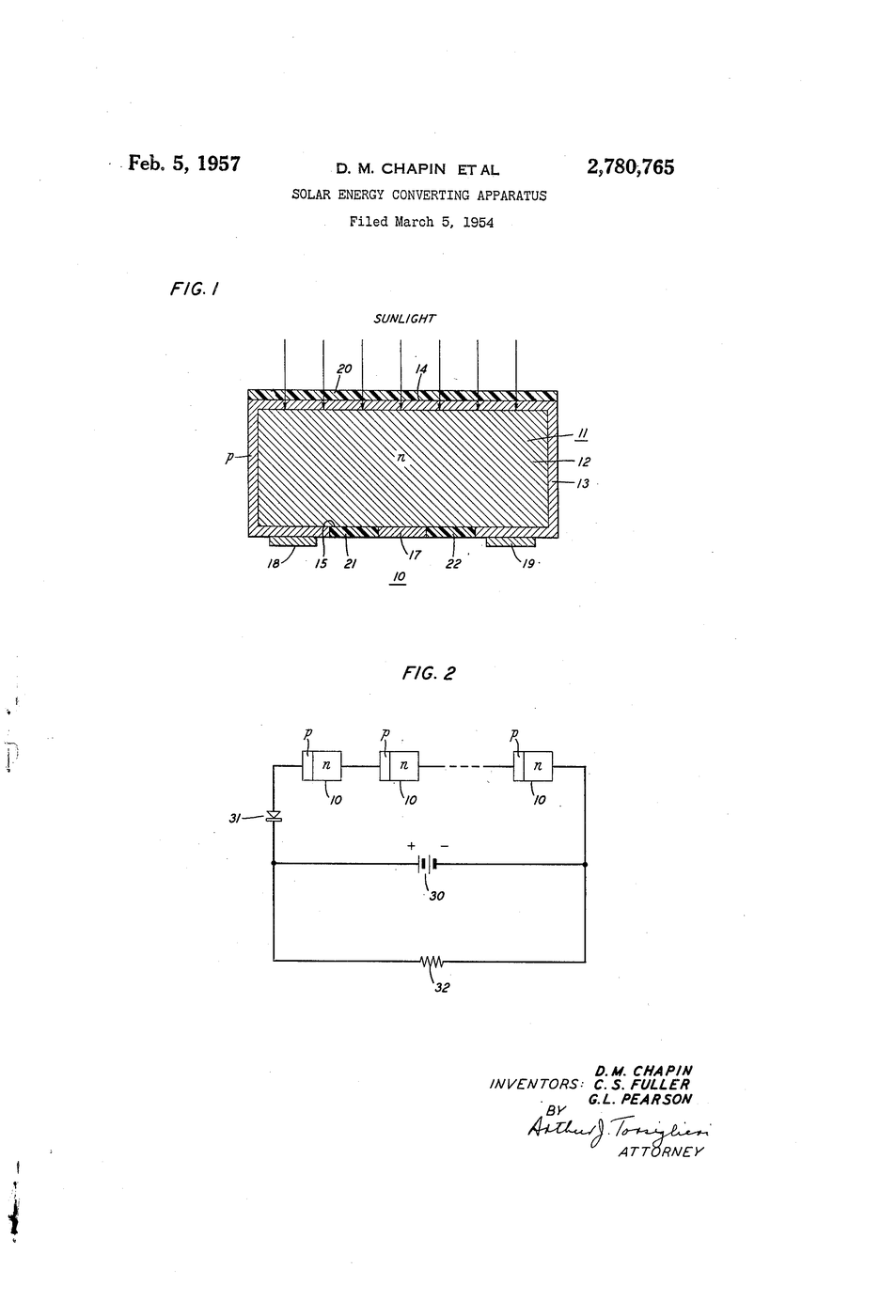
And the claim is not the cell alone — it is the charging circuit. Claim 1 covers a silicon cell and a storage battery and a "unilaterally-conductive element serially connected", poled to pass charging current and "to block discharging currents from the battery through the photosensitive element". A blocking diode, patented in 1954, still fitted to solar installations today.
US Patent 2,780,765, "Solar Energy Converting Apparatus", filed 5 March 1954 and granted 5 February 1957 to Daryl M. Chapin, Calvin S. Fuller and Gerald L. Pearson of Bell Telephone Laboratories.
নির্দেশাবলি
Read claim 1 and count the three parts
Read claim 1 and count the three parts
The claim names a battery, a silicon cell with an n-type zone contiguous with a p-type zone, and a unilaterally-conductive element. Three components — the third is the surprise.
Handle the bare cell by its edges
Handle the bare cell by its edges
A bare cell is thin, brittle silicon and cracks easily. Hold it by the edges and work over a soft surface.
এই ধাপের উপকরণ:
 নগ্ন সৌরকোষ ১৫০ × ১৫০ মিমি1 টুকরা
Identify the two faces
Identify the two faces
One face is dark with fine printed fingers, the other is largely metal. The junction sits just beneath the dark face, very close to the surface.
Measure open-circuit voltage in full sun
Measure open-circuit voltage in full sun
Meter on DC volts across the cell in direct sun. Record it. This is the junction's voltage and it barely depends on brightness.
প্রয়োজনীয় সরঞ্জাম:
 পরীক্ষাগার-মানের ডিজিটাল মাল্টিমিটার
Measure short-circuit current in the same sun
Measure short-circuit current in the same sun
Switch to DC amps straight across the cell. Record it. Voltage came from the junction; current comes from the light.
Shade half the cell and measure both again
Shade half the cell and measure both again
Cover half the cell. Voltage hardly moves; current roughly halves. That asymmetry is the single most useful fact about a solar cell.
Sweep a load and find the maximum power point
Sweep a load and find the maximum power point
Connect a variable resistance and record voltage and current at six settings. Multiply each pair. Power peaks in the middle, not at either end.
Tilt the cell through several angles
Tilt the cell through several angles
Measure current at square-on, 30° and 60°. Output follows how much sunlight the cell's face actually intercepts, which is why mounting angle matters.
প্রয়োজনীয় সরঞ্জাম:
 আলোকমাপক (আপতিত/প্রতিফলিত)
Warm the cell and watch voltage fall
Warm the cell and watch voltage fall
Let the cell heat in the sun and re-measure open-circuit voltage. It drops as the cell warms. Solar cells prefer cold bright days to hot ones — the opposite of a solar water heater.
Connect the cell straight to a battery
Connect the cell straight to a battery
Wire the cell to a small rechargeable cell, matching polarity. In sun, current flows into the battery. Record it.
Cover the cell completely and measure the reverse current
Cover the cell completely and measure the reverse current
Put the cell in full darkness with the battery still connected. Current now flows backwards, out of the battery and into the cell. This is the fault the patent's third component fixes.
Insert a blocking diode and repeat both tests
Insert a blocking diode and repeat both tests
Fit a diode in series, poled to pass charging current. In sun it still charges; in darkness the reverse current is gone. You have just built claim 1.
এই ধাপের উপকরণ:
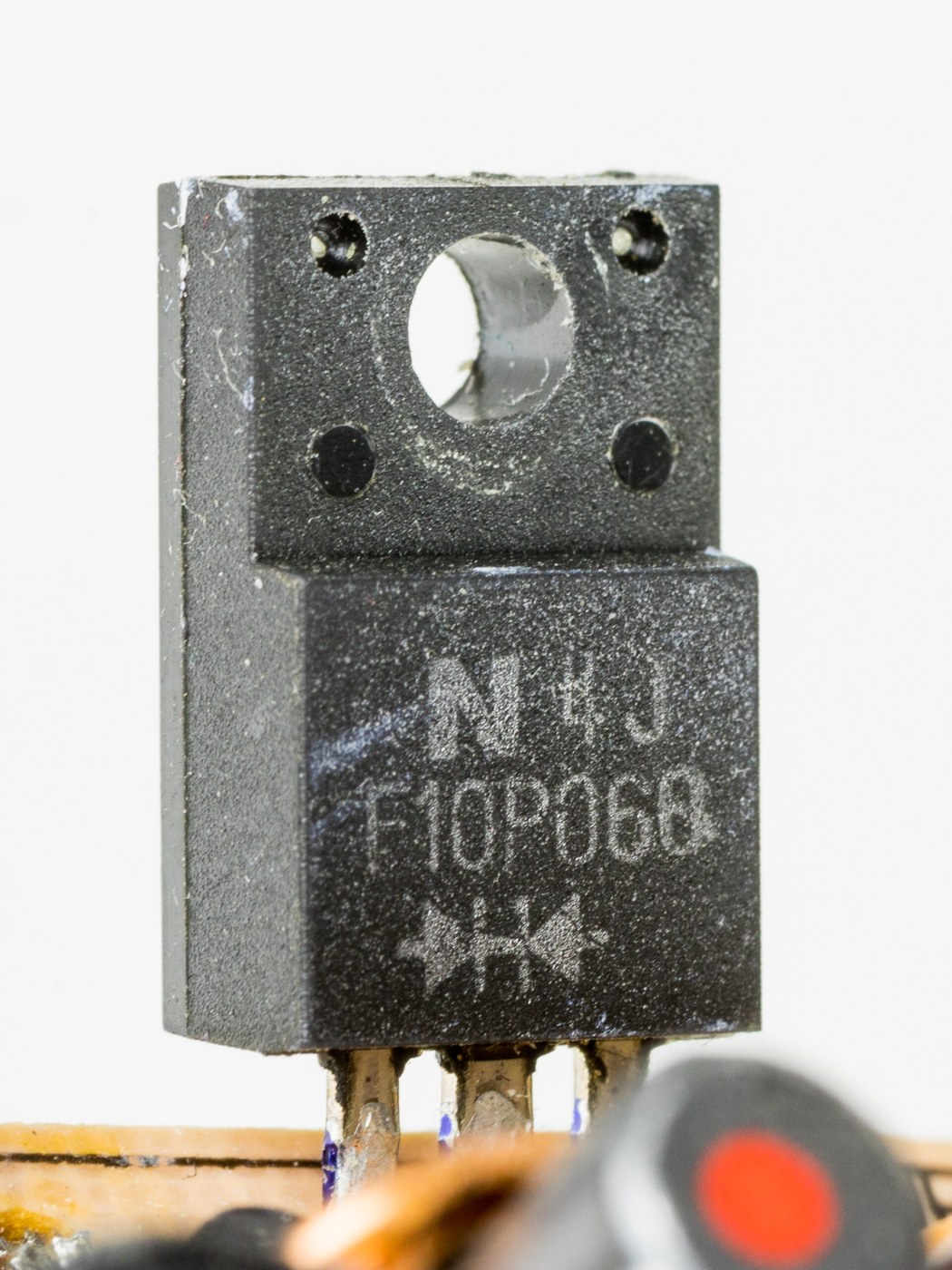 অবরোধক ডায়োড (শটকি)1 টুকরা
Measure the diode's cost in forward voltage
Measure the diode's cost in forward voltage
Compare charging voltage with and without the diode. It costs a few tenths of a volt. Every engineering fix has a price — measure it rather than assume it.
History & Context — three names, one junction, and a night-time leak
History & Context — three names, one junction, and a night-time leak
The patent. US 2,780,765, "Solar Energy Converting Apparatus", application filed 5 March 1954 and granted 5 February 1957 to Daryl M. Chapin of Basking Ridge, Calvin S. Fuller of Chatham and Gerald L. Pearson of Bernards Township, all assignors to Bell Telephone Laboratories. Three inventors, and it is worth naming all three: this programme has now met four consecutive cases of famous work credited to one person when the document names more, and the pattern is consistent enough to treat the inventor field as a required check.
The three did different things, which is why there are three names. Chapin was looking for a power source for remote telephone equipment and had costed out the alternatives; Fuller was the chemist whose diffusion work made controlled p-n junctions in silicon possible; Pearson was the physicist on semiconductor behaviour. The cell exists at the intersection of a practical requirement, a chemical process and a physical understanding.
The patent argues against the previous approach explicitly. It notes that earlier schemes "generally utilized the solar energy as fuel for heating a suitable agent and then utilizing temperature differences in the agent for creating electrical energy", and that these are "intrinsically inefficient because of the large thermal conduction losses resulting from the heating cycle", leaving efficiencies stuck around one percent. The photovoltaic route converts photons to charge carriers directly, with no thermal middleman. It is a clean statement of why a change of mechanism beats refinement of an old one.
The detail worth admiring is the third element. Claim 1 does not stop at the cell. It requires "a unilaterally-conductive element serially connected with said storage battery and photosensitive element, and poled to pass charging currents developed by the photosensitive element and to block discharging currents from the battery through the photosensitive element". In plain terms: at night an unprotected panel becomes a load and quietly drains the battery it charged all day. Steps 11 and 12 show it happening and stop it. That the very first solar-power patent already contains the night-time discharge fix says these were engineers building a system, not physicists demonstrating an effect — and every solar charge controller sold today still performs that function.
Also in the claim: boron. The p-type zone is specified as "including a concentration of boron impurities", and its thickness is to be "of the order of the diffusion length of electrons therein". That second condition is the subtle one — carriers created by light must reach the junction before they recombine, so the layer above the junction has to be thin enough for them to survive the trip. Junction depth is still a central parameter in cell design.
What happened next. The first cells were about 6 % efficient and extraordinarily expensive, and their first real market was not on Earth at all: satellites, where there is no fuel, no maintenance and abundant sunlight. Vanguard 1 in 1958 carried solar cells and transmitted for years after its battery died. Terrestrial cost fell by orders of magnitude over the following decades, and photovoltaics became the cheapest source of new electricity in much of the world — but the device in your hand is recognisably the one in this 1954 drawing.
উপকরণ
2- 1 টুকরাপ্লেসহোল্ডার
- 1 টুকরাপ্লেসহোল্ডার
প্রয়োজনীয় সরঞ্জাম
2- প্লেসহোল্ডার
- প্লেসহোল্ডার
সম্পর্কিত ব্লুপ্রিন্ট
এই ব্লুপ্রিন্টগুলি জ্ঞান ভাগ করে — কৌশল, উপকরণ বা নীতি
CC0 পাবলিক ডোমেন
এই ব্লুপ্রিন্ট CC0-এর অধীনে প্রকাশিত। আপনি অনুমতি ছাড়াই যেকোনো উদ্দেশ্যে এটি অনুলিপি, পরিবর্তন, বিতরণ ও ব্যবহার করতে পারেন।
মেকারের ব্লুপ্রিন্টের মাধ্যমে পণ্য কিনে তাঁকে সমর্থন করুন, যেখানে তিনি আয় করেন মেকার কমিশন বিক্রেতাদের নির্ধারিত, অথবা এই ব্লুপ্রিন্টের একটি নতুন সংস্করণ তৈরি করে নিজের ব্লুপ্রিন্টে সংযোগ হিসেবে যুক্ত করে আয় ভাগ করুন।