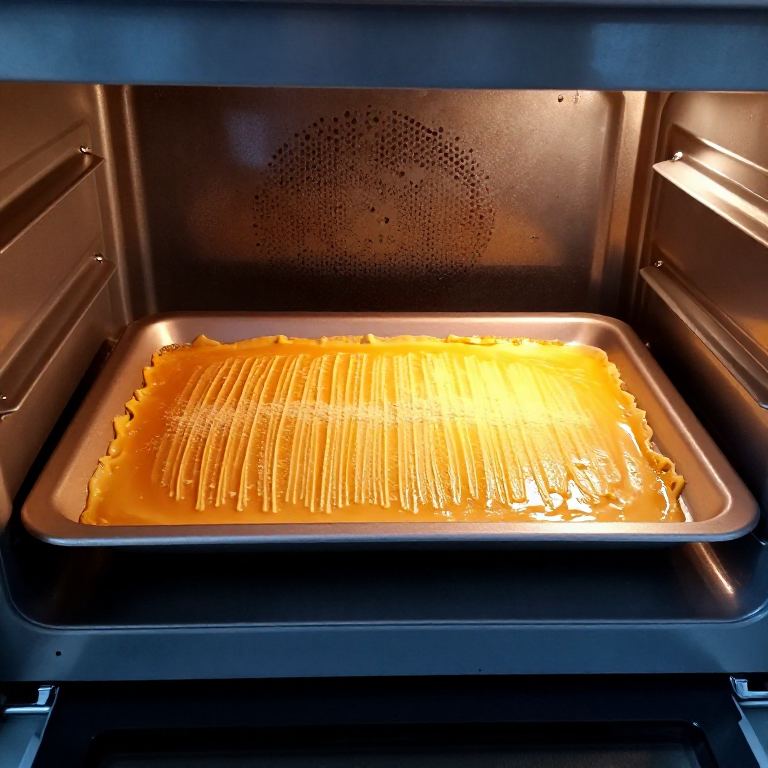


Spencer Microwave Oven
Every other way of cooking heats the outside and waits. A flame, an element, an oven — all of them deliver energy to the surface, and the middle of the food gets hot only when conduction eventually carries it there. That waiting is most of cooking time.
Microwaves deposit energy throughout a layer of the food at once. The field flips direction billions of times a second, water molecules — being electrically lopsided — twist to follow it, and that molecular friction is heat. No surface, no waiting for conduction, no hot air.
Percy Spencer noticed a chocolate bar melting in his pocket near an active radar magnetron at Raytheon. His patent is titled "Method of treating foodstuffs" — US Patent 2,495,429, granted 24 January 1950 — and it makes the efficiency case in numbers: hard-boiling an egg took 2 kilowatt-seconds against 36 by conventional means.
নির্দেশাবলি
Never open or run a magnetron outside its oven
Never open or run a magnetron outside its oven
Do not dismantle a microwave oven. The capacitor holds a lethal charge after unplugging, and an unshielded magnetron emits radiation that can cause serious burns and eye damage. Every experiment here uses an intact, working oven.
প্রয়োজনীয় সরঞ্জাম:
 মাইক্রোওয়েভ উনুন
Read US 2,495,429 and note the numbers
Read US 2,495,429 and note the numbers
Spencer specifies electromagnetic energy around 10 cm wavelength and cites 2 kilowatt-seconds to hard-boil an egg against 36. The patent argues efficiency, not convenience.
Measure the wavelength with cheese and a turntable you disable
Measure the wavelength with cheese and a turntable you disable
Lay a tray of grated cheese across the oven floor with the turntable stopped. Heat briefly. Melted stripes appear at the antinodes of the standing wave.
এই ধাপের উপকরণ:
 কুচানো পনির
Compute the speed of light from your kitchen
Compute the speed of light from your kitchen
Measure the spacing between melted stripes — that is half a wavelength. Multiply the full wavelength by the frequency on the oven's rating plate, usually 2450 MHz. You should get close to 3 × 10⁸ m/s.
প্রয়োজনীয় সরঞ্জাম:
 রুলাররুলার
Understand what the hot and cold stripes mean
Understand what the hot and cold stripes mean
The cavity supports a standing wave with fixed nodes. Food at a node barely heats — which is the entire reason ovens have turntables and mode stirrers.
Heat equal volumes of water and cooking oil
Heat equal volumes of water and cooking oil
Put water and oil in identical cups and run both the same time. Measure both. Water heats far faster, because the mechanism targets polar molecules.
এই ধাপের উপকরণ:
 রান্নার তেল
প্রয়োজনীয় সরঞ্জাম:
 ঘরের তাপমাপক
 রান্নার থার্মোমিটার
Heat something genuinely dry
Heat something genuinely dry
Try dry salt or a dry ceramic dish. Almost nothing happens. The oven does not heat food; it heats WATER in food, and everything else warms by conduction from that.
Measure penetration depth with a thick block
Measure penetration depth with a thick block
Heat a thick piece of potato briefly and cut it open, probing outside and centre. Energy is deposited in roughly the outer centimetre or two, not throughout.
এই ধাপের উপকরণ:
 আলু
আলুCorrect the common misconception
Correct the common misconception
Microwaves do NOT cook from the inside out. They deposit energy in a surface LAYER — deeper than a flame reaches, but still a layer — and conduction does the rest.
Rest the food and measure again
Rest the food and measure again
Take a heated item out and probe the centre after two minutes. It keeps rising. Standing time is part of the cooking, not an afterthought.
Look at the door and count the holes
Look at the door and count the holes
The mesh has holes a few millimetres across in a screen. Microwaves at 12 cm cannot pass an aperture that small, while visible light at 500 nm sails through — a wavelength-selective wall.
Heat two mugs and then just one
Heat two mugs and then just one
Time a single mug, then two together. Two take longer than one but far less than twice — the same power is shared, so load changes everything about timing.
Understand superheating and defeat it
Understand superheating and defeat it
Smooth water in a smooth cup can pass 100 °C without boiling, then erupt when disturbed. Put a wooden stick in the cup — nucleation sites let it boil normally.
Compare browning against a conventional oven
Compare browning against a conventional oven
Cook the same item both ways. Microwaved food does not brown, because the surface stays near 100 °C while water is present, and Maillard browning needs well above that.
Compendium — heating water, not food
Compendium — heating water, not food
The patent. US 2,495,429, "Method of treating foodstuffs", granted 24 January 1950 to Percy L. Spencer of Raytheon. The origin story is unusually well attested: Spencer, a self-taught engineer working on radar magnetrons, found a chocolate bar melted in his pocket, tried popcorn next, then an egg — which exploded. Raytheon's first commercial oven, the 1947 Radarange, stood about 1.8 m tall, weighed some 340 kg and was water-cooled. The domestic counter-top model arrived in 1967.
The mechanism is dielectric heating. A water molecule is polar — its oxygen end is slightly negative, its hydrogen ends slightly positive — so it experiences a torque in an electric field. At 2.45 GHz the field reverses about 2.45 billion times a second, the molecules rotate back and forth trying to follow it, and the resulting molecular friction appears as heat throughout the irradiated volume. It is worth being precise that 2.45 GHz is NOT a resonant frequency of water; that is a persistent myth. The frequency was chosen because it is in an industrial band, gives a useful penetration depth, and magnetrons for it were already mass-produced for radar. A true resonance would deposit all the energy in the first millimetre.
Not inside-out, and not uniform. Penetration depth in moist food at this frequency is on the order of a centimetre or two, so energy is deposited in a thick surface layer and conduction carries it inward — hence standing time. The cavity also supports standing waves with fixed nodes, which is why a stationary load cooks in stripes, why turntables and mode stirrers exist, and why the cheese experiment in step 3 lets you measure the speed of light on a kitchen counter to within a few per cent.
What it cannot do, and why the door works. Browning and crisping require surface temperatures well above 100 °C, which a wet surface cannot reach while it still holds water — so microwaved food is pale, and combination ovens add a grill for exactly this reason. The door's perforated screen is a Faraday cage tuned by geometry: at 12 cm wavelength, holes a few millimetres across are far below cutoff and the radiation cannot escape, while 500-nanometre light passes freely. A single sheet of metal mesh does the job of a wall you can see through.
উপকরণ
3- 1 টুকরাপ্লেসহোল্ডার
- 1 টুকরাপ্লেসহোল্ডার
- 1 টুকরাপ্লেসহোল্ডার
প্রয়োজনীয় সরঞ্জাম
5- প্লেসহোল্ডার
- প্লেসহোল্ডার
- প্লেসহোল্ডার
- প্লেসহোল্ডার
- প্লেসহোল্ডার
সম্পর্কিত ব্লুপ্রিন্ট
এই ব্লুপ্রিন্টগুলি জ্ঞান ভাগ করে — কৌশল, উপকরণ বা নীতি


CC0 পাবলিক ডোমেন
এই ব্লুপ্রিন্ট CC0-এর অধীনে প্রকাশিত। আপনি অনুমতি ছাড়াই যেকোনো উদ্দেশ্যে এটি অনুলিপি, পরিবর্তন, বিতরণ ও ব্যবহার করতে পারেন।
মেকারের ব্লুপ্রিন্টের মাধ্যমে পণ্য কিনে তাঁকে সমর্থন করুন, যেখানে তিনি আয় করেন মেকার কমিশন বিক্রেতাদের নির্ধারিত, অথবা এই ব্লুপ্রিন্টের একটি নতুন সংস্করণ তৈরি করে নিজের ব্লুপ্রিন্টে সংযোগ হিসেবে যুক্ত করে আয় ভাগ করুন।