কলা
সৌন্দর্য এবং সুস্থতা
ক্রাফট
সংস্কৃতি ও ইতিহাস
বিনোদন
পরিবেশ
খাদ্য ও পানীয়
রিভার্স ইঞ্জিনিয়ারিং
বিজ্ঞান
খেলাধুলা
টেকনোলজি
পরিধানযোগ্য


The Clutch Fit: An Interference That Survives Ten Thousand Pulls
Two moulded parts that grip each other, come apart when you want, and still grip after ten thousand cycles, are a harder problem than they look. Too tight and they seize or crack; too loose and the assembly falls apart; and a polymer creeps, so a fit that is right today can be slack in a year.
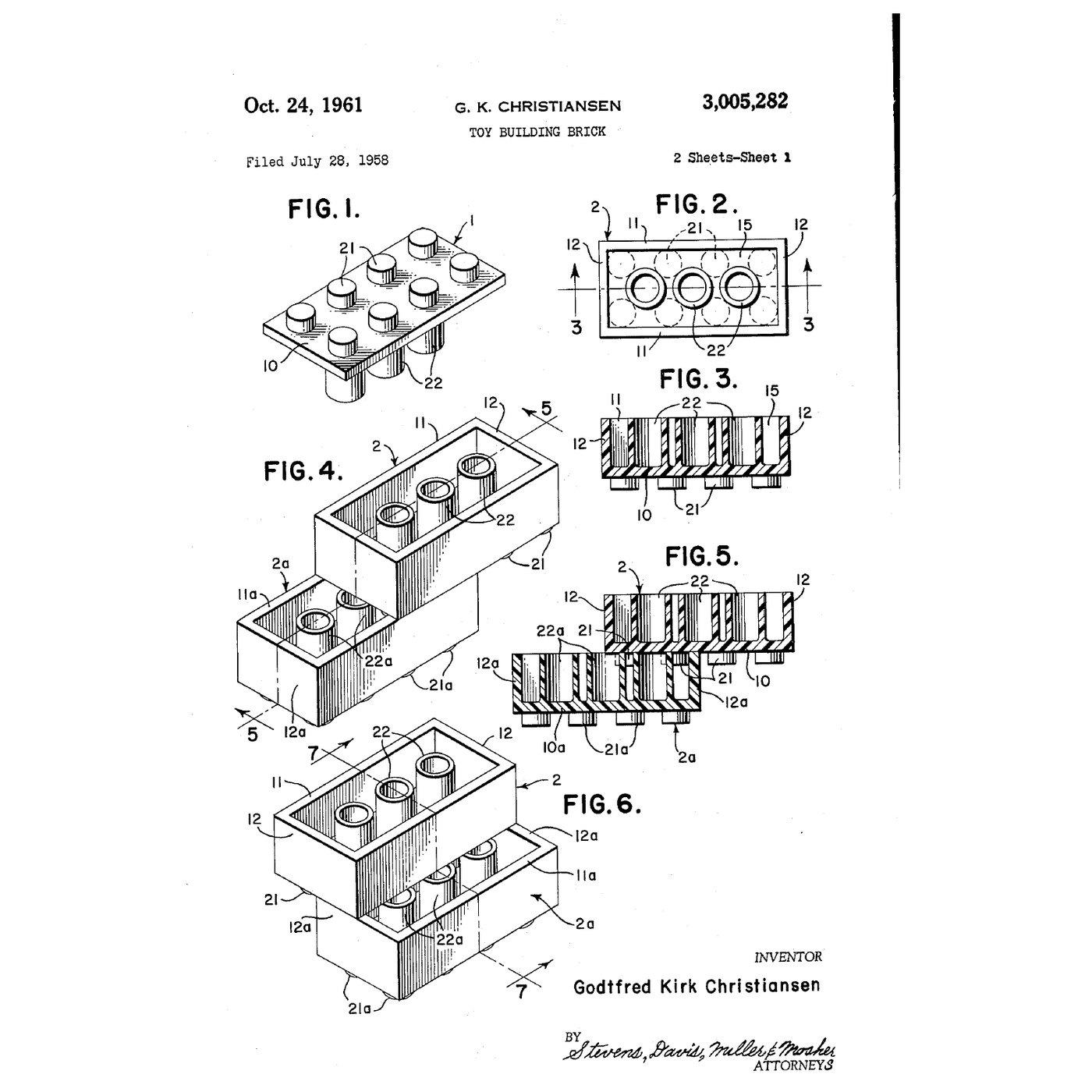
Godtfred Kirk Christiansen's 1958 patent solves it for the most-assembled object ever made. Bricks with studs on top had existed and did not hold together. The invention is what is **inside** the brick: secondary projections placed so that each one touches a stud and a side wall **tangentially** — line contact, not a wrapped interference fit.
This rung measures what an interference fit actually costs in force, finds out why the obvious full-contact version is unusable, and prints a test ladder to see how narrow the usable band really is.
মধ্যবর্তী
About 4 hours, plus print time
নির্দেশ
1
1
Read the claim, and look inside a brick
Read the claim, and look inside a brick
**US 3,005,282**, *Toy Building Brick*, **Godtfred Kirk Christiansen**; filed **28 July 1958** with Danish priority of **28 January 1958**, granted **24 October 1961**; 7 claims, US class 46-45. Expired. The drawing on this page is the patent's own sheet 1, and FIG. 1 and FIG. 3 are the whole invention.
The specification's own statement of purpose is *to provide improved coupling means for clamping* the bricks together, *thus providing for a vast variety of combinations*. Then it concedes the prior art plainly: bricks *provided with primary projections arranged in this manner are well-known per se*, and some had *internal projections located in the cavity*.
So what is new? The **geometry of the contact**. The claim requires that a *primary projection is tangent to at least one secondary projection and the inner face of at least one of the side walls* — and that the spacing is such that the secondary projections sit in the gaps between *the projected cross sections of four primary projections*.
Now pick up a brick and look inside. The studs on top are the primary projections. The tubes or ribs inside the underside are the secondary ones. Push two bricks together slowly and feel where the resistance comes from: not a stud sliding into a hole, but a stud being squeezed between a tube and a wall on **three narrow lines**.
Measure a stud and a tube with the micrometer, several of each, and write down the spread. The numbers are remarkable and step 4 explains why they have to be.
আবশ্যক উপকরণ:
 মাইক্রোমিটার
 ডিজিটাল ক্যালিপার ৬ ইঞ্চি
 অঙ্কের অণুবীক্ষণ
2
2
Measure the clutch force, and then measure it again
Measure the clutch force, and then measure it again
Build a simple rig: clamp one brick in the vise, hook the spring scale to the brick above it, and pull straight up, slowly, until it releases. Read the peak.
Take ten readings on the same pair and write them all down. Then take ten on a different pair. Then ten on a pair you have already cycled a hundred times.
Three things to notice:
1. **The spread within one pair is small.** That is the point of the design.
2. **Cycling changes it very little.** Try a hundred more and measure again. This is the property the whole patent exists to deliver, and it is not obvious — most interference fits in plastic wear loose quickly.
3. **Orientation matters.** A pull straight up is not the same as a twist or a peel from one corner. Measure all three. The peel is far lower, which is exactly why you take bricks apart by tilting.
Then do the destructive version: warm a pair gently with the heat gun to about 60 °C, hold them together under load for ten minutes, cool, and measure again. That is **creep** — the polymer flowing under sustained stress — and it is the failure mode that kills most plastic interference fits over years. Note how little effect it has here, and hold that thought for step 4: low contact area and low strain are what makes a fit creep-resistant.
আবশ্যক উপকরণ:
 বলমাপক (স্প্রিং দাঁড়িপাল্লা)
 বেঞ্চ ভাইস
 গরম হাওয়ার বন্দুক
 অবলোহিত থার্মোমিটার
 স্টপওয়াচমাইক্রোমিটার
 গ্রাফ কাগজ
 স্বচ্ছ নিরাপত্তা-চশমা
 পরীক্ষাগারের খাতা (অনুলিপিসহ)
3
3
Print an interference ladder and find your own window
Print an interference ladder and find your own window
Now make your own, so the tolerance argument stops being abstract.
Design a peg and a matching socket — a plain cylindrical peg 8 mm across, entering a socket in a 2 mm wall, engaged 5 mm deep. Print the peg once. Print the socket **seven times**, with nominal bore from 8.20 mm down to 7.80 mm in 0.05 mm steps.
Measure every printed bore with the calipers before you assemble anything, because a printer does not make what you asked for — it makes what it makes, and the *measured* interference is the variable, not the *commanded* one. This is the single most useful habit in the whole rung.
Assemble each pair and measure the pull-out force with the spring scale. Plot force against measured interference.
You will get three regions: a slack region where the force is near zero and the joint is useless; a working band; and a region where the socket splits on assembly or the peg refuses to enter. Mark the band on the plot and read off how wide it is in millimetres.
It will be narrow — a few hundredths — and that is the finding. Then compare it against what your printer can actually hold, which you measured at the start. If the usable band is narrower than your process spread, **the design is not manufacturable**, and no amount of care at assembly will fix it. That sentence is worth more than the plot.
এই ধাপের উপকরণ:
 PLA ফিলামেন্ট1 টুকরা
 ABS ফিলামেন্ট1 টুকরা
 PETG ফিলামেন্ট1 টুকরা
আবশ্যক উপকরণ:
 থ্রিডি প্রিন্টারমাইক্রোমিটারডিজিটাল ক্যালিপার ৬ ইঞ্চিবলমাপক (স্প্রিং দাঁড়িপাল্লা)বেঞ্চ ভাইস
 ছাঁট তোলার যন্ত্রগ্রাফ কাগজস্বচ্ছ নিরাপত্তা-চশমাপরীক্ষাগারের খাতা (অনুলিপিসহ)
4
4
Interference, pressure and why the contact is tangential
Interference, pressure and why the contact is tangential
Jupyter নোটবুক লোড হচ্ছে…
আবশ্যক উপকরণ:
গ্রাফ কাগজ5
5
History and context
History and context
**Attribution.** US 3,005,282, *Toy Building Brick*, Godtfred Kirk Christiansen; filed 28 July 1958, Danish priority 28 January 1958, granted 24 October 1961, expired. The drawing on this page is the patent's own.
**What was actually invented.** Stud-topped bricks were not new and the patent says so. What did not exist was a brick that **held**. Earlier versions relied on the stud entering the neighbouring brick's hollow with nothing to grip, so a model fell apart when lifted. The tubes and ribs inside the underside are the whole contribution, and the claim's insistence on *tangent* contact is the reason the grip is both strong enough to build with and weak enough for a child to undo.
**The tolerance story is the real one.** A fit like this only works if the parts are made to a few hundredths of a millimetre, every time, for decades — which means a stable polymer, a temperature-controlled tool and relentless measurement. The patent describes a geometry; delivering it is a manufacturing achievement, and step 3 is designed to make you feel exactly how small the window is.
**The idea to keep.** When an interference fit must survive repeated use, **reduce the contact area and let it flex**. A full cylindrical press fit is stiff, so a small error in size is a large error in force, and any wear or creep goes straight into slackness. Three narrow compliant lines absorb both. The same reasoning turns up in a spring-finger connector, a circlip and a collet.
**Honest limits.** Everything here is measured on printed parts, which are layered, anisotropic and nowhere near mould tolerance — step 3 is about the *shape* of the force-against-interference curve, not absolute numbers. The arithmetic in step 4 treats the wall as a thin elastic ring and ignores creep, temperature and the stud's own compliance; it is right about proportions and direction and should not be used to specify a part. And a real production fit is proved on measured samples over time, because creep is the failure that only shows up late.
সামগ্রী
3- 1 টুকরাপ্লেসহোল্ডর
- 1 টুকরাপ্লেসহোল্ডর
- 1 টুকরাপ্লেসহোল্ডর
আবশ্যক উপকরণ
13- প্লেসহোল্ডর
- প্লেসহোল্ডর
- প্লেসহোল্ডর
- প্লেসহোল্ডর
- প্লেসহোল্ডর
- 1 vendor sell this, none ship to you yetপ্লেসহোল্ডর
- প্লেসহোল্ডর
- প্লেসহোল্ডর
- প্লেসহোল্ডর
- প্লেসহোল্ডর
- পরীক্ষাগারের খাতা (অনুলিপিসহ)10% কমীশনপ্লেসহোল্ডর
- প্লেসহোল্ডর
- প্লেসহোল্ডর
সম্পর্কিত ব্লুপ্রিন্ট
এই ব্লুপ্রিন্টগুলি জ্ঞান ভাগ করে — কৌশল, উপকরণ বা নীতি


CC0 পব্লিক ডোমেন
এই ব্লুপ্রিন্ট CC0-এর অধীনে প্রকাশিত। আপনি অনুমতি ছাড়াই যেকোনো উদ্দেশ্যে এটি অনুলিপি, পরিবর্তন, বিতরণ ও ব্যবহার করতে পারেন।
মেকারের ব্লুপ্রিন্টের মাধ্যমে পণ্য কিনে তাঁকে সমর্থন করুন, যেখানে তিনি আয় করেন মেকর কমীশন বিক্রেতাদের নির্ধারিত, অথবা এই ব্লুপ্রিন্টের একটি নতুন সংস্করণ তৈরি করে নিজের ব্লুপ্রিন্টে সংযোগ হিসেবে যুক্ত করে আয় ভাগ করুন।