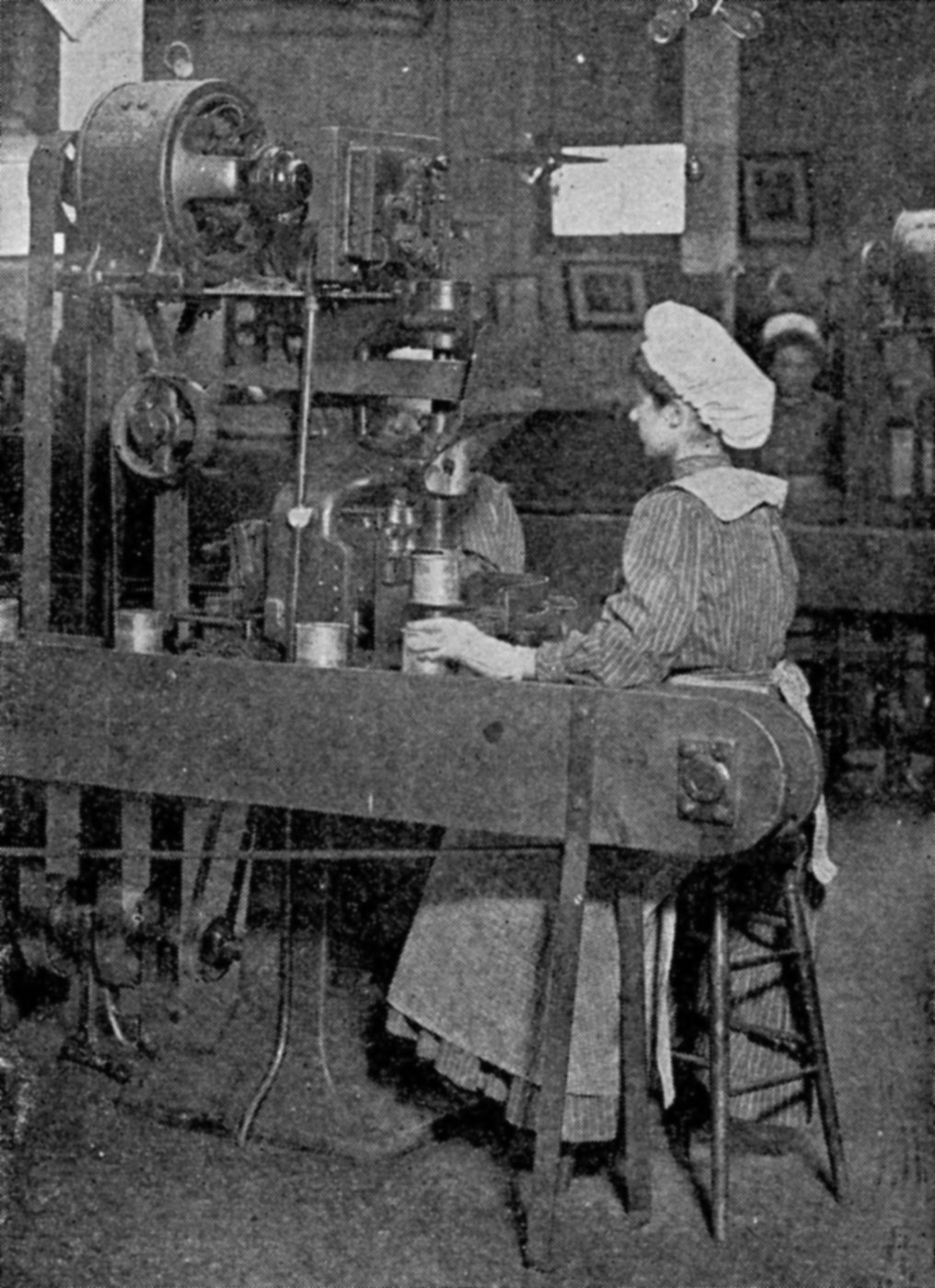


Tin Can
নির্দেশাবলি
Understand what preservation actually requires
Understand what preservation actually requires
Two conditions, both necessary. Neither alone works.
- Kill what is already in the food, with heat.
- Exclude anything new, with a seal that holds indefinitely.
Form the body
Form the body
A cylinder, a base and a lid — the shape is chosen for strength, not convenience.
- Cut a rectangle of tinplate and roll it into a cylinder.
- Overlap the seam and solder it closed along its length.
- Cut a disc for the base and solder it on.
এই ধাপের উপকরণ:
 টিন-সিসার ঝালাই1 রোল
 ঝালাইয়ের ছড়1 টুকরা
Fill, then seal against a vent
Fill, then seal against a vent
The order here is what early canners got wrong and died learning.
- Fill the can, leaving headspace.
- Solder the lid on but leave a small vent hole.
- Heat the can so steam drives air out through the vent.
- Solder the vent shut while it is still hot.
Process, and watch the ends
Process, and watch the ends
Heat the sealed can long enough to sterilise the contents.
- Hold the sealed can in boiling water for an extended period.
- Cool it and inspect the ends.
- Concave ends mean a good vacuum; flat or bulging means a failed seal or gas inside.
এই ধাপের উপকরণ:
 তৎক্ষণাৎ পাঠের থার্মোমিটার1 টুকরা
History and context
History and context
Nicolas Appert won a French government prize in 1810 for a method of preserving food for the navy, having worked it out over more than a decade using glass jars. Peter Durand received a British patent in 1810 covering preservation in vessels including tin; whether he was acting for Appert or independently is not settled. Durand sold the rights to Bryan Donkin and John Hall — the same Donkin who built the Fourdrinier paper machine — and their Bermondsey works supplied canned meat to the Royal Navy from about 1813.
The opening problem is genuinely funny and genuinely revealing. Cans predated can openers by roughly half a century. Early labels carried instructions to cut round the top with a chisel and hammer. It was not an oversight: the first cans were thick, expensive, and sold to institutions — ships, army depots, expeditions — where tools and strong arms were standard issue. Only when thinner steel made cans cheap enough for households did opening them become a problem worth solving, and Ezra Warner patented an opener in 1858.
The lead question, stated carefully. Early cans were sealed with tin-lead solder applied inside the seam, and lead did leach into food. It has been suggested that lead from cans contributed to the loss of the Franklin expedition in the 1840s; later work found the evidence equivocal, with other sources of lead aboard and other causes of death well documented. Lead solder in food cans was a real hazard and was eventually banned; whether it killed Franklin's men specifically is not settled, and the confident version of that story outruns the evidence.
What changed: the double seam. Modern cans are not soldered at all — the lid and body are mechanically folded together through five layers of metal with a sealing compound, which is faster, stronger and puts no lead anywhere near the food.
উপকরণ
3- 1 রোলপ্লেসহোল্ডার
- প্লেসহোল্ডার
- 1 টুকরাপ্লেসহোল্ডার
CC0 পাবলিক ডোমেন
এই ব্লুপ্রিন্ট CC0-এর অধীনে প্রকাশিত। আপনি অনুমতি ছাড়াই যেকোনো উদ্দেশ্যে এটি অনুলিপি, পরিবর্তন, বিতরণ ও ব্যবহার করতে পারেন।
মেকারের ব্লুপ্রিন্টের মাধ্যমে পণ্য কিনে তাঁকে সমর্থন করুন, যেখানে তিনি আয় করেন মেকার কমিশন বিক্রেতাদের নির্ধারিত, অথবা এই ব্লুপ্রিন্টের একটি নতুন সংস্করণ তৈরি করে নিজের ব্লুপ্রিন্টে সংযোগ হিসেবে যুক্ত করে আয় ভাগ করুন।