
Understanding Strontium from Celestine — The Element That Paints Fireworks Red
Strontium (Sr, element 38) is named after the Scottish village of Strontian in Argyll, where the mineral strontianite (SrCO₃) was discovered in 1790 in the lead mines of Strontian parish. Adair Crawford and William Cruickshank recognized it as a new 'earth' (oxide) distinct from baryta (barium oxide) and lime (calcium oxide). Humphry Davy isolated metallic strontium by electrolysis in 1808 — the same productive year he isolated barium, calcium, magnesium, potassium, and sodium.
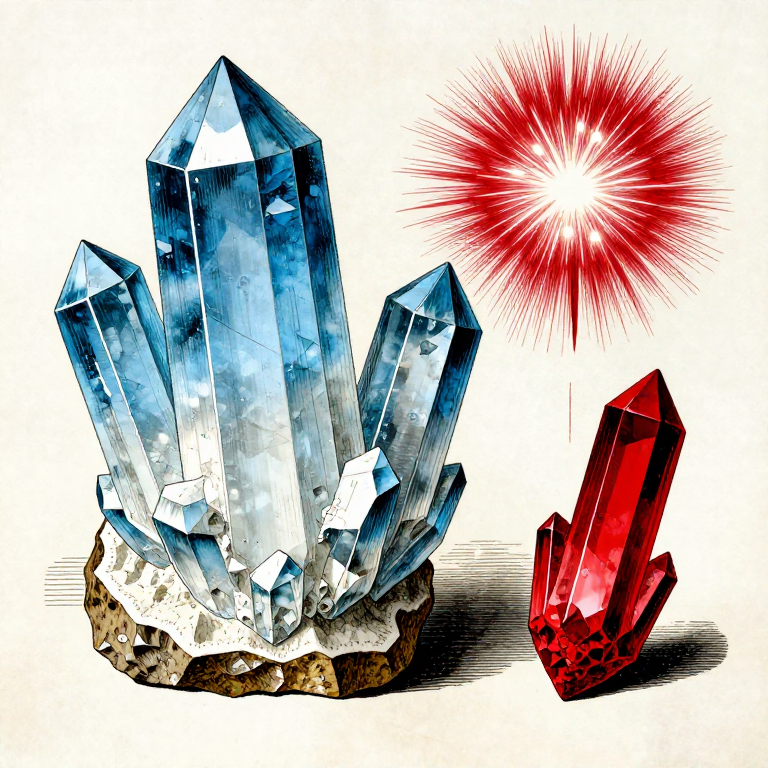
Strontium's most visible application is the brilliant crimson-red color it produces in flames — the red in fireworks and emergency flares is almost always strontium. Strontium chloride (SrCl₂) and strontium carbonate (SrCO₃) are the standard red-flame compounds in pyrotechnics, producing a deep, saturated red that no other element matches.
Celestine (SrSO₄, strontium sulfate) is the primary commercial source of strontium, containing 56.4% SrO (47.7% strontium metal). It is a beautiful, pale blue mineral — its name comes from Latin caelestis ('celestial') for its sky-blue color. Like barium, strontium metal requires electrolysis for production and cannot be reduced by carbon.
HAZARD: Strontium metal reacts with water and ignites in air. Strontium compounds are mildly toxic if ingested in large quantities. The radioisotope strontium-90 (from nuclear fallout) is extremely dangerous because it mimics calcium in bones — but natural strontium is not radioactive. Handle with standard laboratory precautions.
নির্দেশাবলি
Understand strontium chemistry and the alkaline earth group
Understand strontium chemistry and the alkaline earth group
Strontium (Sr, element 38) is an alkaline earth metal in Group 2, sitting between calcium and barium. It has a density of 2.64 g/cm³ (lighter than aluminum), melting point of 777 °C, and is a soft, silvery-yellow metal that oxidizes rapidly in air and reacts with water (more vigorously than calcium but less than barium). Like calcium, strontium forms a hydroxide Sr(OH)₂ that is moderately soluble in water, producing a strongly alkaline solution.
Strontium occupies an intermediate position in the alkaline earth group: its chemistry closely resembles both calcium (above) and barium (below), which is why it was difficult to distinguish as a separate element. Crawford and Cruickshank identified it by showing that strontianite's flame test (crimson red) differed from baryta (green) and lime (orange-red), and that its salts had distinct solubility properties.
The nuclear dimension of strontium's story is important for completeness. Strontium-90 (⁹⁰Sr), a fission product of nuclear weapons and reactor accidents, has a half-life of 28.8 years. Because strontium mimics calcium chemically, ⁹⁰Sr is absorbed by the body and concentrated in bones and teeth, where its beta radiation causes bone cancer and leukemia. ⁹⁰Sr in nuclear fallout was one of the primary health concerns of atmospheric nuclear testing in the 1950s–1960s. Natural strontium (⁸⁸Sr, the dominant isotope) is completely stable and non-radioactive.
Identify celestine and strontianite
Identify celestine and strontianite
Celestine (SrSO₄) is a pale blue to white mineral with a vitreous to pearly luster. Key identification features: Mohs hardness 3–3.5, specific gravity 3.97 (heavy for a pale, non-metallic mineral, though slightly lighter than baryte at 4.48), perfect cleavage in two directions, and a white streak. The pale blue color, when present, is distinctive and diagnostic — few common minerals display this particular shade of sky blue.
Celestine and baryte are chemically analogous (SrSO₄ vs BaSO₄) and can be difficult to distinguish. The key differences: celestine is slightly lighter (SG 3.97 vs 4.48), its flame test is crimson red (baryte's is green), and celestine often shows the characteristic blue color while baryte is typically white or colorless. A flame test is the most reliable field distinction.
Strontianite (SrCO₃) is the carbonate mineral — white to yellowish-grey with vitreous luster, SG 3.78, Mohs hardness 3.5. It effervesces (fizzes) with dilute hydrochloric acid (like calcite), which celestine does not. Strontianite is less common than celestine commercially but was the mineral from which strontium was first identified. Major celestine deposits include Gloucestershire (England — the world's historical source), Iran, Spain, Mexico, and China.
প্রয়োজনীয় সরঞ্জাম:
 ভূতাত্ত্বিক হাতুড়ি
 হাতে ধরা আতশকাচ ১০x
 দাগ-ফলক (প্রলেপহীন চিনামাটি)
Perform the strontium flame test
Perform the strontium flame test
The strontium flame test produces one of the most beautiful and distinctive flame colors of any element — a deep, saturated crimson red. This red is the signature color of fireworks and emergency road flares, and is unmistakable once seen.
Since celestine (SrSO₄) is relatively insoluble, convert a small amount to a soluble compound for a clean flame test. Finely grind 5 grams of celestine and heat it with an equal weight of sodium carbonate (Na₂CO₃) in a crucible at 800 °C for 30 minutes. This produces strontium carbonate (SrCO₃): SrSO₄ + Na₂CO₃ → SrCO₃ + Na₂SO₄. Dissolve the cooled product in dilute hydrochloric acid to form strontium chloride (SrCl₂) solution.
Dip a clean wire (nichrome or steel) into the strontium chloride solution and hold it in a gas flame or candle flame. The flame turns a magnificent crimson red — deeper and more saturated than lithium's red (which is more cherry-red) and completely distinct from calcium's orange-red. This crimson color is produced by SrCl and SrOH molecular emission bands centered around 606 nm and 662 nm. Side-by-side comparison with calcium (orange-red), strontium (crimson), and barium (green) flame tests is one of the most visually compelling demonstrations in chemistry.
এই ধাপের উপকরণ:
 সোডিয়াম কার্বনেট (সোডা অ্যাশ)5 grams
প্রয়োজনীয় সরঞ্জাম:
 গভীর মাটির মুচি
 কাচের নমুনা শিশি
 নাইট্রাইল রবারের দস্তানা
Understand strontium in fireworks and signals
Understand strontium in fireworks and signals
Strontium compounds are the foundation of all red pyrotechnic compositions. The standard formulation uses strontium carbonate (SrCO₃) or strontium nitrate (Sr(NO₃)₂) as the color agent, combined with an oxidizer (potassium perchlorate or potassium nitrate), a fuel (charcoal, aluminum, or magnon), and a chlorine donor (PVC or hexachloroethane) to enhance color saturation by forming volatile SrCl molecules in the flame.
The red color's purity and brilliance depend on flame temperature. At moderate temperatures (1500–2000 K), SrCl molecular emission dominates, producing a deep red. If the flame is too hot (above 3000 K), the SrCl decomposes and the color washes out to whitish. Pyrotechnicians carefully balance fuel and oxidizer to achieve the optimal temperature for color saturation — too cool and the star won't ignite; too hot and the color fades.
Emergency road flares (fusees) are essentially strontium nitrate + potassium perchlorate + wax compositions that burn for 15–30 minutes with a brilliant red flame visible for over a kilometer. Maritime distress signals similarly use strontium for their red flames. The reliability and intensity of strontium red in these safety-critical applications illustrates why strontium — despite being a relatively obscure element — is commercially important.
Understand why electrolysis was needed and Davy's method
Understand why electrolysis was needed and Davy's method
Like barium and calcium, strontium oxide (SrO) is too thermodynamically stable for carbon reduction. The Ellingham diagram places SrO below the CO line at all practical temperatures. Davy's 1808 electrolysis of a moist strontium hydroxide paste produced small globules of metallic strontium at the mercury cathode (he used a mercury cathode to protect the reactive metal from air and water). The strontium amalgam was then distilled to remove the mercury, leaving metallic strontium.
Davy's approach was systematic: he recognized that the same electrolytic technique that worked for potassium (1807) should work for the other 'earths' and 'fixed alkalis.' He methodically applied electrolysis to lime (producing calcium), baryta (producing barium), strontia (producing strontium), and magnesia (producing magnesium) in rapid succession during 1808. His laboratory notebooks from this period record one of the most extraordinary sustained achievements in experimental chemistry.
Modern metallic strontium production uses either electrolysis of molten strontium chloride or reduction of strontium oxide with aluminum metal at high temperature in a vacuum (the aluminothermic process). Neither method is accessible at small scale, which is why this blueprint focuses on demonstrating strontium's distinctive chemistry through its flame color and mineral properties.
Clean up and document results
Clean up and document results
Strontium compounds are mildly toxic if ingested in large quantities but are not acutely dangerous at the small quantities used in these demonstrations. Strontium chloride solution should be neutralized with sodium sulfate (Na₂SO₄) to precipitate insoluble, non-toxic strontium sulfate before disposal. Celestine and strontianite specimens can be handled without special precautions.
Document the complete experiment: celestine identification (density, color, cleavage), flame test color (crimson red, compare with written descriptions of barium green and calcium orange-red), and any chemical conversions performed. If you have access to celestine, baryte, and calcite specimens, the side-by-side density comparison (SG 3.97, 4.48, 2.71) is instructive — celestine is noticeably lighter than baryte but heavier than any common silicate or carbonate mineral.
Strontium's story connects Scottish Highland lead mines (Strontian, 1790) to Humphry Davy's electrolysis campaign (1808) to the crimson fireworks of every Fourth of July and New Year's celebration worldwide. The element was identified by its flame color, named for a village, and found its primary use producing that same flame color — one of the most circular narratives in the periodic table.
উপকরণ
1- প্লেসহোল্ডার
প্রয়োজনীয় সরঞ্জাম
7- প্লেসহোল্ডার
- প্লেসহোল্ডার
- প্লেসহোল্ডার
- প্লেসহোল্ডার
- প্লেসহোল্ডার
- প্লেসহোল্ডার
- প্লেসহোল্ডার
CC0 পাবলিক ডোমেন
এই ব্লুপ্রিন্ট CC0-এর অধীনে প্রকাশিত। আপনি অনুমতি ছাড়াই যেকোনো উদ্দেশ্যে এটি অনুলিপি, পরিবর্তন, বিতরণ ও ব্যবহার করতে পারেন।
মেকারের ব্লুপ্রিন্টের মাধ্যমে পণ্য কিনে তাঁকে সমর্থন করুন, যেখানে তিনি আয় করেন মেকার কমিশন বিক্রেতাদের নির্ধারিত, অথবা এই ব্লুপ্রিন্টের একটি নতুন সংস্করণ তৈরি করে নিজের ব্লুপ্রিন্টে সংযোগ হিসেবে যুক্ত করে আয় ভাগ করুন।