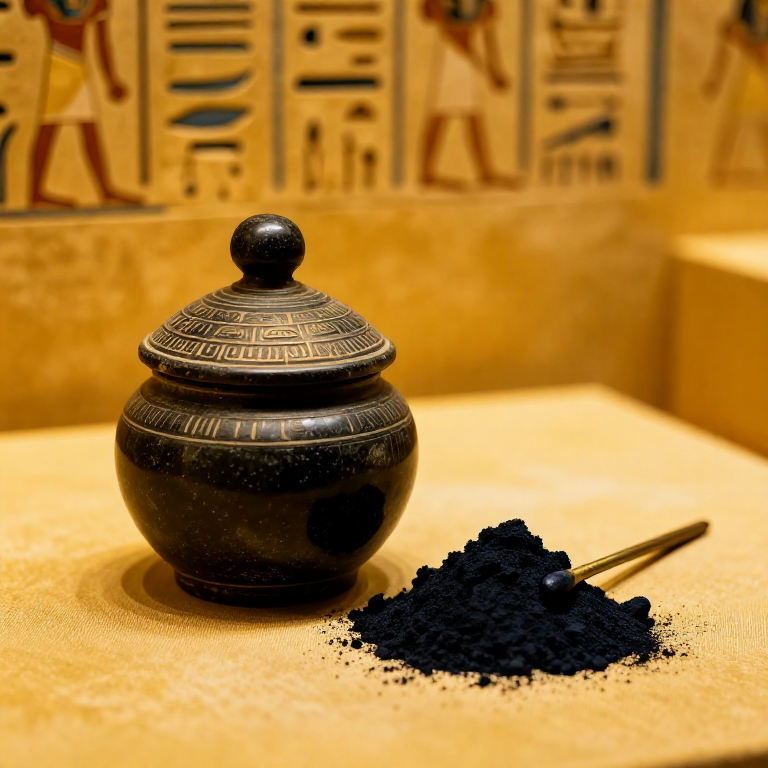


Making Egyptian Kohl Eye Cosmetic — Ancient Chemistry That Fought Infection
Kohl (Arabic: كحل, kuḥl — the origin of the word 'alcohol') is the world's oldest cosmetic, used continuously for over 5,000 years across Egypt, Mesopotamia, the Indian subcontinent, and the Arab world. Egyptian tomb paintings from 3100 BCE show both men and women wearing dramatic black eye liner — not for vanity alone, but as medical protection.
The primary ingredient in ancient Egyptian kohl was galena (lead sulfide, PbS), ground to a fine powder and mixed with animal fat or oil to create a paste. Modern analysis of kohl samples from Egyptian tombs (now in the Louvre) revealed that the Egyptians also deliberately synthesised two rare lead compounds not found in nature: laurionite (PbOHCl) and phosgenite (Pb₂Cl₂CO₃). These compounds are produced by a wet-chemistry process involving lead oxide, salt, water, and natron — a process that takes 30-40 days of patient grinding and mixing.
In 2010, French researchers at the CNRS discovered why: these synthetic lead chloride compounds stimulate the production of nitric oxide (NO) in human skin cells. Nitric oxide is a key signalling molecule in the immune system — it activates macrophages (white blood cells) that fight bacterial infections. In the hot, fly-plagued environment of ancient Egypt, eye infections were endemic. The kohl was not just cosmetic — it was a deliberately manufactured antimicrobial treatment, 5,000 years before germ theory.
Instructions
Obtain and prepare galena ore
Obtain and prepare galena ore
Galena (lead sulfide, PbS) is the primary mineral of lead — a dense, silvery-grey mineral with a metallic lustre that breaks along perfect cubic cleavage planes. The Egyptians mined galena from deposits in the Eastern Desert and the Sinai Peninsula. Select dense, clean specimens free of quartz or other mineral inclusions.
Crush the galena in a stone mortar and grind to a fine powder. The powder should be uniformly dark grey-black with a slight metallic sheen. Continue grinding until the powder feels smooth between the fingers with no detectable grit — the finer the grind, the smoother the kohl applies to the delicate skin around the eyes. WARNING: Galena is a lead compound. Lead is a cumulative neurotoxin. Handle with gloves, work in ventilated areas, and wash hands thoroughly. This blueprint documents ancient practices for historical and chemical education.
Tools needed:
 Stone Mortar and Pestle (large)
 Nitrile Rubber Gloves (Thick)
Synthesise laurionite — the Egyptian wet-chemistry process
Synthesise laurionite — the Egyptian wet-chemistry process
The ancient Egyptians deliberately manufactured laurionite (PbOHCl), a lead chloride hydroxide not found in nature. The synthesis, reconstructed from Louvre kohl samples, involves dissolving lead oxide (litharge, PbO) in a solution of natron (sodium carbonate/bicarbonate) and salt (sodium chloride) in water. The reaction proceeds slowly over 30-40 days with daily grinding.
Mix finely powdered litharge (PbO) with a solution of natron and salt in water — approximately 1 part litharge to 3 parts water with 10% natron and 5% salt by weight. Grind the mixture daily in a stone mortar, returning it to the vessel after each grinding session. Over weeks, the lead oxide reacts with the chloride ions and hydroxide to form microscopic crystals of laurionite — the exact compound detected in 4,000-year-old Egyptian kohl samples. The Egyptians documented this as a 30-day process — and modern replication confirms the timeline is chemically accurate.
Materials for this step:
 Natron50 g
Tools needed:
 Chemical Splash GogglesNitrile Rubber Gloves (Thick)
Prepare the kohl paste
Prepare the kohl paste
Combine the ground galena powder with the synthesised laurionite powder at approximately 4:1 galena to laurionite ratio — matching the proportions found in analysed Egyptian kohl samples. Grind the combined powders together until uniformly blended and extremely fine — the particle size must be below 50 micrometers for safe application near the eyes.
Mix the powder with a binding agent: animal fat (beef tallow or mutton fat), castor oil, or almond oil. The Egyptians used multiple binders depending on the intended consistency — oil for a liquid liner applied with a thin stick (the traditional kohl stick, a thin rod of wood, bone, or metal), and fat for a denser paste stored in small decorated pots. Add binder gradually until the mixture forms a smooth, creamy paste that adheres to a thin stick without dripping.
The kohl applicator — mesdemet stick
The kohl applicator — mesdemet stick
The traditional kohl applicator (Egyptian: mesdemet) is a thin, smooth rod approximately 8-10 cm long and 2-3 mm in diameter, made from wood, bone, ivory, bronze, or glass. Egyptian kohl pots have been found with their applicator sticks still inside — some carved into miniature columns or lotus buds, demonstrating that even utilitarian cosmetic tools were crafted with artistic care.
To apply, dip the stick into the kohl pot, rotate it to pick up a thin, even coating of paste, and draw it along the upper and lower eyelid margins. The classic Egyptian eye shape extends the line beyond the outer corner of the eye in a sweeping upturn — the iconic 'Eye of Horus' style visible in every Egyptian tomb painting. Both eyes are lined on both upper and lower lids, creating a dramatic frame that reduces glare from the desert sun while (as modern research confirms) boosting immune response against bacterial eye infections.
The science behind ancient medicine — nitric oxide immunology
The science behind ancient medicine — nitric oxide immunology
In 2010, researchers Philippe Walter and colleagues at the CNRS (Centre national de la recherche scientifique) published a groundbreaking study in the journal Analytical Chemistry demonstrating that the synthetic lead compounds in Egyptian kohl — specifically laurionite and phosgenite — stimulate human skin cells (keratinocytes) to produce nitric oxide (NO) at concentrations 240% above baseline.
Nitric oxide is a critical signalling molecule in the innate immune system: it activates macrophages (the immune cells that engulf and destroy bacteria) and directly kills certain pathogens through oxidative damage. In the ancient Egyptian environment — hot, humid, with endemic fly-borne eye infections (trachoma, conjunctivitis) — this antimicrobial effect would have provided genuine medical benefit. The Egyptians could not have known about nitric oxide, but they observed that kohl-wearing individuals suffered fewer eye infections — and they responded by developing an increasingly sophisticated chemistry to optimise the protective effect.
The lead paradox — medicine that poisons
The lead paradox — medicine that poisons
The modern understanding of lead toxicity creates an uncomfortable paradox: Egyptian kohl genuinely protected against eye infections, but the same lead compounds that stimulated immune defence also caused chronic lead poisoning. Lead accumulates in bones and soft tissue, causing neurological damage, kidney disease, anaemia, and developmental harm in children. Egyptian mummies show elevated lead levels consistent with lifetime kohl exposure.
The ancient Egyptians may have recognised some of lead's harmful effects — medical papyri describe symptoms consistent with chronic lead poisoning (abdominal pain, confusion, fatigue) — but attributed them to curses or spiritual causes rather than to the cosmetic they applied daily. The net balance of benefit versus harm would have depended on dosage, application frequency, and the severity of the endemic infections being prevented. In an environment where trachoma blindness was common and antibiotics did not exist, the tradeoff may have been rational — trading long-term lead exposure for short-term protection against a more immediate threat.
Tools Required
3- Placeholder
- Placeholder
- Placeholder
Related Blueprints
These blueprints share knowledge with this one — techniques, materials, or principles that connect them in the learning graph.
Related blueprints
Other builds that share materials, tools, or techniques with this one.


CC0 Public Domain
This blueprint is released under CC0. You are free to copy, modify, distribute, and use this work for any purpose, without asking permission.
Support the Maker by purchasing products through their Blueprint where they earn a Maker Commission set by Vendors, or create a new iteration of this Blueprint and include it as a connection in your own Blueprint to share revenue.