
Isolating Platinum from Alluvial Deposits — The Unwanted Silver of the Conquistadors
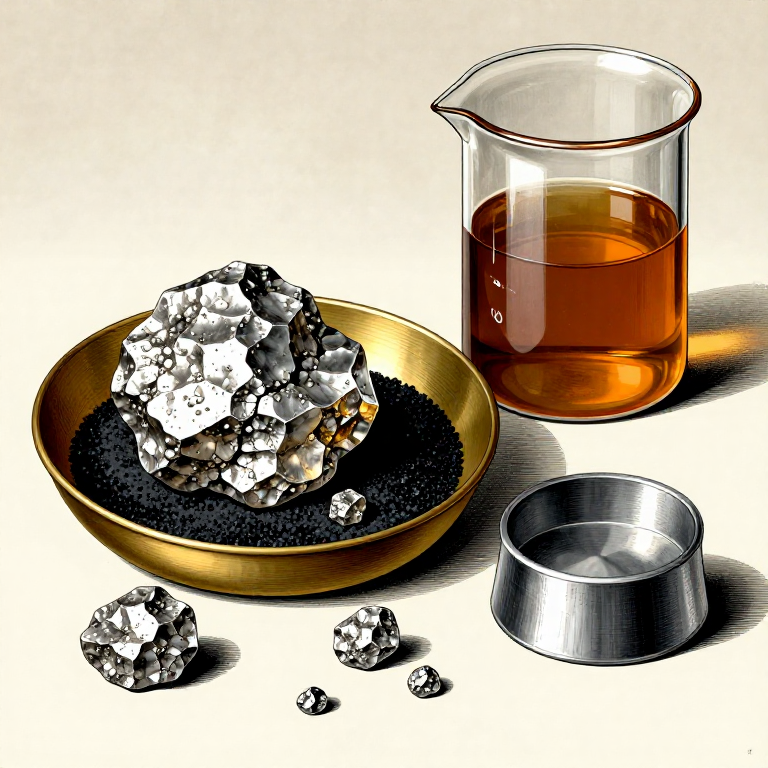
Platinum (Pt, element 78) was encountered by Spanish conquistadors in the alluvial gold deposits of Colombia's Chocó region in the 16th century. They called it platina — 'little silver' — a dismissive term, because the dense, silvery-white grains contaminated their gold concentrates and could not be melted or worked with the technology available. Spanish authorities considered it worthless and even ordered it thrown back into the rivers to prevent it from being used to adulterate gold. This was arguably the most expensive mistake in the history of metallurgy — platinum is now more valuable than gold.
Antonio de Ulloa published the first scientific description of platinum in 1748, based on specimens collected during a French geodetic expedition to Peru (1735–1744). The metal resisted all attempts at melting — its melting point (1768 °C) was far beyond what any furnace of the time could achieve. It was not until 1782 that Antoine Lavoisier succeeded in melting platinum using an oxygen-hydrogen blowpipe, and 1804 when William Hyde Wollaston developed a practical method using powder metallurgy (pressing and sintering sponge platinum).
Platinum occurs primarily as native metal grains in alluvial (placer) deposits, where it concentrates alongside gold due to its extreme density (21.45 g/cm³ — denser than gold at 19.32 g/cm³). The extraction from alluvial deposits uses gravity separation — identical in principle to gold panning, but targeting the densest fraction. Chemical purification requires aqua regia (a mixture of hydrochloric and nitric acids), which is one of the few reagents capable of dissolving platinum.
HAZARD: Aqua regia (used in purification) is extremely corrosive — a mixture of concentrated hydrochloric and nitric acids that produces toxic chlorine and nitrosyl chloride fumes. Handle only outdoors with full respiratory protection, chemical-resistant gloves, and eye protection. Platinum metal itself is non-toxic and biologically inert.
Instructions
Understand platinum chemistry and why it resisted discovery
Understand platinum chemistry and why it resisted discovery
Platinum (Pt, element 78) is a dense, malleable, ductile, silvery-white metal with extraordinary chemical stability. Its density is 21.45 g/cm³ — the third densest naturally occurring element (after osmium and iridium). Its melting point is 1768 °C, and it does not oxidize in air at any temperature. Platinum is resistant to attack by almost all individual acids, alkalis, and common reagents. Only aqua regia (a 3:1 mixture of concentrated hydrochloric and nitric acids), molten alkalis, and halogens at high temperature can dissolve it.
This extreme chemical inertness is why platinum escaped identification for so long. Unlike copper, tin, or iron — which can be extracted from their ores by simple heating with charcoal — platinum cannot be smelted, dissolved, or chemically attacked by any reagent available to pre-industrial metallurgists. The conquistadors had no way to work it, and its resemblance to silver (combined with its refusal to behave like silver) made it seem like a defective imitation.
Platinum's inertness arises from its electron configuration: [Xe] 4f¹⁴ 5d⁹ 6s¹. The nearly complete d-shell creates a metal with unusually strong metallic bonding and a filled, stable electronic structure. Paradoxically, while bulk platinum is almost inert, finely divided platinum is one of the most powerful catalysts known — platinum catalyzes hundreds of chemical reactions, including the catalytic converters that clean automobile exhaust.
Identify platinum in alluvial deposits
Identify platinum in alluvial deposits
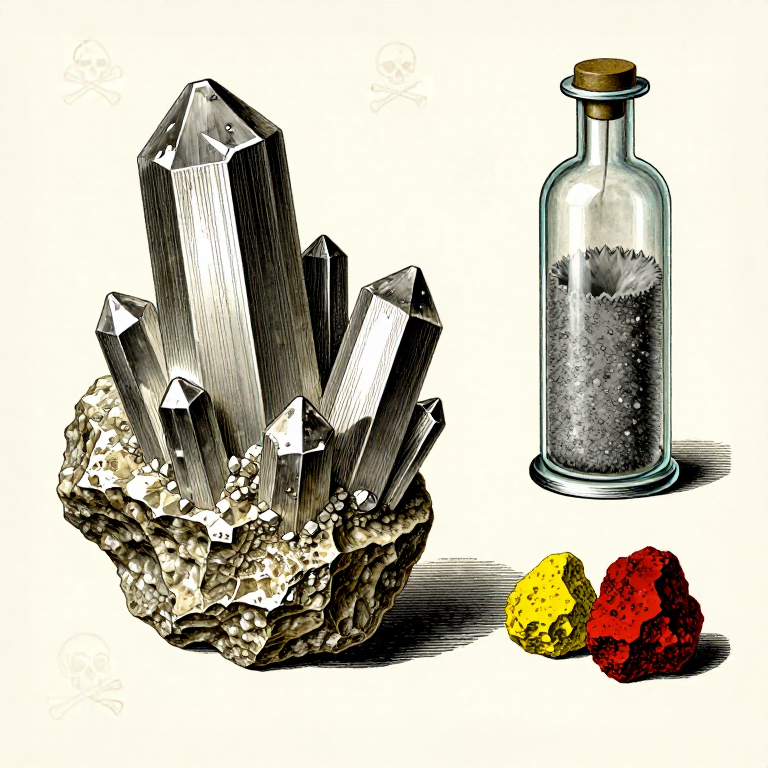
Native platinum occurs as small, irregular grains, flattened flakes, or occasionally as nuggets in alluvial (placer) deposits. The grains are silvery-white to steel-grey, with a bright metallic luster that does not tarnish. Platinum grains are typically associated with gold in the heavy mineral concentrate of stream sediments — they concentrate together because both are extremely dense.
Key identification features: platinum is denser than gold (21.45 vs 19.32 g/cm³), so in a gold pan, platinum grains settle even faster than gold. Platinum is silvery-white (gold is yellow), harder than gold (Mohs 4–4.5 vs 2.5–3 for gold), and does not react with nitric acid (gold dissolves slowly in hot concentrated nitric acid; platinum does not). Platinum grains are often slightly magnetic due to iron inclusions — this distinguishes them from silver grains, which are never magnetic.
Natural platinum is rarely pure — it typically contains 60–90% platinum with iron (5–25%), and smaller amounts of palladium, rhodium, iridium, and osmium. This natural alloy is called native platinum or polyxene. Alluvial platinum deposits are found in the Ural Mountains (Russia — historically the world's primary source), Colombia (Chocó), South Africa (Merensky Reef, Bushveld Complex), and smaller deposits in Ethiopia, Canada, and the western United States.
Tools needed:
 Geological Hammer
 Hand Lens (10x)
 Small Magnet
Collect platinum grains by gravity separation
Collect platinum grains by gravity separation
Platinum is concentrated from alluvial sediments using the same gravity-separation techniques as gold panning. Shovel stream sediment (gravel, sand) from locations downstream of known ultramafic or mafic igneous rocks (platinum's source rocks). Process the sediment in a gold pan exactly as for gold panning: fill the pan, submerge in water, agitate to stratify by density, and carefully wash away lighter material.
Platinum, being denser than gold, collects in the very bottom of the pan — the heaviest fraction of the heavy mineral concentrate. After the gold-colored grains become visible (if any), continue concentrating to find silvery-white, non-tarnishing grains among or beneath the gold. These silvery grains that resist tarnishing and feel exceptionally dense are likely platinum-group minerals.
Separate candidate platinum grains from other heavy minerals (magnetite, chromite, zircon) using a magnet: magnetite is strongly magnetic and lifts away cleanly. Platinum grains may be weakly magnetic (due to iron content) but should not lift cleanly onto the magnet as magnetite does. Collect all suspected platinum grains into a glass vial for testing.
Tools needed:
 Gold Pan (14 inch)
 Classifier Sieve (mesh screen)
 Glass Sample Vial (50ml)Small MagnetHand Lens (10x)
Test candidate grains for platinum identity
Test candidate grains for platinum identity
The definitive field test for platinum is resistance to nitric acid. Place a candidate grain on a non-reactive surface (glass, porcelain) and apply a drop of dilute nitric acid (10–20% concentration). Gold dissolves very slowly or not at all in dilute nitric acid; silver dissolves readily (turning the acid milky with AgCl if chloride is present); base metals dissolve with visible effervescence. Platinum shows absolutely no reaction — the acid sits on the surface without effect.
A stronger test uses concentrated nitric acid (68%): apply a drop to the grain with a glass rod. Silver dissolves immediately with green-blue coloration. Gold may dissolve very slowly with a faint yellow tint. Platinum shows zero reaction — no dissolution, no color change, no gas evolution. This total inertness to concentrated nitric acid is highly characteristic of platinum.
Additional confirmation: test the grain's hardness by scratching with a steel needle (Mohs ~6.5). Platinum (Mohs 4–4.5) scratches more easily than steel but harder than gold (2.5–3). Test malleability by pressing between two steel surfaces — platinum deforms without cracking (it is malleable), unlike chromite or other silvery minerals which shatter. The combination of high density, nitric acid inertness, silver-white color, malleability, and slight magnetism is diagnostic for native platinum.
Tools needed:
Glass Sample Vial (50ml)Hand Lens (10x)Dissolve platinum in aqua regia
Dissolve platinum in aqua regia
EXTREME HAZARD — OUTDOORS ONLY with full respiratory and eye protection. Aqua regia ('royal water') is a freshly mixed 3:1 ratio of concentrated hydrochloric acid (HCl, 37%) to concentrated nitric acid (HNO₃, 68%). It dissolves platinum through a synergistic reaction: the nitric acid oxidizes the platinum metal, while the hydrochloric acid provides chloride ions that complex with the oxidized platinum, pulling the equilibrium forward: Pt + 4HCl + 4HNO₃ → H₂PtCl₆ + 4NO₂↑ + 4H₂O (simplified). The product is chloroplatinic acid (H₂PtCl₆), a deep reddish-orange solution.
In a heat-resistant glass beaker (borosilicate/Pyrex), add 30 ml of concentrated HCl, then carefully add 10 ml of concentrated HNO₃. The mixture turns yellow-orange and fuming begins immediately — these fumes (NO₂, Cl₂, NOCl) are extremely toxic. Place the platinum grains into this mixture and warm gently on a sand bath. The platinum slowly dissolves over 30–60 minutes, producing a deep amber-orange solution.
Do not prepare aqua regia in advance — it decomposes rapidly and loses effectiveness. Always mix fresh. The reaction produces nitrogen dioxide (NO₂, a brown toxic gas), chlorine (Cl₂, a yellow-green toxic gas), and nitrosyl chloride (NOCl). All are severely irritating and toxic. Work exclusively outdoors, upwind, with a P100 respirator and chemical-resistant gloves.
Materials for this step:
 Hydrochloric Acid (37% concentrated)30 ml
 Nitric Acid (68% concentrated)10 ml
Tools needed:
 Heat-Resistant Glass Beaker (1 liter)
 P100 Respirator
 Safety Goggles
 Sand Bath (shallow pan with sand)
Precipitate pure platinum from solution
Precipitate pure platinum from solution
The chloroplatinic acid solution (H₂PtCl₆, deep amber-orange) contains dissolved platinum. To recover pure platinum metal, add ammonium chloride (NH₄Cl) to the solution. This precipitates ammonium hexachloroplatinate ((NH₄)₂PtCl₆), a yellow crystalline solid that is insoluble in the acidic solution: H₂PtCl₆ + 2NH₄Cl → (NH₄)₂PtCl₆↓ + 2HCl.
Add solid ammonium chloride gradually while stirring until no more yellow precipitate forms. Allow the precipitate to settle (30–60 minutes), then carefully decant or filter the liquid. Wash the yellow precipitate with a small amount of cold water to remove residual acid. The precipitate is ammonium hexachloroplatinate — a well-defined compound of known platinum content (44.1% Pt by mass).
This precipitation step selectively isolates platinum from the other platinum-group metals: palladium, rhodium, and iridium do not precipitate with ammonium chloride under these conditions. This selectivity is the basis of Wollaston's 1804 method, which was used commercially for over a century and led to his discovery of palladium and rhodium in the filtrate.
Materials for this step:
 Ammonium Chloride (NH4Cl)20 grams
Tools needed:
Glass Sample Vial (50ml) Nitrile Rubber Gloves (Thick)
Reduce the precipitate to platinum sponge
Reduce the precipitate to platinum sponge
Heat the dried ammonium hexachloroplatinate ((NH₄)₂PtCl₆) in a small crucible at 800–1000 °C. The compound decomposes: (NH₄)₂PtCl₆ → Pt + 2NH₃↑ + 2HCl↑ + Cl₂↑. The result is platinum sponge — a grey, porous mass of pure platinum metal. This sponge retains the shape of the original precipitate but is significantly smaller and denser.
Platinum sponge cannot be melted in a charcoal furnace (melting point 1768 °C) but can be consolidated by repeated heating and hammering — the traditional technique of Wollaston's powder metallurgy. Heat the sponge to bright orange-white heat in a forge and hammer it firmly on an anvil. The sponge compresses, porosity decreases, and with repeated heat-and-hammer cycles, the material becomes a dense, coherent metallic piece with platinum's characteristic silvery-white luster.
This hot-forging technique — heating platinum sponge and hammering it into a solid — was the only way to work platinum before electric arc furnaces became available. Pre-Columbian artisans in Ecuador (La Tolita culture, 600 BCE – 400 CE) independently developed this technique, producing intricate platinum jewelry by sintering and hammering platinum grains mixed with gold — one of the most remarkable achievements of ancient metallurgy.
Tools needed:
 Clay Crucible (deep)
 Charcoal Furnace (small)
 Bellows (hand-operated)
 Hand Hammer (500g)
Verify purity and document results
Verify purity and document results
The consolidated platinum piece should be silvery-white, dense (21.45 g/cm³ if pure), and completely resistant to tarnishing in air. Confirm purity by re-testing with nitric acid — pure platinum shows zero reaction. The metal should be malleable (deforms without cracking under hammer blows), moderately hard (Mohs 4–4.5), and non-magnetic (pure platinum is paramagnetic; if the piece is magnetic, iron contamination is present).
Weigh the final platinum piece and calculate recovery from your original grains. The purification losses through aqua regia dissolution, precipitation, and sponge reduction are typically 10–20%, so recovery of 80–90% of the original platinum content is achievable with careful work.
Document the complete process: location and method of collection, weight of raw grains, aqua regia volumes used, precipitate weight, sponge weight after calcination, and final consolidated metal weight. Store platinum in any container — it does not tarnish, corrode, or react with anything at room temperature. Your platinum piece, if properly purified, will look exactly the same in a thousand years as it does today. Dispose of all acid waste through proper hazardous waste channels — never pour aqua regia or its residues down drains or onto soil.
Tools needed:
Hand Lens (10x)Glass Sample Vial (50ml)Materials
3- Placeholder
- Placeholder
- 20 gramsPlaceholder
Tools Required
19- Placeholder
- Placeholder
- Placeholder
- Placeholder
- Placeholder
- Placeholder
- Placeholder
- Placeholder
- Placeholder
- Placeholder
- Placeholder
- Placeholder
- Placeholder
- Placeholder
- Placeholder
Connected Blueprint Materials
Related blueprints
Other builds that share materials, tools, or techniques with this one.
CC0 Public Domain
This blueprint is released under CC0. You are free to copy, modify, distribute, and use this work for any purpose, without asking permission.
Support the Maker by purchasing products through their Blueprint where they earn a Maker Commission set by Vendors, or create a new iteration of this Blueprint and include it as a connection in your own Blueprint to share revenue.