ART
BEAUTY & WELLNESS
CRAFT
CULTURE & HISTORY
ENTERTAINMENT
ENVIRONMENT
FOOD & DRINKS
GREEN FUTURE
REVERSE ENGINEERING
SCIENCES
SPORTS
TECHNOLOGY
WEARABLES



Galileo's Falling Bodies — Race a Ball Down a Ramp
A hands-on school project: drop two different weights to see them land together, then roll a ball down a ramp and time it to discover that distance grows as the square of the time. A Python cell checks your ramp measurements, and a compendium explains why a feather and a hammer fall together on the airless Moon.
Beginner
30 minutes
Instructions
1
1
Do heavy things fall faster?
Do heavy things fall faster?
Aristotle said heavier objects fall faster; around 1600 Galileo said they fall together. Test it: hold a heavy ball and a light one at the same height and drop them at the same instant. They land together (as long as neither is fluffy enough for air to slow it). Heaviness does not win the race.
2
2
Build a ramp to slow gravity down
Build a ramp to slow gravity down
Free fall is too fast to time by hand, so do what Galileo did: prop up a smooth board as a gentle ramp and roll a ball down it. The ball follows the same speeding-up pattern as a fall, only slower. Mark distances along the ramp with a tape measure — say 10, 20, 30, 40 cm from the start.
Materials for this step:
 Red Alder Board1 piece
 Ball Bearing1 piece
Tools needed:
 Measuring Tape 3m
3
3
Time the ball to each mark
Time the ball to each mark
Release the ball from the top and time how long it takes to reach each mark. Repeat a few times and average — timing rolling balls by hand is tricky, so several tries help. Write down each time and distance. You should find the ball covers far more than double the distance when you double the time.
Tools needed:
 Stopwatch
4
4
Check the time-squared law
Check the time-squared law
Loading Jupyter Notebook...
Tools needed:
 Desktop Computer
 Calculator
5
5
Compendium: the law of falling
Compendium: the law of falling
What your ramp reveals. (1) Distance grows as time SQUARED (d = one-half g t-squared), so in equal seconds a falling object covers distances in the ratio 1, 3, 5, 7 — Galileo's famous odd-number rule, and the odd numbers add to the perfect squares. (2) The MASS never enters the formula, so without air everything falls at the same rate — the astronaut David Scott proved it on the airless Moon in 1971 by dropping a hammer and a feather together. (3) A steeper ramp accelerates faster; a vertical 'ramp' is just free fall, with acceleration g about 9.8 metres per second every second. (4) This single law, wrung from a rolling ball, was the first piece of the mechanics Newton would complete, and it still describes every dropped object, thrown ball and launched rocket.
Materials
2- 1 piecePlaceholder
- 1 piecePlaceholder
Related Blueprints
These blueprints share knowledge with this one — techniques, materials, or principles that connect them in the learning graph.
Related blueprints
Other builds that share materials, tools, or techniques with this one.

Aryabhata's Spinning Earth — A Torch, a Ball, and Day and Night
Building a Roman Cofferdam — Pumping Water to Build Below the Waterlineconstruction

Making Soda Ash by the Leblanc Process — The Chemical That Made Soap and Glass Affordableindustrial-chemistry
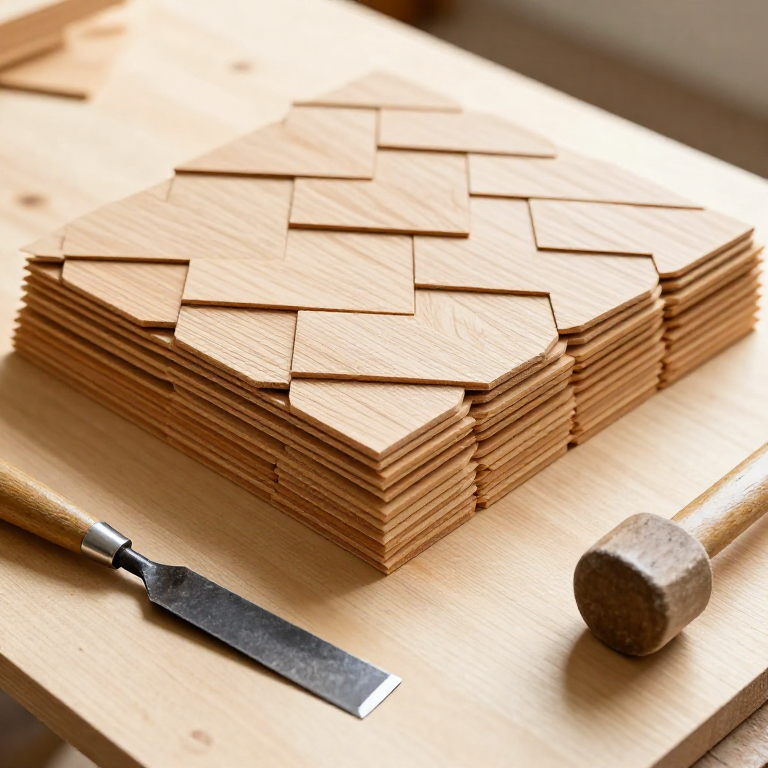
Making Wooden Shingles — Riving Roof Tiles from a Bolt of TimberWoodworking

Building a Macadam Road — Cheap, Dry Highways from Small Broken StoneENGINEERING

Making a Deer Antler Knife Handle — Drill, Shape, and Epoxy a Hidden-Tang Gripwoodworking
CC0 Public Domain
This blueprint is released under CC0. You are free to copy, modify, distribute, and use this work for any purpose, without asking permission.
Support the Maker by purchasing products through their Blueprint where they earn a Maker Commission set by Vendors, or create a new iteration of this Blueprint and include it as a connection in your own Blueprint to share revenue.