Extracting Antimony from Stibnite — The Ancient Cosmetic Turned Metal
Antimony (Sb, element 51, from Latin stibium) has one of the longest histories of any element. Stibnite (antimony trisulfide, Sb₂S₃) — a lustrous, steel-grey mineral — was ground into powder and used as kohl eye cosmetic in ancient Egypt from at least 3100 BCE. The Ebers Papyrus (c. 1550 BCE) mentions it as a medicine. Yet metallic antimony was not reliably produced until the 16th century CE, when Vannoccio Biringuccio described its smelting in De la pirotechnia (1540).
Stibnite is the principal ore of antimony, containing 71.7% antimony by mass. The extraction involves two stages: first, stibnite is roasted in air to convert Sb₂S₃ to antimony trioxide (Sb₂O₃), releasing sulfur dioxide. Then the oxide is reduced with carbon at approximately 700–800 °C to yield metallic antimony. Alternatively, stibnite can be reduced directly using metallic iron in a precipitation reaction — the iron displaces antimony from the sulfide because iron has a greater affinity for sulfur.
HAZARD: Antimony and its compounds are toxic. Antimony trioxide is classified as a possible carcinogen (IARC Group 2B). Chronic exposure causes antimoniosis — a pneumoconiosis affecting the lungs. Stibine gas (SbH₃), while not produced in this process, is extremely toxic. Work outdoors with respiratory protection. Wash hands thoroughly after handling antimony or its ores.
Instructions
Understand antimony chemistry and properties
Antimony (Sb, element 51) is a metalloid — it sits on the boundary between metals and non-metals in the periodic table, in Group 15 alongside nitrogen, phosphorus, arsenic, and bismuth. Its density is 6.70 g/cm³, melting point 630.63 °C, and boiling point 1587 °C. Antimony is brittle and silvery-white with a bluish tinge, and it exhibits a distinctive property: it expands on solidification (like water and bismuth), making it useful in type metal alloys where sharp casting detail is required.
The symbol Sb comes from Latin stibium, itself from Egyptian stm, referring to the cosmetic powder made from stibnite. Antimony has two main oxidation states: +3 (as in Sb₂O₃ and Sb₂S₃) and +5 (as in Sb₂O₅). The +3 state predominates in nature. Antimony is a poor conductor of electricity and heat compared to true metals.
Toxicity: Antimony compounds cause nausea, vomiting, and diarrhea if ingested. Chronic inhalation of antimony dust or fumes causes lung damage (antimoniosis). Antimony trioxide is a suspected carcinogen. Handle all antimony materials with gloves and respiratory protection. Wash hands before eating or drinking.
Identify stibnite in the field
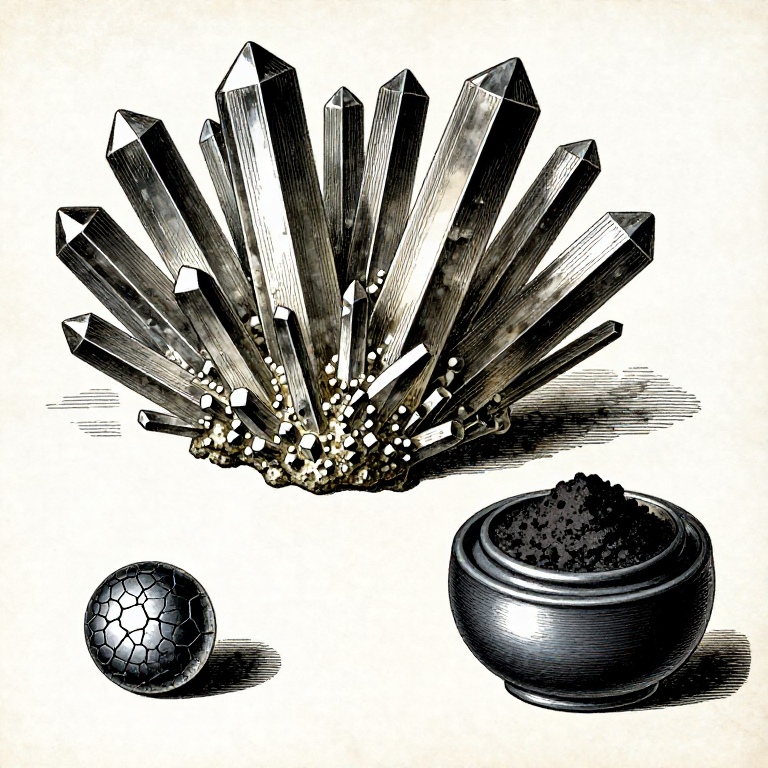
Stibnite (Sb₂S₃) is one of the most distinctive and beautiful ore minerals. It forms long, prismatic, steel-grey crystals with a brilliant metallic luster, often occurring in radiating clusters or bladed aggregates. Stibnite crystals can grow to spectacular lengths — specimens over 40 cm are known from mines in China and Japan.
Key identification features: Mohs hardness 2 (very soft — can be scratched with a fingernail), perfect cleavage along the crystal length, specific gravity 4.63, and a lead-grey streak on unglazed porcelain. Stibnite bends slightly before breaking (unusual for a sulfide mineral). When heated with a match or lighter flame, stibnite melts readily (melting point 550 °C) and produces a characteristic sulfurous smell.
Stibnite forms in low-temperature hydrothermal veins, often in association with quartz, calcite, and sometimes gold. Major deposits include Xikuangshan (Hunan, China — the world's largest), Ichinokawa (Japan), Kadamzhai (Kyrgyzstan), and various deposits in Mexico and Bolivia. Stibnite was historically mined throughout the Mediterranean for cosmetic use.
Tools needed:
Geological Hammer
Hand Lens (10x)
Streak Plate (unglazed porcelain)Crush the stibnite ore
Crush the stibnite ore
Break stibnite specimens into small fragments (under 1 cm) using a geological hammer. Stibnite is very soft (Mohs 2) and cleaves easily along its crystal faces, so it crushes readily. Remove visible gangue (quartz, calcite) by hand-sorting — stibnite's high density (4.63 g/cm³) and metallic luster make it easy to distinguish from lighter waste rock.
Weigh 300–500 grams of sorted stibnite ore. Pure stibnite contains 71.7% antimony by mass (Sb = 121.76, S = 32.06; Sb₂S₃ = 339.72; 2 × 121.76 / 339.72 = 0.717). In practice, most ore contains 40–60% stibnite mixed with gangue, so expect correspondingly lower yields.
Wear a dust mask and gloves during crushing. Antimony sulfide dust is moderately toxic if inhaled. Work on a stable surface and collect all fragments — stibnite's softness causes it to generate fine powder during crushing.
Materials for this step:
Stibnite Ore (antimony sulfide)500 gramsTools needed:
Geological Hammer
Dust Mask (P2)
Nitrile Rubber Gloves (Thick)Reduce stibnite with iron (precipitation method)
Reduce stibnite with iron (precipitation method)
The simplest and most historically significant method of producing metallic antimony is the iron precipitation method. When stibnite is heated with metallic iron, the iron displaces antimony because iron has a stronger affinity for sulfur: Sb₂S₃ + 3Fe → 2Sb + 3FeS. This reaction proceeds at approximately 600–700 °C — well below the temperatures needed for oxide reduction, and without producing toxic SO₂ gas.
Mix the crushed stibnite with iron filings or small pieces of scrap iron at a ratio of approximately 1 part stibnite to 0.5 parts iron by weight. The iron must be in small pieces to ensure good contact with the ore. Clean iron nails, cut into short lengths, work well. Avoid galvanized (zinc-coated) iron — the zinc coating introduces complications.
Place the mixture in a clay or graphite crucible. The crucible must be deep enough to contain the charge with room for the reaction products to separate — molten antimony (density 6.70) sinks to the bottom while iron sulfide slag (density 4.74) floats on top.
Materials for this step:
Iron Filings (clean scrap iron)250 gramsTools needed:
Clay Crucible (deep)Heat the crucible to reaction temperature
Heat the crucible to reaction temperature
PERFORM OUTDOORS with respiratory protection. Place the loaded crucible into a charcoal furnace and heat to approximately 650–750 °C (dull red heat). The reaction begins as the stibnite melts (melting point 550 °C) and contacts the iron. You may observe gentle bubbling or movement of the melt surface as the displacement reaction proceeds.
The reaction Sb₂S₃ + 3Fe → 2Sb + 3FeS is mildly exothermic, so once started it helps sustain itself. Maintain the temperature for 30–45 minutes to ensure complete reaction. Stir the melt once or twice using a steel rod to promote contact between unreacted ore and iron pieces.
During this process, small amounts of antimony vapor may be released. While antimony has a high boiling point (1587 °C), trace vaporization occurs at furnace temperatures. Wear a P100 respirator and position yourself upwind. The characteristic metallic smell of antimony vapor is a warning sign of inadequate ventilation.
Materials for this step:
Charcoal (hardwood lump)3 kgTools needed:
Charcoal Furnace (small)
Bellows (hand-operated)
Steel Stirring Rod
P100 Respirator
Safety GogglesAllow separation and pour the melt
Allow separation and pour the melt
After 30–45 minutes at temperature, the crucible contents separate into two layers by density: metallic antimony (6.70 g/cm³) sinks to the bottom, while iron sulfide slag (4.74 g/cm³) floats on top. Allow the crucible to stand undisturbed for 5–10 minutes at temperature to ensure complete separation.
Using long-handled crucible tongs and wearing full protective gear, carefully pour the molten contents into a pre-heated mold (a small depression in dry sand works adequately). Pour steadily — the lighter FeS slag will pour first, followed by the denser antimony if you empty the crucible completely. Alternatively, let the entire melt solidify in the crucible, then break the crucible to separate the antimony button from the slag.
The antimony regulus (button of metal) forms at the bottom — a characteristic star-shaped crystalline pattern often appears on its surface during cooling. This star pattern, called the star of antimony or regulus of antimony, was regarded as significant by alchemists and is caused by crystallization along preferred directions in antimony's rhombohedral crystal structure.
Tools needed:
Crucible Tongs (long-handled)
Leather Gauntlet GlovesSeparate and clean the antimony regulus
Separate and clean the antimony regulus
Once cooled, the antimony regulus (metal button) can be separated from the iron sulfide slag by tapping with a hammer. The slag is brittle and grey-black; the antimony is silvery-white with a bluish tinge. The boundary between metal and slag is usually clean and distinct.
The regulus may have irregular shape and a rough surface where it contacted the slag. File or grind the surface to reveal clean, bright antimony metal. Freshly exposed antimony has a brilliant silvery luster with a distinctive bluish-white color. Antimony does not tarnish rapidly in dry air, but over weeks a thin oxide layer develops.
Weigh the regulus and calculate recovery: from 500 grams of pure stibnite, the theoretical maximum is 358 grams of antimony (71.7%). In practice, expect 40–60% recovery (140–215 grams) due to incomplete reaction, mechanical losses, and antimony retained in the slag. The slag can be re-processed with additional iron to recover residual antimony.
Tools needed:
Hand Hammer (500g)
Hand Lens (10x)Verify antimony identity and properties
Verify antimony identity and properties
Confirm the metal is antimony by testing its characteristic properties. Antimony is distinctively brittle — strike the regulus with a hammer and it shatters into angular fragments rather than deforming (unlike lead or tin, which deform plastically). The fractured surface shows a coarsely crystalline, flaky texture.
Antimony expands slightly on solidification — one of only a few elements with this property (others include water/ice, bismuth, and gallium). If you remelt a small piece and let it solidify in a narrow container, the solid antimony will be larger than the liquid volume, sometimes cracking the container.
Chemical confirmation: antimony dissolves slowly in hot concentrated hydrochloric acid, producing antimony trichloride (SbCl₃). If this solution is diluted with water, a white precipitate of antimony oxychloride (SbOCl) forms — a reaction known as the 'powder of Algaroth,' named after the 17th-century physician who described it. This precipitate test is specific to antimony.
Tools needed:
Glass Sample Vial (50ml)Dispose of materials safely and document results
Dispose of materials safely and document results
Iron sulfide slag from the reduction is not acutely toxic but should not be dumped in water sources — FeS can acidify water as it oxidizes. Allow slag to cool completely, then dispose of it with mineral waste or through your local waste facility. The crucible, if broken, can be discarded with the slag.
All surfaces that contacted antimony powder or ore should be wiped with damp cloths. Do not sweep antimony dust dry — it becomes airborne and poses an inhalation hazard. Wash all tools with soap and water. Remove and wash work clothing separately.
Record the date, ore source, charge weights (stibnite and iron), approximate temperatures, reaction time, and final antimony weight. Note the appearance of the star of antimony if observed — this crystallization pattern varies with cooling rate and purity, and documenting it contributes to understanding the metallurgical conditions. Store the antimony regulus in a labeled container. Antimony metal is stable in dry air and will keep indefinitely.
Materials
3- 500 gramsPlaceholder
- 250 gramsPlaceholder
Tools Required
15- Placeholder
- Placeholder
- Placeholder
- Placeholder
- Placeholder
- Placeholder
- Placeholder
- Placeholder
- Placeholder
- Placeholder
- Placeholder
- Placeholder
- Placeholder
- Placeholder
- Placeholder
CC0 Public Domain
This blueprint is released under CC0. You are free to copy, modify, distribute, and use this work for any purpose, without asking permission.
Support the Maker by purchasing products through their Blueprint where they earn a Maker Commission set by Vendors, or create a new iteration of this Blueprint and include it as a connection in your own Blueprint to share revenue.