སྒྱུ་རྩལ
མཛེས་སྡུག་དང་བདེ་ཐང
བཟོ་རིག
རིག་གནས་དང་ལོ་རྒྱུས
དགའ་སྟོན
ཁོར་ཡུག
ཟས་དང་བཏུང་རྫས
ལྗང་མ་འཇོར་ལུགས
ཕྱིར་འཕྲུལ་རིག
ཚན་རིག
རྩེད་འགྲན
རིག་རྩལ
གྱོན་རུང
Extracting Neodymium-Rich Rare Earth Oxide from Monazite — The Magnet Metal That Reshaped Technology
Peter

བཟོས་མཁན

Peter

13. སྤྱི་ཟླ་ལྔ་པ 2026SE
༡༦

Extracting Neodymium-Rich Rare Earth Oxide from Monazite — The Magnet Metal That Reshaped Technology

Neodymium is element 60 — a silvery-white lanthanide rare earth metal that would be utterly obscure if not for one extraordinary property: neodymium-iron-boron (NdFeB) magnets are the strongest permanent magnets ever created, generating magnetic fields up to 1.4 tesla. These magnets made possible the miniaturization of electric motors, hard drives, headphones, MRI machines, and wind turbines. Without neodymium, modern technology would be physically larger, heavier, and less efficient.

Neodymium was discovered in 1885 by Carl Auer von Welsbach, who separated the supposed element didymium (from the Greek 'didymos', twin) into two new elements: praseodymium (green twin) and neodymium (new twin). The separation required hundreds of fractional crystallizations of ammonium didymium nitrate — a testament to both patience and precision. Today, neodymium is extracted almost exclusively from monazite ((Ce,La,Nd,Th)PO₄) and bastnäsite ((Ce,La,Nd)CO₃F), both rare earth phosphate/carbonate minerals found in placer sands and carbonatite deposits.

This blueprint covers the caustic cracking of monazite sand to produce a neodymium-enriched rare earth oxide concentrate. The process — gravity concentration, alkaline digestion, selective precipitation, and cerium removal — follows the same chemistry used in industrial rare earth processing, scaled to a laboratory bench. The final product is a mixed rare earth oxide with the characteristic lilac-violet color of Nd₂O₃, confirmed by the sharp absorption bands unique to neodymium in solution.

HAZARD: Monazite contains thorium (typically 5–9% ThO₂), a radioactive alpha emitter. While the external radiation risk from small samples is minimal, inhalation or ingestion of monazite dust is dangerous. Concentrated NaOH at 140 °C causes severe chemical burns and produces caustic steam. HCl fumes are corrosive to lungs. All work must be performed with chemical splash goggles, acid-resistant gloves, and a P100 respirator with acid gas cartridge, in a well-ventilated area or under a fume hood.

མཐོ་རིམ
12-16 hours (over 2-3 days)

ལམ་སྟོན

1

Understand neodymium's chemistry and significance

Neodymium (Nd, atomic number 60, atomic mass 144.24) is a lanthanide rare earth element — the third most abundant rare earth after cerium and lanthanum. Despite the name 'rare earth', these elements are not geologically rare: neodymium is more abundant than tin or lead in the Earth's crust (~33 ppm). The 'rare' refers to the difficulty of separating one lanthanide from another, because all 15 lanthanides share nearly identical chemical behavior — they all form +3 ions of very similar size.

Neodymium's defining property is its 4f³ electron configuration, which gives Nd³⁺ ions strong magnetic anisotropy — they resist demagnetization along certain crystal axes. In 1982, General Motors and Sumitomo Special Metals independently discovered that the compound Nd₂Fe₁₄B forms a tetragonal crystal structure with extraordinarily high magnetocrystalline anisotropy and saturation magnetization. NdFeB magnets produce energy densities 5–10 times greater than traditional ferrite magnets. A NdFeB magnet the size of a coin can lift several kilograms of steel. This discovery transformed electric motors, generators, speakers, and sensors worldwide.

2

Identify and collect monazite-bearing sand

Monazite ((Ce,La,Nd,Th)PO₄) is a dense (specific gravity 5.0–5.3), hard (5–5.5 Mohs), yellowish-brown to reddish-brown monoclinic mineral found in placer deposits — beach sands, river sands, and alluvial gravels where heavy minerals concentrate naturally by water action. Classic monazite-rich localities include the beaches of Kerala (India), Guarapari (Brazil), the coastal sands of Sri Lanka and Madagascar, and alluvial deposits of the Carolinas (USA).

Use a gold pan to concentrate heavy minerals from sand. Monazite, along with ilmenite, rutile, zircon, and garnet, settles to the bottom as lighter quartz and feldspar wash away. The heavy mineral concentrate appears as a dark band of black, brown, and reddish grains. Monazite grains are typically 0.1–0.5 mm, translucent amber to reddish-brown, with a resinous to vitreous lustre. Alternatively, purchase monazite sand from a mineral specimen supplier — this is the safest and most controlled approach for laboratory work. A 50-gram sample is sufficient for this extraction.

ལག་ཆས་དགོས་མཁོ:

Gold PanGold Pan
3

Check monazite purity and measure radioactivity

Before processing, verify your monazite sample. Under a hand lens, monazite grains are translucent amber-brown with a resinous lustre and conchoidal fracture — distinct from the opaque black of ilmenite and magnetite. Test with a magnet: monazite is non-magnetic, while magnetite and some ilmenite grains are strongly magnetic. Remove magnetic minerals by passing a strong magnet over the sand spread in a thin layer.

Monazite contains 5–9% ThO₂ (thorium oxide) and traces of uranium, making it measurably radioactive. If available, use a Geiger counter to confirm: monazite sand typically reads 0.5–5 μSv/hr depending on thorium content and sample mass. This level is low-risk for external exposure from a small sample but demands strict dust control — never grind, sieve, or handle dry monazite without a P100 respirator. All subsequent wet chemistry steps keep the material safely in solution or as wet precipitates, minimizing airborne dust risk.

ལག་ཆས་དགོས་མཁོ:

Small MagnetSmall Magnet
P100/FFP3 Respirator with Acid Gas CartridgeP100/FFP3 Respirator with Acid Gas Cartridge
Safety GogglesSafety Goggles
4

Prepare concentrated sodium hydroxide solution

The caustic cracking process requires concentrated NaOH — approximately 50–60% by weight. In a heat-resistant glass beaker, dissolve 150 grams of NaOH pellets in 100 mL of distilled water. Always add NaOH to water, never water to NaOH — the dissolution is extremely exothermic and adding water to solid NaOH causes violent spattering. Add pellets slowly, stirring continuously with a glass rod. The solution will heat to 80–100 °C spontaneously.

Wear chemical splash goggles and chemical-resistant gloves throughout. Concentrated NaOH at any temperature causes severe skin burns and permanent eye damage on contact. The resulting solution is a thick, clear, syrupy liquid with approximately 60% NaOH concentration. Allow it to cool to room temperature before proceeding — you will heat it again in a controlled manner during the digestion step.

གོམ་པ་འདིའི་རྫས་རིགས:

Sodium Hydroxide (Lab Grade, 500g)Sodium Hydroxide (Lab Grade, 500g)150 g
Distilled Water (1 Liter)Distilled Water (1 Liter)100 mL

ལག་ཆས་དགོས་མཁོ:

Heat-Resistant Glass Beaker (1 liter)Heat-Resistant Glass Beaker (1 liter)
Borosilicate Glass RodBorosilicate Glass Rod
Chemical Splash GogglesChemical Splash Goggles
Chemical-Resistant GlovesChemical-Resistant Gloves
5

Digest monazite in hot caustic soda (caustic cracking)

Add 50 grams of monazite sand to the concentrated NaOH solution in a nickel or stainless steel container (not glass — hot concentrated NaOH attacks glass aggressively). Heat the mixture to 140–150 °C on a hot plate and maintain this temperature for 3 hours, stirring periodically. The reaction proceeds: (Ce,La,Nd,Th)PO₄ + 3NaOH → RE(OH)₃ + Th(OH)₄ + Na₃PO₄. The phosphate backbone of monazite is destroyed, converting the rare earths and thorium into their respective hydroxides while the phosphorus leaves as soluble trisodium phosphate.

The mixture becomes a thick, pasty grey-brown mass as the reaction progresses. Caustic steam is released — work in a well-ventilated area or under a fume hood. After 3 hours at temperature, the monazite should be fully decomposed. Allow the mixture to cool to approximately 80 °C before proceeding to the washing step. Do not let it cool completely — the solidified NaOH cake is much harder to process.

ལག་ཆས་དགོས་མཁོ:

Hot Plate (Laboratory/Kitchen)Hot Plate (Laboratory/Kitchen)
Borosilicate Glass RodBorosilicate Glass Rod
P100/FFP3 Respirator with Acid Gas CartridgeP100/FFP3 Respirator with Acid Gas Cartridge
Leather Gauntlet GlovesLeather Gauntlet Gloves
6

Wash the hydroxide cake to remove phosphate

While still warm (~80 °C), add 300 mL of hot distilled water to the reaction mass and stir thoroughly to dissolve the trisodium phosphate (Na₃PO₄) and excess NaOH. The rare earth hydroxides and thorium hydroxide are insoluble in water and remain as a fine-grained precipitate. Allow the solids to settle for 10–15 minutes, then carefully decant the clear supernatant liquid — this contains the dissolved phosphate and NaOH. Discard the decanted liquid safely (it is strongly alkaline).

Repeat the hot water wash 3–4 times: add 200 mL of hot distilled water, stir, settle, decant. Each wash removes more residual phosphate and NaOH. After the final wash, the supernatant should be only mildly alkaline (pH 8–9) and nearly free of phosphate. The remaining solid — a grey to tan paste — is mixed rare earth hydroxides (RE(OH)₃) and thorium hydroxide (Th(OH)₄). This is the crude rare earth concentrate.

གོམ་པ་འདིའི་རྫས་རིགས:

Distilled Water (1 Liter)Distilled Water (1 Liter)1000 mL

ལག་ཆས་དགོས་མཁོ:

Heat-Resistant Glass Beaker (1 liter)Heat-Resistant Glass Beaker (1 liter)
Litmus PaperLitmus Paper
7

Dissolve the hydroxide cake in hydrochloric acid

Transfer the washed hydroxide cake to a clean glass beaker. Add dilute hydrochloric acid (approximately 3–4 M, or about 10–12% HCl) slowly while stirring. The hydroxides dissolve with mild effervescence: RE(OH)₃ + 3HCl → RECl₃ + 3H₂O. Add acid gradually until the solution is clear or nearly clear and slightly acidic (pH 3–4). Avoid adding excess acid — you want pH 3–4, not strongly acidic. Use about 200 mL of 10% HCl for 50 grams of starting monazite.

The solution should be a pale yellow-green color — this is the mixed rare earth chloride solution. The yellow tint comes primarily from Ce³⁺ and Pr³⁺ ions, while the pink-lilac undertone (if visible against the yellow) is from Nd³⁺. Any undissolved dark residue is undigested monazite or insoluble contaminants — filter through filter paper and discard the residue. Keep the clear filtrate — this contains your rare earths and thorium in solution.

གོམ་པ་འདིའི་རྫས་རིགས:

Hydrochloric Acid (10% dilute)Hydrochloric Acid (10% dilute)200 mL

ལག་ཆས་དགོས་མཁོ:

Borosilicate BeakerBorosilicate Beaker
Borosilicate Glass RodBorosilicate Glass Rod
Filter Paper (fine pore)Filter Paper (fine pore)
Litmus PaperLitmus Paper
Chemical Splash GogglesChemical Splash Goggles
8

Remove thorium by selective precipitation

Thorium must be separated from the rare earths for both safety and purity. Thorium hydroxide precipitates at a lower pH than the light rare earth hydroxides — Th(OH)₄ is insoluble above approximately pH 3.5, while the light rare earths (La, Ce, Pr, Nd) remain in solution until pH 6–7. Slowly add dilute NaOH (10% solution) to the mixed chloride solution while stirring, monitoring pH with litmus or pH paper.

Raise the pH to 5.5–5.8 — at this point, thorium precipitates as a white gelatinous Th(OH)₄ while the rare earth chlorides remain dissolved. The precipitate may also contain some iron hydroxide (brown) if iron was present in the monazite. Allow the precipitate to settle for 15 minutes, then filter through fine filter paper. The filtrate is a thorium-depleted rare earth chloride solution. The filter cake containing thorium should be sealed in a container, labelled as radioactive waste, and disposed of according to local regulations — do not discard in regular waste.

གོམ་པ་འདིའི་རྫས་རིགས:

Sodium Hydroxide (10% solution)Sodium Hydroxide (10% solution)50 mL

ལག་ཆས་དགོས་མཁོ:

Litmus PaperLitmus Paper
Filter Paper (fine pore)Filter Paper (fine pore)
Borosilicate Glass RodBorosilicate Glass Rod
Erlenmeyer FlaskErlenmeyer Flask
9

Remove cerium by oxidative precipitation

Cerium typically constitutes 45–50% of the rare earths in monazite. Unlike all other lanthanides (which are strictly trivalent), cerium can be oxidized from Ce³⁺ to Ce⁴⁺. Ceric hydroxide (Ce(OH)₄) is far less soluble than the trivalent rare earth hydroxides, precipitating as a yellow-tan solid at much lower pH. This unique chemistry allows selective cerium removal.

To the thorium-free rare earth chloride solution (at pH ~4), add hydrogen peroxide (3% H₂O₂) — about 20 mL per 200 mL of solution — while stirring. The peroxide oxidizes Ce³⁺ to Ce⁴⁺. Then slowly raise the pH to approximately 4.5 by adding dilute NaOH drop by drop. The oxidized cerium precipitates as yellow-tan CeO₂·xH₂O (hydrated ceric oxide), while Nd³⁺, La³⁺, and Pr³⁺ remain in solution. Allow the precipitate to settle, then filter. The filtrate — now depleted of both thorium and cerium — is significantly enriched in neodymium relative to the starting material.

གོམ་པ་འདིའི་རྫས་རིགས:

Hydrogen Peroxide (3%)Hydrogen Peroxide (3%)20 mL
Sodium Hydroxide (10% solution)Sodium Hydroxide (10% solution)30 mL

ལག་ཆས་དགོས་མཁོ:

Borosilicate Glass RodBorosilicate Glass Rod
Filter Paper (fine pore)Filter Paper (fine pore)
Glass PipetteGlass Pipette
Litmus PaperLitmus Paper
10

Observe the characteristic Nd³⁺ color in solution

With cerium removed, the solution should show a distinctly pink to reddish-violet color — this is the signature of Nd³⁺ ions in aqueous solution. The color arises from f-f electronic transitions in the 4f³ shell, which produce some of the sharpest absorption bands of any element. The most prominent absorption bands are at 521 nm (green light absorbed, giving the red-pink color), 575 nm, 740 nm, and 800 nm.

If you have access to a handheld spectroscope or diffraction grating, view a white light source through the solution. You will see narrow, dark absorption lines — much sharper than the broad absorption bands of transition metals like copper or cobalt. These needle-sharp lines are diagnostic for neodymium and were historically used to detect Nd in mineral samples. The Nd³⁺ absorption spectrum is so distinctive that it was used as a wavelength calibration standard for spectrophotometers. Record the color and, if possible, sketch or photograph the absorption lines.

ལག་ཆས་དགོས་མཁོ:

Handheld SpectroscopeHandheld Spectroscope
11

Precipitate rare earth oxalates

The rare earths remaining in solution (predominantly La, Pr, Nd, and Sm) can be recovered as a solid by precipitation with oxalic acid. Prepare a saturated oxalic acid solution by dissolving approximately 10 grams of oxalic acid dihydrate (H₂C₂O₄·2H₂O) in 100 mL of warm water. Add this oxalic acid solution slowly to the rare earth chloride solution while stirring vigorously.

A dense white to pale pink precipitate forms immediately — this is mixed rare earth oxalate (RE₂(C₂O₄)₃·nH₂O). The rare earth oxalates are extremely insoluble (Ksp on the order of 10⁻²⁶ to 10⁻³⁰), so the precipitation is essentially quantitative — nearly all rare earth ions leave the solution. Continue adding oxalic acid until no further precipitation occurs. Allow the precipitate to settle for 30 minutes, then filter through fine filter paper. Wash the precipitate twice with small volumes of cold distilled water. The filtrate (containing residual HCl and excess oxalic acid) can be discarded.

གོམ་པ་འདིའི་རྫས་རིགས:

Oxalic Acid DihydrateOxalic Acid Dihydrate10 g
Filter Paper (fine pore)Filter Paper (fine pore)3 sheets

ལག་ཆས་དགོས་མཁོ:

Borosilicate BeakerBorosilicate Beaker
Borosilicate Glass RodBorosilicate Glass Rod
Precision Scale (0.01g)Precision Scale (0.01g)
12

Calcine the oxalates to rare earth oxide

Transfer the washed rare earth oxalate precipitate to a refractory crucible. Heat gradually to 900 °C in a furnace or kiln and hold at temperature for 2 hours. The oxalates decompose: RE₂(C₂O₄)₃ → RE₂O₃ + 3CO₂ + 3CO. The carbon oxides burn off as gas, leaving behind the rare earth oxides as a fine powder.

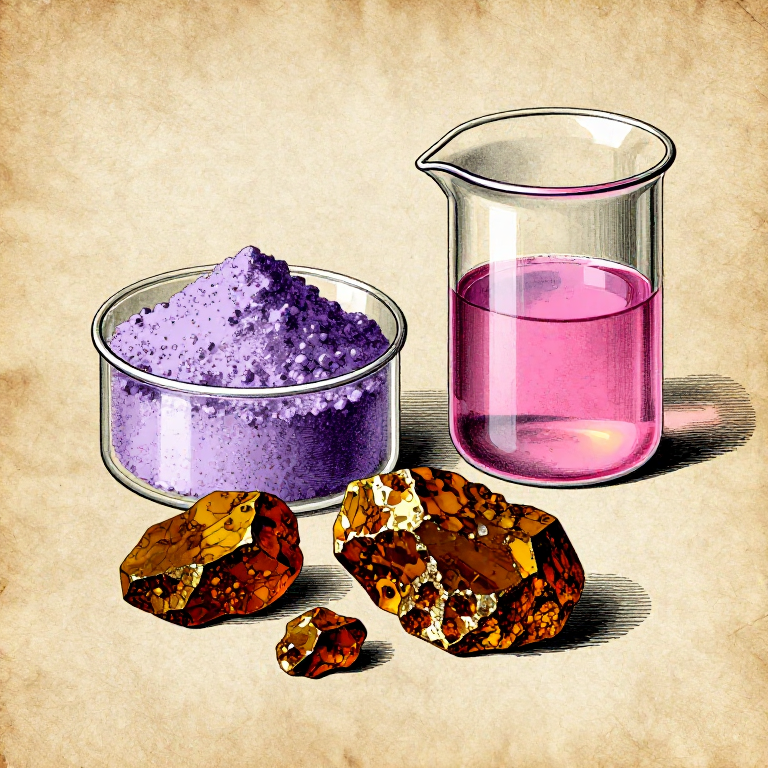
The color of the product reveals its composition. Pure Nd₂O₃ is a striking lilac-blue to pale violet color. Pure La₂O₃ is white. Pr₆O₁₁ (the stable oxide of praseodymium) is black. Your product — a mixture of these with Nd as the dominant colored component after cerium removal — should be a pale lilac to greyish-violet powder, darker or lighter depending on the Nd:La:Pr ratio. Weigh the final product and record the yield. From 50 grams of monazite, expect approximately 15–25 grams of mixed rare earth oxide.

ལག་ཆས་དགོས་མཁོ:

Clay Crucible (refractory)Clay Crucible (refractory)
Crucible Tongs (long-handled)Crucible Tongs (long-handled)
Precision Scale (0.01g)Precision Scale (0.01g)
Leather Gauntlet GlovesLeather Gauntlet Gloves
Safety GogglesSafety Goggles
13

Perform the didymium flame test

Dissolve a small pinch of the rare earth oxide in a few drops of concentrated HCl on a watch glass. Dip a clean platinum or nichrome wire loop into the solution and hold in a gas burner flame. The flame should show a brief pale lilac to lavender coloration — this is the combined emission of Nd and Pr, historically called the 'didymium' flame. It is subtle compared to the vivid flames of sodium (yellow) or strontium (red), but distinctly different from the absent flame color of lanthanum.

For a more dramatic confirmation, the 'borax bead test' is definitive: heat a loop of platinum wire, dip in borax to form a glass bead, then touch to the rare earth oxide and reheat. A borax bead containing neodymium shows a beautiful lilac to violet color in the oxidizing flame and a grey to violet color in the reducing flame. This color — caused by the same f-f transitions visible in solution — was the key diagnostic that led von Welsbach to suspect didymium was actually two elements. Record all observations.

ལག་ཆས་དགོས་མཁོ:

Bunsen BurnerBunsen Burner
Watch GlassWatch Glass
14

Understand the path from oxide to NdFeB magnets

The rare earth oxide you have produced is the starting material for metallic neodymium production — but the final step is industrially demanding. Neodymium metal cannot be reduced from its oxide by carbon or hydrogen (the oxide is too stable). Instead, Nd₂O₃ is dissolved in a molten fluoride salt bath (NdF₃ + LiF) and reduced by electrolysis at approximately 1050 °C, depositing liquid neodymium metal at the cathode. This process is analogous to the Hall-Héroult process for aluminum and requires similar infrastructure.

To make NdFeB magnets, neodymium metal is alloyed with iron and boron (typically 31% Nd, 68% Fe, 1% B by weight), rapidly cooled (melt-spinning or strip-casting), milled to single-domain particle size (~5 μm), aligned in a strong magnetic field, pressed, and sintered at 1050–1100 °C. The aligned Nd₂Fe₁₄B grains create the extraordinary magnetic properties. The entire supply chain — from monazite in beach sand to a magnet in your headphones — passes through rare earth oxide, the material you have just produced. Every NdFeB magnet in the world began as a pile of coloured powder much like yours.

རྫས་རིགས

7

ལག་ཆས་དགོས་མཁོ

21

མཐུད་སྦྲེལ་བིལུ་པིརིན་ཊི་རྫས་རིགས

འབྲེལ་ཡོད་བིལུ་པིརིན་ཊི

བིལུ་པིརིན་ཊི་འདི་ཚུ་ཐབས་ལམ་དང་རྫས་རིགས། སྤྱི་ཆོས་བགོ་བཤའ་བྱེད
CC0 སྤྱི་དབང

བིལུ་པིརིན་ཊི་འདི་CC0 འོག་བཀྲམས་ཡོད། ཁྱེད་རང་གིས་ཆོག་མཆན་མ་བཞེས་པར་ཕབ་ལེན་དང་བཟོ་བཅོས། བགོ་བཤའ། དགོས་མཁོ་གང་ལའང་བཀོལ་སྤྱོད་བྱས་ཆོག

བཟོ་མཁན་ལ་རྒྱབ་སྐྱོར་བྱེད་པའི་ཆེད་ཁོང་ཚོའི་བིལུ་པིརིན་ཊི་བརྒྱུད་ཐོན་སྐྱེད་ཉོ། བཟོ་མཁན་གྱིས བཟོ་མཁན་གྱི་ཁེ་ཕོགས ཚོང་པས་གཏན་འཁེལ་བྱས་པ། ཡང་ན་བིལུ་པིརིན་ཊི་འདིའི་པར་གསར་བཟོས་ཏེ་ཁྱེད་རང་གི་བིལུ་པིརིན་ཊི་ནང་མཐུད་སྦྲེལ་བྱས་ཏེ་ཡོང་སྒོ་བགོ་བཤའ་བྱེད།

གྲོས་བསྡུར

(0)

ནང་འཛུལ གྲོས་བསྡུར་ནང་མཉམ་ཞུགས་ཆེད

བསམ་ཚུལ་ཚུ་ཐོབ་བཞིན...