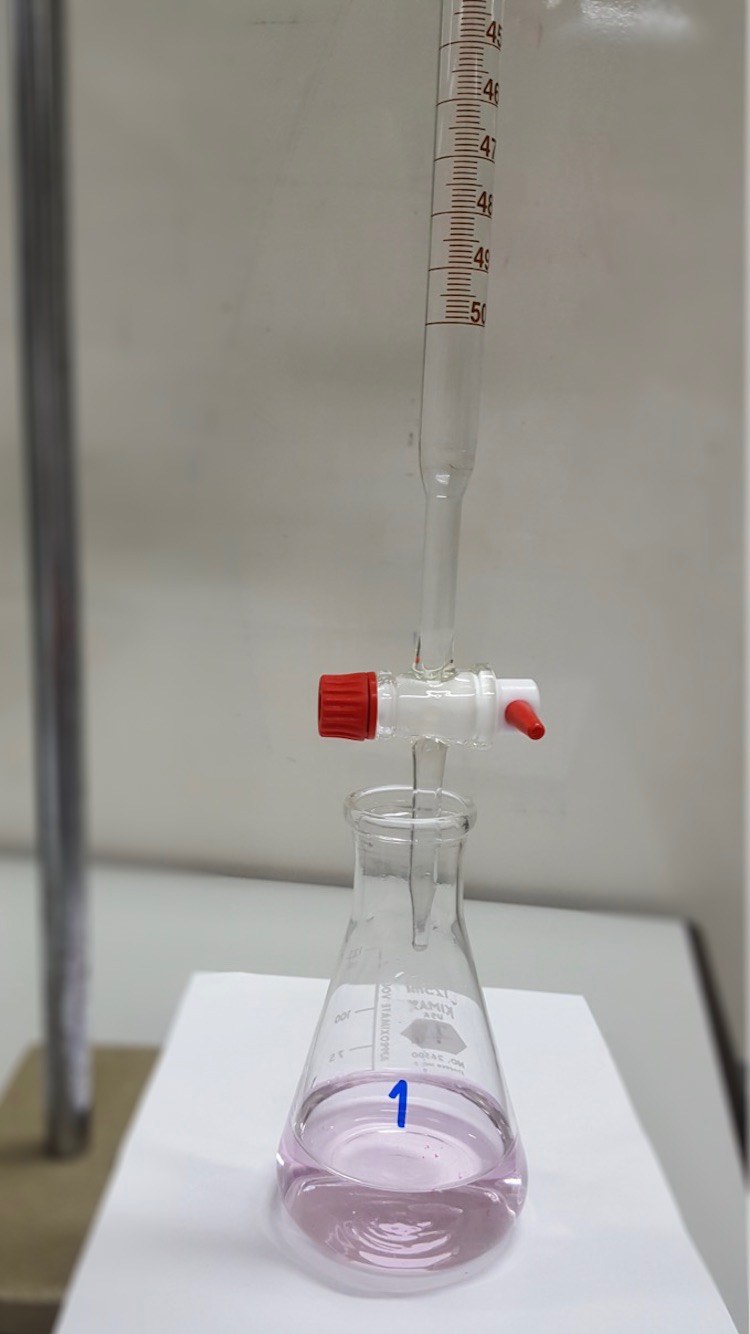


Acid-Base Titration
A bottle of vinegar says 5 %. How would you check?
You cannot weigh the acid out — it is dissolved in water and there is no way to separate it. What you can do is consume it with something you can measure. Add a base of known concentration, drop by drop, until exactly enough has been added to neutralise all the acid present. Read off the volume you used, and the arithmetic gives you the amount of acid that was in the flask.
That is a titration, and it is the oldest quantitative trick in analytical chemistry: measure the unknown by counting out a known.
The whole method turns on knowing when to stop. The equivalence point is the moment the acid is exactly used up — a real chemical event you cannot see. The endpoint is what you actually observe: an indicator changing colour. These are not the same thing, and understanding the gap between them is most of what this blueprint teaches.
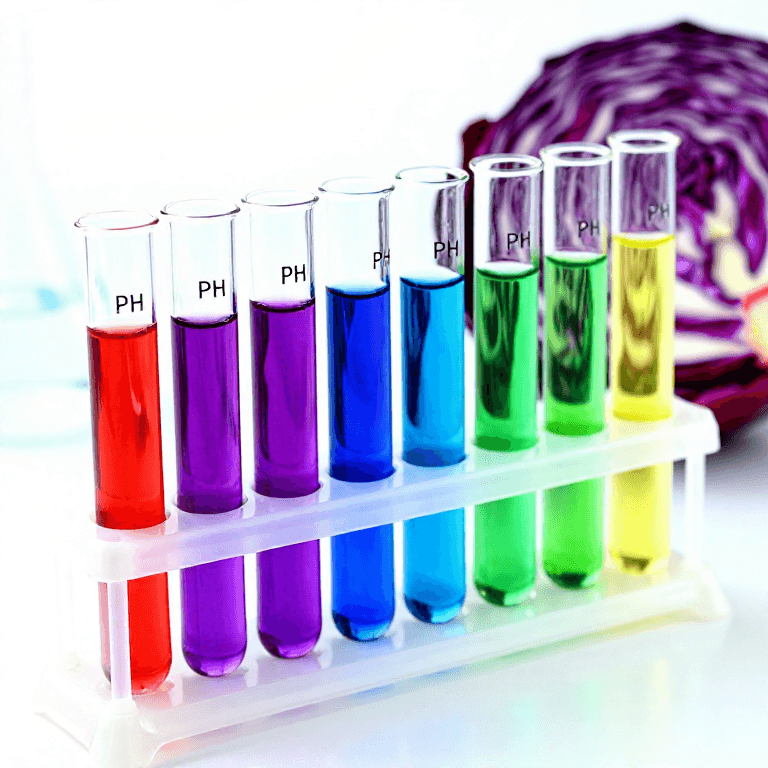
Phenolphthalein is colourless in acid and pink in base, switching around pH 8.2-10. That is deliberately above pH 7 — and for a weak acid like acetic against a strong base, that is exactly right, because the solution at true neutralisation is already alkaline.
Titrate your kitchen vinegar and see whether the label is honest.
说明
Set up the burette properly
Set up the burette properly
Rinse the burette with a little of the sodium hydroxide solution and discard it, then fill.
Run solution through the tap until no air bubble remains in the tip, and bring the level onto the scale.
Read the bottom of the meniscus, at eye level.
A bubble in the tip is the classic hidden error — it comes out during the titration and is counted as delivered volume that never reached the flask.
此步骤所需材料:
 氢氧化钠溶液250 毫升
所需工具:
 滴定管(玻璃)
Measure the sample by pipette, not by burette
Measure the sample by pipette, not by burette
Pipette 25.0 ml of vinegar into a conical flask. Add about 50 ml of water and two drops of phenolphthalein.
The dilution water does not change the answer — it adds no acid and removes none, it only makes the colour change easier to see.
Swirl to mix.
此步骤所需材料:
 清洁用白醋100 毫升
 酚酞指示剂溶液5 毫升
所需工具:
 带刻度移液管(莫尔式)
 锥形瓶
锥形瓶Run a fast rough titration first
Run a fast rough titration first
Add base quickly, swirling, until the flask goes pink and stays pink. Record the volume to the nearest millilitre and discard.
This is deliberately sloppy and deliberately first.
It tells you where the endpoint is, so on every later run you can add fast to within a millilitre or two of it and slow right down — which is the only way to get a precise result without spending an hour per titration.
Titrate to a single drop, three times
Titrate to a single drop, three times
Repeat with a fresh 25.0 ml sample. Add fast to 2 ml below the rough figure, then drop by drop, swirling after each.
Stop at the first faint pink that persists for 30 seconds of swirling.
Repeat until three runs agree within 0.10 ml. Average those three.
A strong pink means you overshot. The endpoint is the first permanent trace of colour, not a convincing one.
所需工具:
 秒表
秒表Do the arithmetic and compare with the label
Do the arithmetic and compare with the label
Moles of base = concentration x average volume in litres. Acetic acid reacts one-to-one with hydroxide, so moles of acid = moles of base.
Multiply by the molar mass of acetic acid, 60.05 g/mol, to get the mass in your 25.0 ml sample, and convert to a percentage.
Compare with the bottle.
Expect to land close to the stated figure but not exactly on it — and the difference is a result, not a failure.
所需工具:
 计算器
计算器Show that the endpoint is not the equivalence point
Show that the endpoint is not the equivalence point
Repeat the titration using a pH meter instead of the indicator, recording pH after every 1 ml and every 0.2 ml near the jump. Plot pH against volume.
Find the steepest part of the curve — that is the equivalence point. Mark where phenolphthalein turned pink.
Expect the equivalence point to sit at a pH above 7, because neutralising a weak acid leaves its conjugate base behind, and expect the indicator's change to fall on the steep section but not exactly on the midpoint.
Choosing an indicator means choosing one whose range lies inside the vertical part of the curve. Methyl orange, which turns in acid, would be badly wrong here.
所需工具:
 pH 计与滴定装置
 坐标纸
坐标纸Compendium — what the numbers really rest on
Compendium — what the numbers really rest on
Sodium hydroxide is a genuinely bad primary standard, and this is the largest hidden error in the whole experiment. Solid NaOH absorbs water from the air, so a "weighed" mass is partly water; and it absorbs carbon dioxide, converting some hydroxide to carbonate. A solution made up by weighing is therefore approximately the concentration on the label. Real analytical work standardises it first by titrating against a substance that can be weighed honestly — potassium hydrogen phthalate is the usual choice, because it is stable, pure and not hygroscopic. Until you have done that, every percentage you calculate inherits the error in the bottle.
Why phenolphthalein and not something else. At the equivalence point of a weak acid against a strong base, the flask contains sodium acetate, and acetate is a weak base — so the solution is alkaline, typically around pH 8-9. An indicator that changes in that region reports the equivalence point closely; one that changes at pH 4 would signal long before the acid was used up. Indicator choice is not aesthetic, it is determined by the shape of the titration curve, which is why step 6 is worth the extra time.
The technique is older than the theory. Volumetric analysis grew through the eighteenth and nineteenth centuries out of practical assaying — testing the strength of bleach, of potash, of indigo dyebaths — long before anyone could explain what an indicator was doing. Karl Friedrich Mohr's mid-nineteenth-century textbook systematised the apparatus and much of the modern burette practice; the word titre comes from the assayer's language of fineness, as in the title of a coin.
What a titration cannot tell you. It measures total titratable acid, not which acid. Vinegar is mostly acetic acid, but any other acid present is counted in and reported as though it were acetic — so the answer is a well-defined quantity that is not quite "the acetic acid content". This is why food labels specify a method: the number depends on how you asked. The same limitation is a virtue elsewhere: total acidity is exactly what a brewer or a winemaker wants, regardless of which acids contribute.
Handling. Sodium hydroxide solution is corrosive — it attacks skin and especially eyes, and it does so without much warning because it feels soapy rather than painful. Goggles throughout, cover skin, and rinse any splash with plenty of running water. Corrosive is not the same as toxic: this blueprint is not age-gated, and lye is a routine material in soapmaking, food preparation and metal conservation. Treat it with the same respect as a hot pan, and clean up spills immediately — dried NaOH is invisible.
已连接蓝图材料

CC0 公共领域
此蓝图以 CC0 协议发布。你可以自由复制、修改、分发和使用此作品,无需征得许可。
通过购买蓝图中的产品支持创客,他们将获得 创客佣金 (由供应商设定),或创建此蓝图的新版本并将其作为连接包含在你自己的蓝图中以分享收入。