艺术
美容与健康
工艺
文化与历史
娱乐
环境
食品与饮料
逆向工程
科学
体育
技术
可穿戴设备
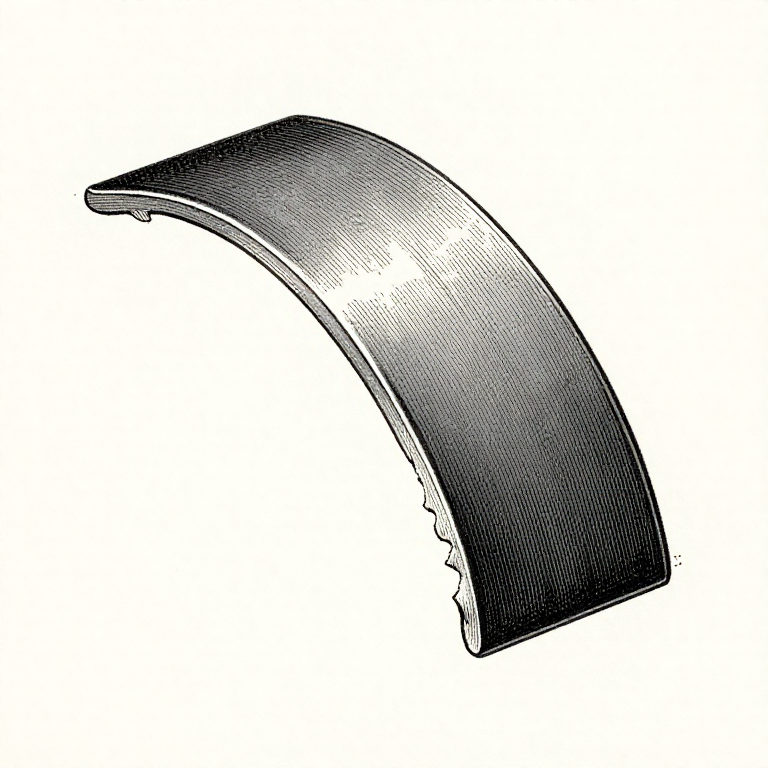


Adhesion: Four Tests, and Three of Them Destroy the Part
A plated part that looks perfect and a plated part that will peel next month are indistinguishable by eye. Adhesion has to be tested, and every worthwhile test destroys the piece it is performed on.
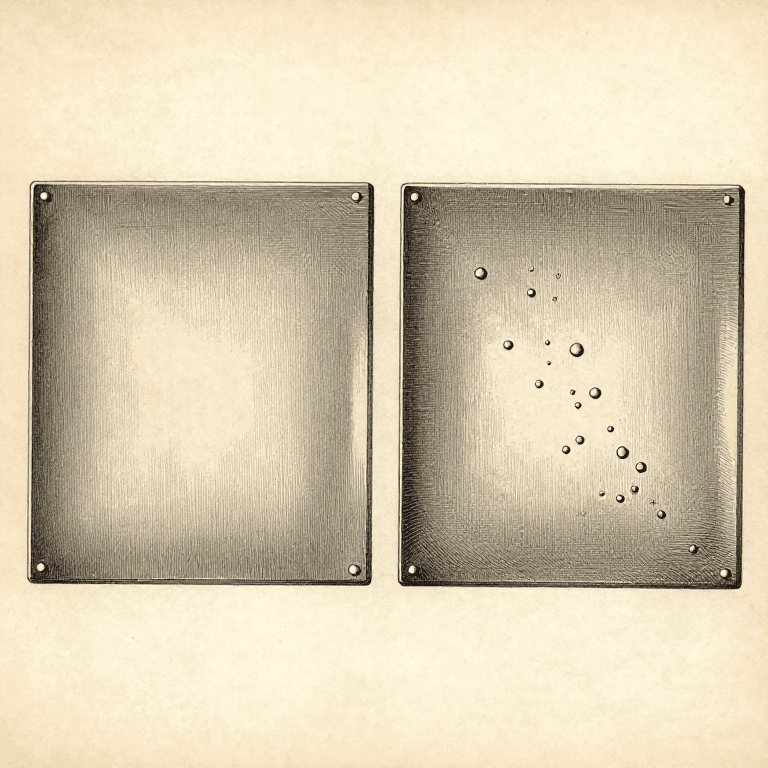
So the standard practice is to plate a **test coupon** alongside the real work, from the same batch, through the same baths, and to destroy that instead. A coupon costs a scrap of steel and answers the only question that matters.
The tests are simple, they need no equipment, and the failure modes each point at a different mistake earlier in the process.
中级
2 hours
说明
1
1
The bend test and the burnish test
The bend test and the burnish test
**The bend test.** Bend the coupon through 180 degrees over a mandrel of a few times its thickness, then examine the outside of the bend under magnification.
A well-adhered coating **cracks with the substrate** — it may craze, but the pieces stay attached, because the coating and the metal are failing together.
A poorly adhered coating **lifts, flakes or peels away from the bend**, often in a sheet. That is a clean separation at the interface, and it means the surface was not clean.
**The burnish test.** Rub a small area briskly with a smooth hard tool — the back of a knife, a burnisher — for fifteen seconds. A well-adhered coating polishes. A poorly adhered one blisters, because the friction works it loose from underneath.
**The file test.** File across the edge of the coupon at 45 degrees, from the substrate towards the coating. A good coating is cut through cleanly; a bad one lifts ahead of the file.
**Look at the WAY it failed.** A coating that lifts in large sheets with a shiny back was on a greasy surface. One that lifts in small flakes with a dull grey back was on an oxidised one. The fracture surface names the cause.
此步骤所需材料:
 低碳钢板2 个
 镍片1 个
镍片1 个所需工具:
 放大目镜
放大目镜2
2
Thermal shock, which finds what the others miss
Thermal shock, which finds what the others miss
**Heat the part and quench it.** The coating and the substrate expand by different amounts, so a sudden temperature change puts a large shear stress directly on the interface — which is exactly what an adhesion test wants to do.
Typical: 150 to 300 C for an hour, depending on the substrate, then straight into cold water. Blistering or peeling afterwards is a fail.
**It is the most searching of the tests**, because it stresses the whole area at once rather than one line, and it finds marginal adhesion that a bend test passes.
**It doubles as the hydrogen bake.** Heating plated high-strength steel to 190 to 220 C for several hours drives dissolved hydrogen out before it can cause delayed brittle fracture, and it must be done within hours of plating. A part that both bakes and survives the quench has answered two questions.
**Do not thermal-shock a part that has been hardened**, unless the temperature is safely below its tempering temperature. The test would ruin the part in a different way.
**Record which test was used** alongside the result. "Passed adhesion" means nothing without it, in the same way that a purity figure means nothing without its method.
此步骤所需材料:
低碳钢板2 个所需工具:
 实验室温度计
 硼硅玻璃烧杯
 耐化学品手套
3
3
Why adhesion fails, in order of likelihood
Why adhesion fails, in order of likelihood
**Contamination.** Oil, grease, a fingerprint, polishing compound, or drag-in from a previous bath. This is the great majority of failures, and the water-break test would have caught it.
**Oxide.** The part was pickled, then stood in air, then plated. A clean steel surface re-oxidises visibly in minutes and invisibly in seconds.
**Passivity.** Some metals — stainless steel, aluminium, titanium, chromium — carry an oxide film that re-forms faster than it can be removed. They need a specific activation step: a **Wood's nickel strike** for stainless, a zincate for aluminium. Plating them directly always fails, however clean they are.
**Interrupted current.** If the current stops mid-plate and then restarts, the surface passivates in the gap and the second layer does not bond to the first. A bath that has lost power is stripped and restarted, not resumed.
**Internal stress.** A highly stressed deposit — bright nickel with too much brightener, or chromium, which is always in tension — pulls itself off a marginal bond. It can peel weeks later with nothing else having changed.
**Dissimilar expansion.** A thick hard coating on a substrate with a very different expansion coefficient, in service across a temperature range.
The first two account for most of it, and both are preparation.
此步骤所需材料:
低碳钢板1 个镍片1 个所需工具:
放大目镜4
4
Stripping and starting again
Stripping and starting again
A failed coating has to come off completely before another can go on, and a partially stripped part plates worse than a bare one.
**Chemical stripping** is the usual route and it is specific to the pair of metals. The requirement is a solution that dissolves the coating and does not attack the substrate — which is exactly the opposite of the plating chemistry, and is why a strip for nickel-on-steel is not a strip for nickel-on-brass.
**Reverse-current stripping** makes the part the anode and dissolves the coating off electrochemically. Controllable, and it stops when the coating is gone if the solution is chosen so the substrate passivates.
**Mechanical stripping** — blasting, grinding — always removes some substrate and changes the dimensions. It is the last resort on a precision part and the first choice on a rough one.
**Then start from the beginning.** A stripped part goes back through mechanical preparation, degreasing and pickling, not straight into the plating tank. The stripping solution is itself contamination.
**Consider whether it is worth it.** Stripping and replating a small part often costs more than the part. The decision is easier with a test coupon, because the failure is discovered on the coupon rather than after the part is assembled into something.
此步骤所需材料:
 10 % 稀盐酸1 个低碳钢板1 个
所需工具:
硼硅玻璃烧杯 可调式台式电源耐化学品手套
 化学防溅护目镜
相关蓝图
这些蓝图共享知识——技术、材料或原理


CC0 公共领域
此蓝图以 CC0 协议发布。你可以自由复制、修改、分发和使用此作品,无需征得许可。
通过购买蓝图中的产品支持创客,他们将获得 创客佣金 (由供应商设定),或创建此蓝图的新版本并将其作为连接包含在你自己的蓝图中以分享收入。