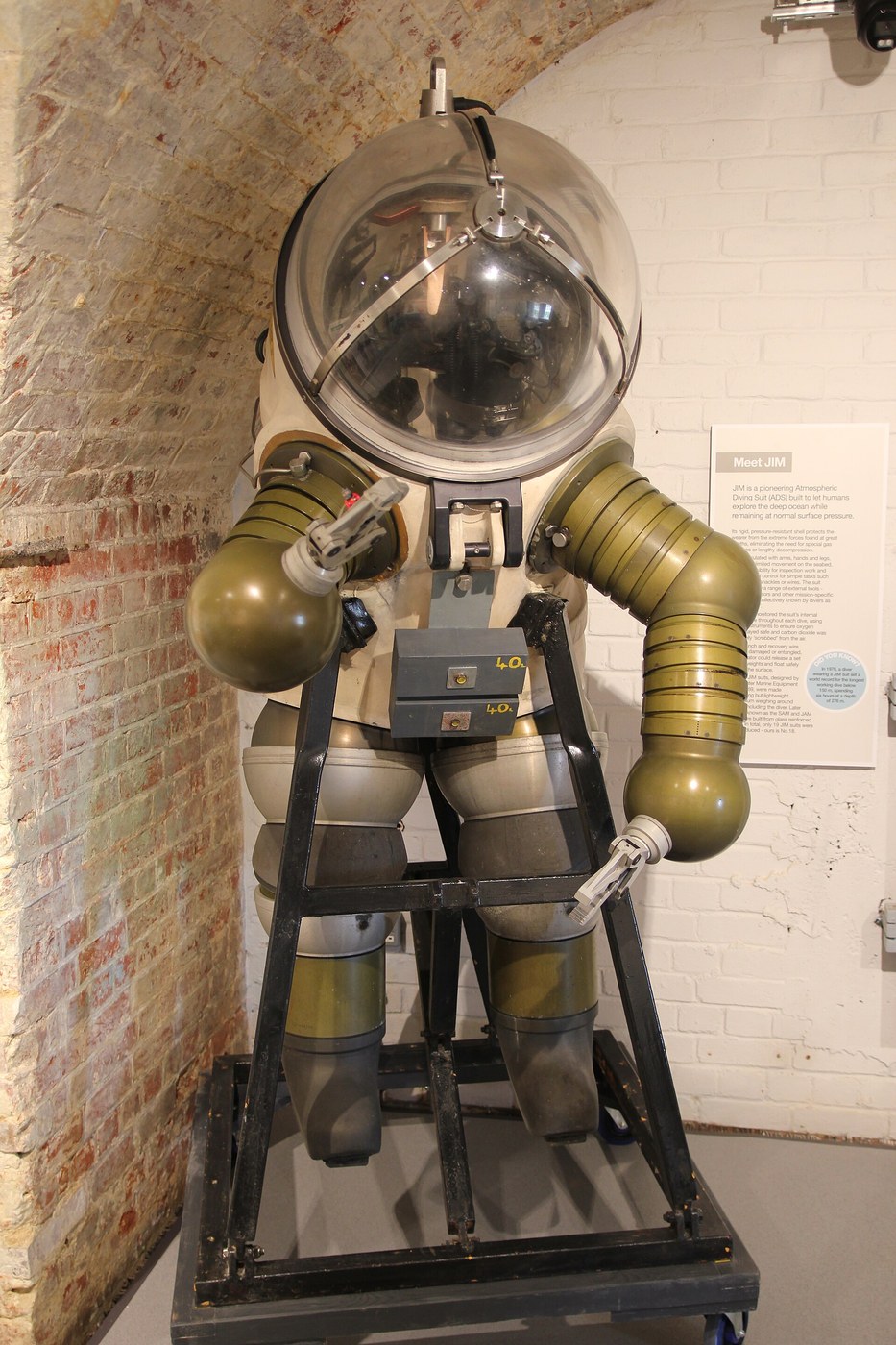


The Atmospheric Diving Suit
说明
Compare the two philosophies on one chart
Compare the two philosophies on one chart
所需工具:
 台式电脑
台式电脑Why an ordinary joint seizes under pressure
Why an ordinary joint seizes under pressure
Build the naive version and watch the sea defeat it.
- Make a simple rotating joint: two tubes with an O-ring seal between them, free to turn.
- Turn it in air and note the torque needed.
- Now pressurise the outside of the joint in a test vessel and try to turn it again.
- Increase the pressure in steps, measuring the torque each time.
Torque rises steeply with pressure, because the pressure is squeezing the seal harder against its running surface AND pressing the joint faces together. By a few tens of bar an ordinary joint cannot be turned by a human at all.
Now compute the force involved: at 600 m the pressure is about 61 bar, and on a joint 100 mm across that is roughly 4.8 tonnes trying to close it. The operator has to move an elbow against that, using human muscle, all day.
This is the entire engineering problem of the atmospheric diving suit, and it is why early rigid suits from the 1920s were nearly useless — the operator could reach the bottom in perfect physiological safety and then could not bend an arm to do anything once there.此步骤所需材料:
 铝圆棒1 个
 O 形圈组合套件1 套件
 透明压力容器(有认证)1 个
所需工具:
 金属车床
金属车床 扭力扳手
扭力扳手 压力表
压力表 30 加仑空气压缩机
 面屏
面屏The fluid-supported rotary joint
The fluid-supported rotary joint
The fix is to stop the pressure from ever bearing on the sliding surface.
- Rebuild the joint with an oil-filled annular chamber between the two halves, sealed from the sea by a flexible diaphragm.
- The diaphragm lets sea pressure act on the OIL rather than on the bearing.
- Because the oil is at sea pressure on both sides of the bearing, the net force across the bearing is near zero.
- Pressurise and measure torque again.
Torque now stays nearly constant as pressure rises, because the joint is pressure-BALANCED — the load is carried by the oil, not by the sliding faces.
This is the same reasoning as the SF6 breaker shaft seal and the rocket turbopump's purged interspace: put a fluid between the two things that must not meet, and keep it at a pressure that cancels the load. The catalogue has now met that pattern three times in three unrelated domains.
Modern ADS joints such as the JIM and Newtsuit families use exactly this, with the joint segments cut at compound angles so a chain of simple rotations produces a natural-looking bend. The arm does not have an elbow; it has a stack of rotating rings that together behave like one.此步骤所需材料:
铝圆棒1 个 食品级矿物油1 升O 形圈组合套件1 套件
 橡胶板1 张
所需工具:
金属车床 4 英寸铣床虎钳扭力扳手压力表面屏
Life support, and the CO2 that matters more than oxygen
Life support, and the CO2 that matters more than oxygen
Follow the loop, and note which sensor is primary. The operator is not going to run out of oxygen — a small cylinder lasts many hours. What runs out is the scrubber's ability to absorb carbon dioxide, and rising CO2 is far more dangerous because the body's alarm for it is unreliable at depth.
Breathlessness is triggered by CO2 in normal circumstances, but in a closed loop with adequate oxygen the warning is muted — the classic pattern is a headache, then poor judgement, then nothing.
Reverse-engineering note: an ADS carries 48 hours or more of reserve for a dive of a few hours, because the failure mode is being stuck rather than being flooded. The suit is designed so a trapped operator survives long enough to be recovered — and like the bathyscaphe, releasing ballast makes it float, so the default failure is upward.Flow
此步骤所需材料:
 碱石灰(二氧化碳吸收剂)1 公斤
 二氧化碳传感模块(NDIR)1 个
 氧传感器电解池1 个
所需工具:
台式电脑 实验室级数字万用表
 焊台
焊台Where the ADS wins, and where it does not
Where the ADS wins, and where it does not
Close the batch by placing every method on one axis.
- Tabulate: helmet diving, scuba, saturation diving, ADS, and a remotely operated vehicle.
- For each, record depth limit, decompression obligation, dexterity, endurance and cost.
- Mark which task each one wins.
The ADS gives depth and zero decompression and takes away dexterity. Manipulators are clumsy compared with a gloved hand, so delicate work still goes to a saturation diver who can feel what they are doing — at the cost of weeks of their life per job.
And the honest end of the story: for most deep work, the winning answer removed the human entirely. An ROV has no decompression, no life support, no fatigue and no limit but its tether, and modern ones have manipulators approaching a diver's usefulness.
That is the same move this session keeps finding. The turbojet deleted the propeller, staging deleted the exponential, nuclear power deleted the need to breathe, and the ROV deleted the diver. Optimising within a constraint has a ceiling; removing the constraint does not. The ADS is the last and cleverest answer to the question of how to put a person very deep — and the question itself turned out to be optional.所需工具:
台式电脑材料
8- 1 个占位符
- 1 套件占位符
- 1 个占位符
- 1 升占位符
- 1 张占位符
- 1 公斤占位符
- 占位符
- 1 个占位符
相关蓝图
这些蓝图共享知识——技术、材料或原理


CC0 公共领域
此蓝图以 CC0 协议发布。你可以自由复制、修改、分发和使用此作品,无需征得许可。
通过购买蓝图中的产品支持创客,他们将获得 创客佣金 (由供应商设定),或创建此蓝图的新版本并将其作为连接包含在你自己的蓝图中以分享收入。