

Turret Milling Head
A milling machine with a fixed head can only present its cutter one way. Every angled feature then requires the work to be moved and re-clamped — and every re-clamping is a fresh chance to lose the reference you spent the morning establishing.
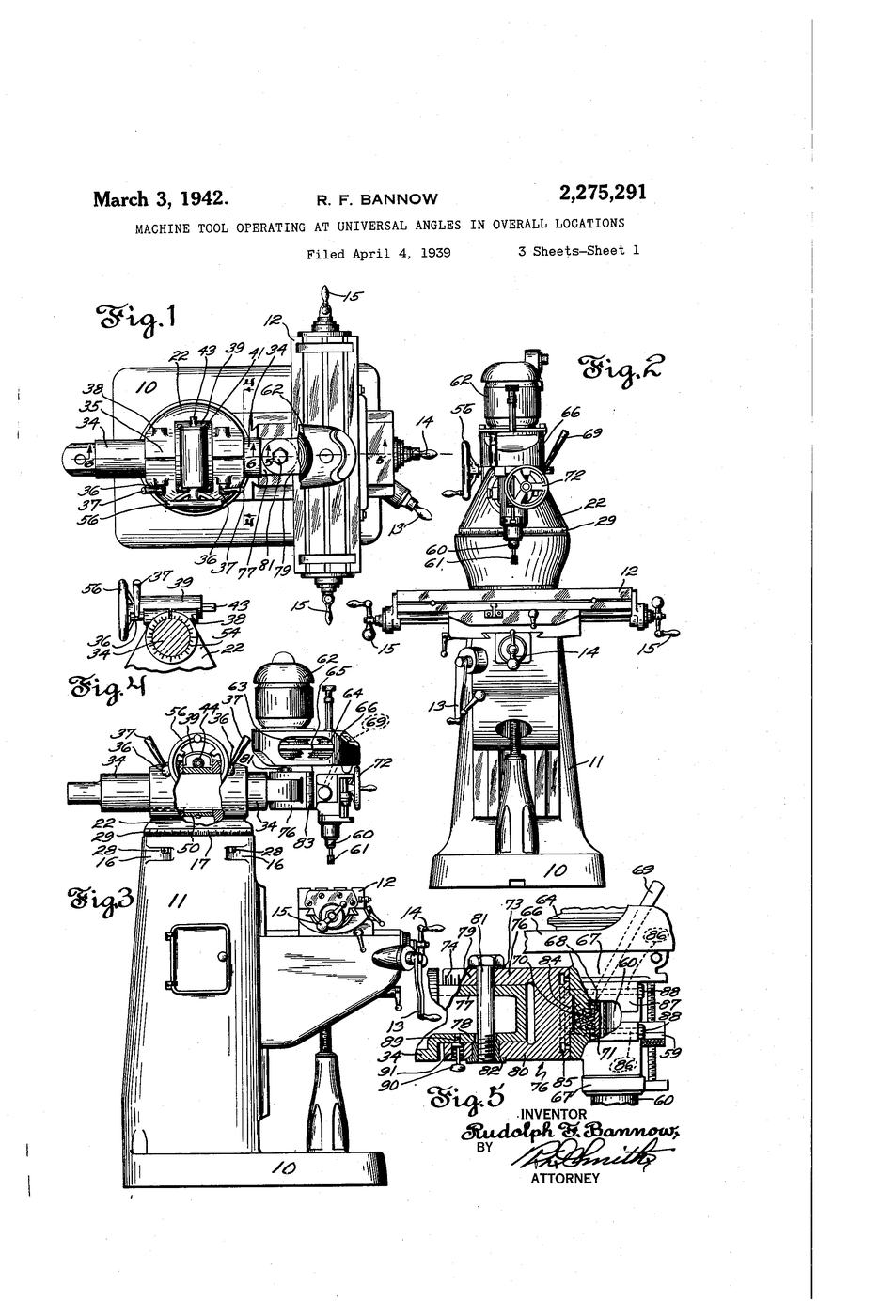
US 2,275,291, “Machine Tool Operating at Universal Angles in Overall Locations”, Rudolph F. Bannow of Bridgeport, Connecticut. Filed 4 April 1939, granted 3 March 1942. An overarm slides and rotates on a swivelling turret, and the head tilts on it, so the cutter can be brought to the work “at any desired angular inclination” and reach the far ends of a long workpiece without moving it at all.
Bannow conceived the improvement in 1936; the machine was first built in 1938, the patent was applied for in 1939, and it issued in 1942. The result — the ram-and-turret vertical knee mill — became so standard that “a Bridgeport” is still how machinists name the type, whoever built it.
说明
Count the freedoms you need
Count the freedoms you need
Write down what a cutter must be able to do: reach anywhere in X, Y and Z, and arrive at any angle. That is six freedoms, and a fixed head offers three.
Build the column
Build the column
Glue a 300 mm plywood upright to a plywood base. This is the column, and it must be square to the base — check it.
此步骤所需材料:
 波罗的海桦木胶合板1 张
 木工胶20 毫升
所需工具:
 机工角尺
机工角尺Add the turret
Add the turret
Screw a plywood disc to the top of the column with a single machine screw so it rotates. That is the turret.
此步骤所需材料:
波罗的海桦木胶合板1 张 #6-32 机螺钉1 个
所需工具:
 手工刀
手工刀Add the ram
Add the ram
Cut a 200 mm plywood arm and fit it so it slides in and out across the turret. That is the overarm, or ram.
此步骤所需材料:
波罗的海桦木胶合板1 张所需工具:
 直尺手工刀
直尺手工刀Hang the head on a pivot
Hang the head on a pivot
Pivot a small block on the end of the ram with a screw so it tilts. Mark a dowel stub in it as the spindle.
此步骤所需材料:
波罗的海桦木胶合板1 张 木榫条1 个#6-32 机螺钉1 个
Mark a protractor scale on the head pivot
Mark a protractor scale on the head pivot
Draw a degree scale around the head pivot with the protractor, zero at vertical.
此步骤所需材料:
 卡纸1 张
卡纸1 张所需工具:
 量角器
量角器 油性记号笔
油性记号笔Reach the four corners of a long part
Reach the four corners of a long part
Lay a 250 mm bar on the base. Reach the spindle to each end using only ram and turret — the workpiece never moves.
此步骤所需材料:
 低碳钢方钢1 个
Try the same with the ram locked
Try the same with the ram locked
Lock the ram and turret and try again. Now the part must be re-clamped to reach the far end. Count the re-clampings.
此步骤所需材料:
 坐标纸1 张
Set a 30° compound angle
Set a 30° compound angle
Swivel the turret 20° and tilt the head 30°. Record both settings. Two rotations compose into one arbitrary approach direction.
此步骤所需材料:
坐标纸1 张所需工具:
量角器Return to zero and check repeatability
Return to zero and check repeatability
Return both to zero and check the spindle against the square. Any error is what a real machine calls tramming, and it must be re-checked after every head move.
所需工具:
机工角尺Tram a real head with an indicator
Tram a real head with an indicator
On the benchtop mill, sweep the dial indicator in a circle across the table and record the readings at four points. Equal readings mean the spindle is square to the table.
此步骤所需材料:
坐标纸1 张所需工具:
 小型铣床(台式)
 百分表
百分表Clamp work in the milling vise
Clamp work in the milling vise
Set the milling vise on the table and indicate its fixed jaw parallel to the table travel. A swivelling head is worthless above a crooked vise.
所需工具:
 4 英寸铣床虎钳百分表
Write down the trade-off
Write down the trade-off
List what the ram-and-turret buys (reach, angles, small footprint) against what it costs (rigidity, and re-tramming after every move). Heavy cuts still go on fixed-bed machines.
此步骤所需材料:
坐标纸1 张History & Context
History & Context
US 2,275,291, “Machine Tool Operating at Universal Angles in Overall Locations”, Rudolph F. Bannow, Bridgeport, Connecticut. Filed 4 April 1939, granted 3 March 1942. The claims cover a two-section articulated support — an overarm that both slides longitudinally and rotates, carried on a swivelling turret head, with worm-and-wheel angular adjustment — so a cutter can work on “extreme end portions of a long piece of work” without repositioning it.
The dates, in order. Bannow (1897-1962) conceived the improvement in 1936. He and Magnus Wahlstrom, both Swedish immigrants, had founded Bridgeport Machines in 1929 and were already selling a high-speed milling attachment. The complete knee-and-column vertical mill was first built in 1938; the patent was applied for in 1939 and issued in 1942. Sources that give a single date for “the Bridgeport” are picking one of four.
Why it took over the world's small shops. One machine of modest size and cost could drill, bore, face, slot and cut at compound angles — work that previously needed several dedicated machines or a horizontal mill and a lot of setup skill. For a jobbing shop that never makes the same thing twice, flexibility beats rigidity, and this machine is the flexible one.
What it cost. Everything that swivels can be out of square. A Bridgeport-type head must be trammed, and re-trammed after any head movement — steps 10 and 11 are that discipline. Production shops cutting one part in quantity still choose fixed-bed machines, which cannot be angled and do not need to be checked.
The direct line to CNC. Fit the knee mill's three lead screws with servo motors and you have the first generation of small CNC machining centres — which is exactly what happened in the 1970s, often to second-hand Bridgeports converted in place. The machine in this blueprint is the immediate ancestor of the desktop CNC mill, and its geometry is still visible in them.
材料
7- 1 张占位符
- 20 毫升占位符
- 1 个占位符
- 1 个占位符
- 1 张占位符
- 1 个占位符
- 1 张占位符

相关蓝图
这些蓝图共享知识——技术、材料或原理


CC0 公共领域
此蓝图以 CC0 协议发布。你可以自由复制、修改、分发和使用此作品,无需征得许可。
通过购买蓝图中的产品支持创客,他们将获得 创客佣金 (由供应商设定),或创建此蓝图的新版本并将其作为连接包含在你自己的蓝图中以分享收入。