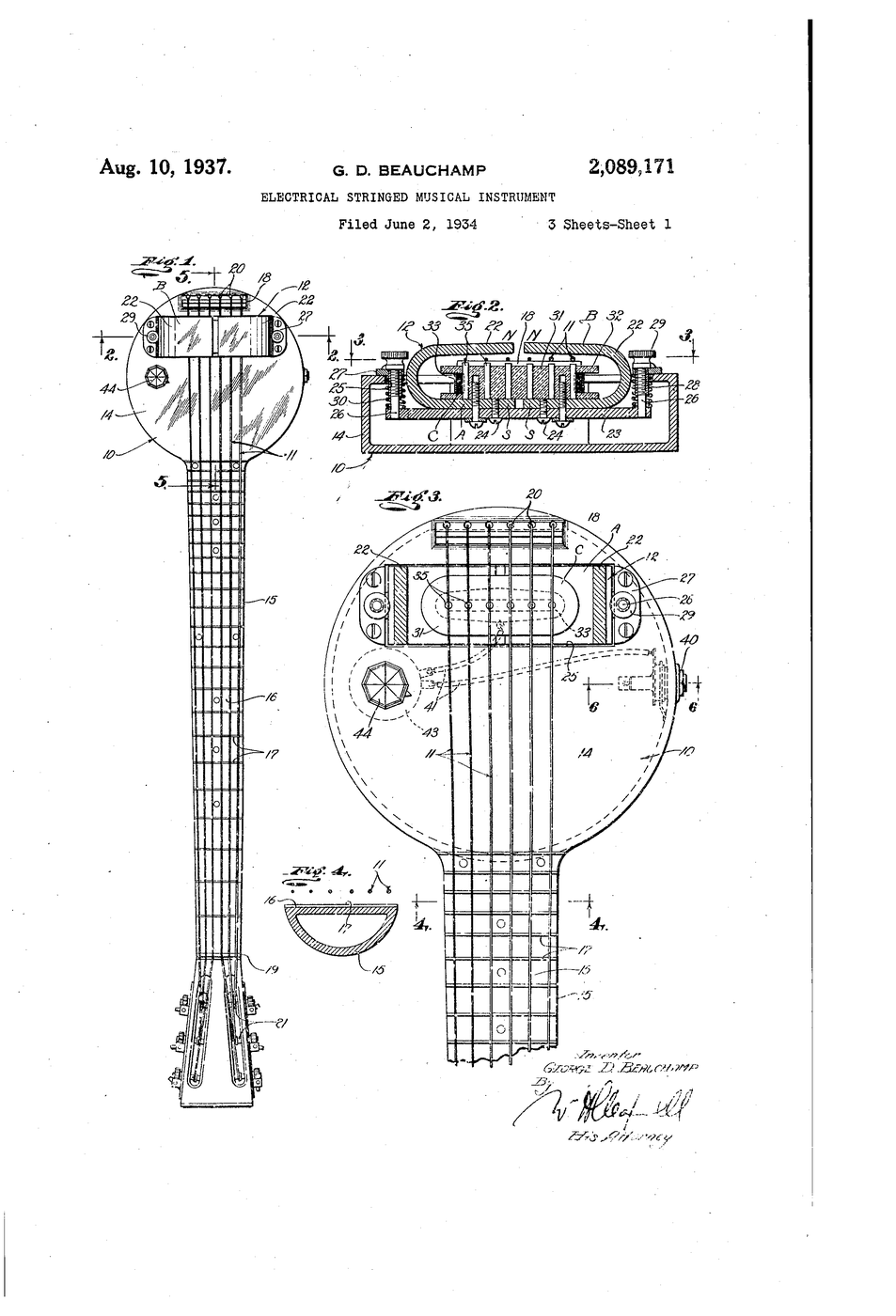


Electric Guitar Pickup
An acoustic guitar is quiet because a string is a bad loudspeaker — it is thin, so it barely disturbs the air. The body exists to fix that: the string drives the bridge, the bridge drives a large soundboard, and the soundboard moves enough air to be heard. Every gain in volume comes from that box, and in a dance band with brass in it, the box is still not enough.
Beauchamp's pickup abandons air completely. Put a magnet under a steel string and the string becomes part of a magnetic circuit. Vibrate it and the circuit's reluctance varies; a coil around the magnet turns that variation straight into an electrical signal. The string is read directly, and everything after it is amplification.
Then the body becomes unnecessary — and that is the radical part. The patent says so outright: no resonance box, no soundboard, so the instrument can be cheap metal.
US Patent 2,089,171, "Electrical stringed musical instrument", filed 2 June 1934 and granted 10 August 1937 to George D. Beauchamp.
说明
Read US 2,089,171 and note what is not needed
Read US 2,089,171 and note what is not needed
Beauchamp states the instrument requires no resonance box or soundboard. The pickup does not amplify the guitar — it replaces the reason the guitar had a body.
Stretch a steel string over a plain plank
Stretch a steel string over a plain plank
Fix a steel string between two bolts on a board, with a nut and bridge to define its length. Pluck it. It is almost inaudible — that is the problem.
此步骤所需材料:
 波罗的海桦木胶合板1 张
Rest the bridge on a thin sheet and pluck again
Rest the bridge on a thin sheet and pluck again
Let the bridge bear on a large thin panel. Volume jumps. That is the acoustic solution, and the whole reason guitars are hollow.
Wind the coil
Wind the coil
Wind a few thousand turns of fine enamelled wire onto a small bobbin. It is tedious and it must be neat — crossing turns cause shorts and dead spots.
此步骤所需材料:
 漆包铜线1 卷
所需工具:
 平口钳
平口钳Measure the coil before going further
Measure the coil before going further
A few kilohms of DC resistance means the winding is continuous. Open circuit means a break, and it is always at the fragile start or finish lead.
所需工具:
 数字万用表——自动量程、真有效值
Fit the magnet through the bobbin
Fit the magnet through the bobbin
Pass a magnet through the coil so its pole faces the string. Magnet and coil must share one magnetic path — a coil beside a magnet does nothing useful.
Mount it a few millimetres under the string
Mount it a few millimetres under the string
Set the assembly close beneath the string without touching. The string must be steel — a nylon string is invisible to it.
Amplify the coil and pluck
Amplify the coil and pluck
Run the coil into an amplifier and speaker, then pluck. The note comes out loud while the string itself stays quiet — you are hearing the string read, not heard.
所需工具:
 微型扬声器 8 欧 2 瓦
Remove the magnet and try again
Remove the magnet and try again
Take the magnet out, leaving the coil. Silence. The magnet is not there to attract anything — without it there is no field to vary, so there is no signal.
Change the height and listen
Change the height and listen
Raise and lower the pickup. Closer is louder, up to the point where the magnet's pull starts fighting the string and the note goes sour. Find that limit.
Move it along the string
Move it along the string
Slide the pickup from the bridge toward the middle. Near the bridge it is thin and bright; near the centre it is fat and round. Position selects harmonics, because it samples a different part of the standing wave.
Pluck sideways, then downward
Pluck sideways, then downward
Compare horizontal and vertical plucks. The patent notes the difference: motion toward and away from the pole gives more fundamental, motion across gives more harmonics.
Damp the board and confirm nothing changes
Damp the board and confirm nothing changes
Clamp the plank to a bench to kill its resonance. The amplified sound barely alters. The body genuinely is not part of the signal path.
Hold the coil near a mains adapter
Hold the coil near a mains adapter
Bring it close to a transformer and hear the hum. A coil picks up any changing magnetic field, not only your string — the permanent weakness of the design.
History & Context — the patent does not say Rickenbacker
History & Context — the patent does not say Rickenbacker
The patent. US 2,089,171, "Electrical stringed musical instrument", filed 2 June 1934 and granted 10 August 1937.
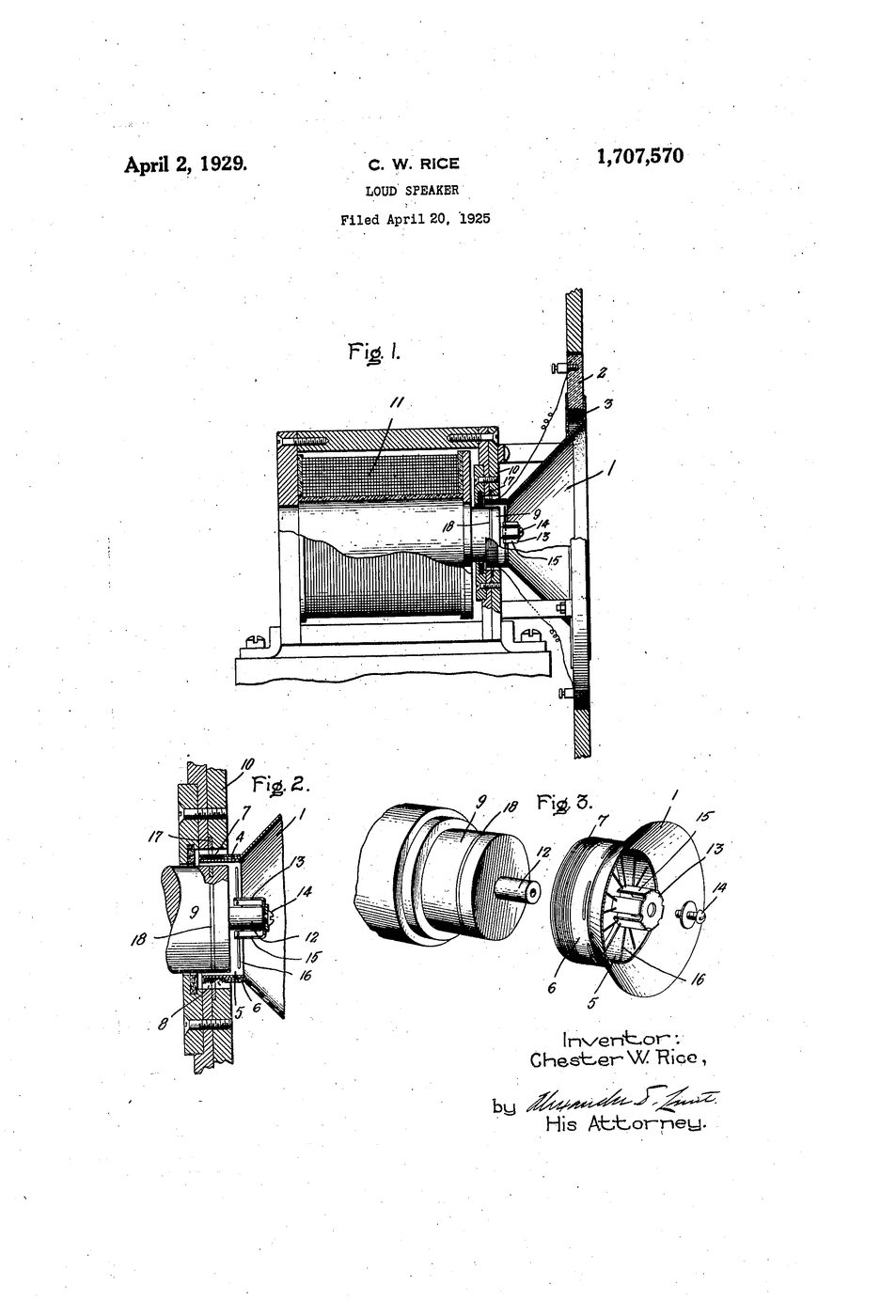
🔴 The inventor named is George D. Beauchamp. The instrument this patent covers is universally called the Rickenbacker Frying Pan, and the company that made it was Rickenbacker — but Adolph Rickenbacker was the manufacturing partner, not the inventor. Beauchamp, a musician who had earlier co-founded National with the Dopyera brothers to make resonator guitars, is the one who worked out the pickup and is the one on the document. The brand name has almost entirely displaced his. This is the second case in as many batches of a famous instrument whose patent names a different person than the story does — the Rice loudspeaker is the other — and both are corrected the same way: read the inventor field.
Three years from filing to grant, and that delay mattered. The patent office was reportedly slow to accept that an electrical device could be a musical instrument at all. By the time it issued in 1937 the market already had competitors, and the patent was never the commercial fortress it might have been. The instrument itself — a cast aluminium lap steel with a long neck and a round body, hence the nickname — had been on sale since about 1932.
Why the solid body follows logically. Once the pickup reads the string directly, the body's acoustic job disappears, and step 13 shows this concretely. What the body then has to do is the opposite: stay still. A resonant hollow body fed back into an amplifier howls, which is why early electrified archtops were awkward at volume and why solid bodies took over. Beauchamp's patent states the consequence — no resonance box needed, so build it in cheap metal — a decade before Fender and Gibson made solid-body guitars ordinary.
What it changed about music. Guitars had been rhythm instruments in big bands because they could not compete with brass. A guitar that is as loud as the amplifier allows can carry a melody, and then a solo, and then a whole genre. Everything else the electric guitar became — sustain, overdrive, feedback used deliberately, effects — follows from the signal being electrical before it is ever sound. The hum in step 14 is part of that bargain too, and is why humbucking pickups, which cancel it with a second reversed coil, were invented twenty years later.

CC0 公共领域
此蓝图以 CC0 协议发布。你可以自由复制、修改、分发和使用此作品,无需征得许可。
通过购买蓝图中的产品支持创客,他们将获得 创客佣金 (由供应商设定),或创建此蓝图的新版本并将其作为连接包含在你自己的蓝图中以分享收入。