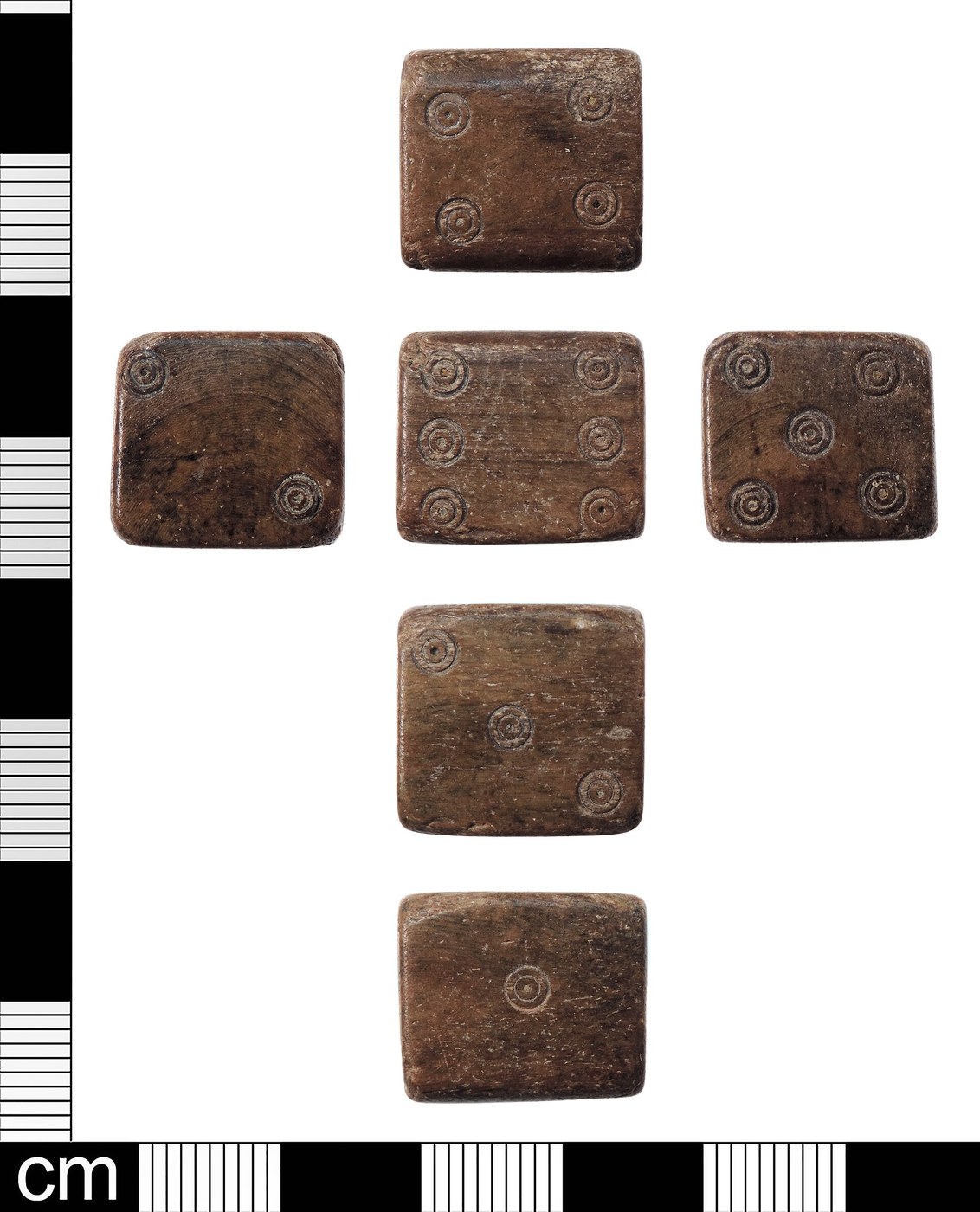


Bone Dice
Long before anyone cut a cube, people threw ankle bones. The astragalus of a sheep or a goat is a small blocky bone that lands on one of four faces and cannot stand on the other two — a four-sided die, ready made, four to a carcass.
The cube came later, and it came from the same workshop: a length of long-bone shaft, sawn into a block, squared up, and drilled with ring-and-dot pips. Bone is dense, easy to work with simple tools, and takes a drilled pip cleanly.
Make both. The astragalus teaches you why ancient dice were not fair and why nobody minded; the cut cube teaches you how much work fairness actually takes.
说明
Get bone from a butcher
Get bone from a butcher
Ask a butcher for beef or lamb shank bone, and for ankle bones if you want astragali. This is food-chain material, not anything gathered from the wild.
此步骤所需材料:
 牛骨2 个
牛骨2 个Simmer the bone clean
Simmer the bone clean
Simmer the bones for two hours, then scrape off all tissue. Every scrap of soft tissue left behind will smell, permanently.
Degrease for several days
Degrease for several days
Soak the cleaned bone in warm water with a little washing-up liquid for three to five days, changing the water daily. Bone is full of fat, and undegreased bone yellows and goes rancid within a year.
Dry it slowly
Dry it slowly
Dry the bone in the air for a week. Forced heat drives cracks along the shaft that only show up once you start cutting.
Set the astragali aside as they are
Set the astragali aside as they are
Clean four ankle bones and do nothing else to them. They already roll on four faces — flat, concave, convex and sinuous — and land on those only.
Record how the astragalus actually falls
Record how the astragalus actually falls
Throw one astragalus a hundred times and tally the faces. The four results are not equally likely — the broad faces come up far more often than the narrow ones. Write your numbers down before reading any book that tells you the answer.
Assign the historical values
Assign the historical values
Mark the four faces 1, 3, 4 and 6, the values used in antiquity. The two missing numbers are the two faces the bone cannot land on — which is why 2 and 5 are absent.
Saw a block from the shaft
Saw a block from the shaft
For the cubic die, saw a section from the thick wall of a long bone and cut it roughly square, about 12 mm on a side. Work the densest wall, not the spongy end.
所需工具:
 手锯
手锯Wear a mask while filing
Wear a mask while filing
File and sand with a dust mask on and, if you can, wet the bone. Bone dust is an irritant and there is no reason to breathe it.
所需工具:
 N95 防颗粒物口罩
File the block square
File the block square
File each face flat, checking opposite faces with a caliper as you go. Aim for all three dimensions within a few tenths of a millimetre — this is the entire difference between a die and a lump.
所需工具:
 什锦锉套装
什锦锉套装Lay out the pips so opposite faces total seven
Lay out the pips so opposite faces total seven
Mark the pips with 1 opposite 6, 2 opposite 5, 3 opposite 4. That convention is ancient and near-universal, and it makes a wrongly marked die obvious at a glance.
Drill ring-and-dot pips
Drill ring-and-dot pips
Drill a shallow dot at each pip, then cut a fine ring around it with the point of a knife or a small centre bit. Ring-and-dot is the standard ancient pip and it is a decorative motif across bone working generally.
Drill every pip to the same depth
Drill every pip to the same depth
Keep the pips shallow and equal. Deep pips remove real mass, and a six-face with six deep pips is lighter than the one-face opposite it — the oldest way to bias a die by accident.
Blacken the pips
Blacken the pips
Rub soot, ash or dark pigment into the pips and wipe the surface clean. The pips have to read instantly across a table.
Polish and test the die
Polish and test the die
Polish the faces smooth, then throw it 120 times and tally. Any face turning up far more than about 20 times suggests a bias — usually a face that is not flat or a pip pattern that took too much material.
Compare the two dice you made
Compare the two dice you made
Put your astragalus tallies next to your cube tallies. One is wildly uneven and needed no work; the other is nearly even and took hours of filing. That trade is the entire history of the die in one comparison.
History & Context
History & Context
Astragaloi and tali. The earliest dice were unmodified ankle bones of sheep, goats, pigs or deer — astragalos in Greek, talus in Latin, and knucklebones in English, despite the bone being in the ankle rather than the hand. The bone is a rough rounded rectangle and lands on one of four long faces, conventionally valued 1, 3, 4 and 6.
The Romans knew the odds were uneven. They recognised that the four faces of a talus do not fall with equal probability, gave each face its own name, and scored them accordingly. Throws had names too: the Venus throw, four tali all showing different faces, was the best result; the Dog, all four alike, was the worst. This is scoring built deliberately around a known asymmetry rather than in ignorance of it.
And they also cheated. Natural knucklebones were sometimes cut down, ground, drilled and filled with lead. Loaded dice are as old as dice.
The cube is the engineered version. Making a cubical die means squaring six faces and marking them so no face loses more mass than another — real work, for one purpose: to make each outcome as close to equally likely as a craftsman can manage. Surviving Roman dice are often visibly irregular, so ancient fairness was an aim rather than an achievement.
Opposite faces sum to seven. The convention appears very early and persists to this day. It is not required by anything — it is a checking rule, and it survives because it works.
CC0 公共领域
此蓝图以 CC0 协议发布。你可以自由复制、修改、分发和使用此作品,无需征得许可。
通过购买蓝图中的产品支持创客,他们将获得 创客佣金 (由供应商设定),或创建此蓝图的新版本并将其作为连接包含在你自己的蓝图中以分享收入。