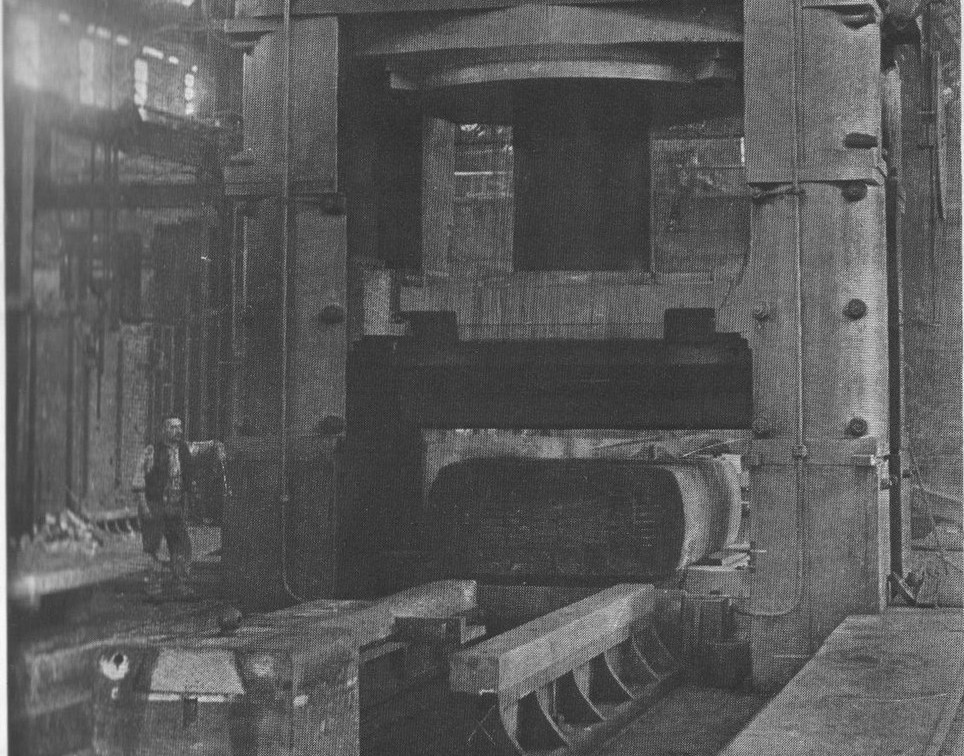


Hydraulic Press
A lever multiplies force by trading distance for it, and its ratio is fixed by its length. To press with a hundred tonnes you would need a lever, and a building to hold it, of absurd size.
Bramah's press does the same trade through a liquid. Pressure in a confined fluid is the same everywhere — Pascal's principle, known for a century and a half before anyone made a machine of it. So a small piston pushing hard on a small area creates a pressure, and that pressure acting on a large area produces a proportionally larger force.
The arithmetic is the entire machine: F₂ = F₁ × (A₂/A₁). A 10 mm pump piston driving a 200 mm ram gives an area ratio of 400:1. Lean on the lever with 200 N and the ram delivers 80,000 N — eight tonnes.
Nothing is free: the ram moves 1/400th of the distance the pump piston travels, so you pump many times for a short stroke. Force multiplied, distance divided, work conserved. It is a lever whose arms are areas instead of lengths, and whose "beam" is a pipe that can be routed anywhere.
Joseph Bramah, British patent 2045, "Obtaining and Applying Motive Power", 31 March 1795.
⚠ The press did not work at first, and the reason it eventually did belongs to someone else — see the history step.
说明
Measure the two areas
Measure the two areas
Take two syringes of clearly different size — say 5 ml and 50 ml. Measure the bore diameter of each with a caliper.
Compute areas: A = π d² / 4.
Compute the ratio A₂/A₁. This single number predicts everything the machine will do, so write it down before testing anything.
此步骤所需材料:
 注射器套装1 套
所需工具:
 6 英寸数显卡尺
Connect them and purge the air
Connect them and purge the air
Join the two syringes with tubing and fill the whole circuit with water, working every bubble out.
Air is the enemy and this is not a detail. Air compresses; water essentially does not. A bubble absorbs your stroke as squash instead of passing it on, so the press feels spongy and delivers a fraction of its force.
Every hydraulic system ever built has a bleed procedure for this reason.
此步骤所需材料:
 硅胶管1 m
 蒸馏水200 毫升
Measure the force multiplication
Measure the force multiplication
Stand the large syringe upright and put a kitchen scale under its plunger. Press the small syringe with a known force — rest a known mass on it.
Read the force at the large syringe.
Compare against your predicted ratio from step 1. Expect agreement within perhaps 10–20% — the shortfall is seal friction, which is the real-world tax on every hydraulic machine and the thing Bramah could not solve on his own.
所需工具:
 数字厨房秤
数字厨房秤Measure the distance you paid
Measure the distance you paid
Mark both plungers. Push the small one a measured 50 mm and measure how far the large one moved.
Expect it to be 50 mm ÷ (A₂/A₁).
Multiply force × distance at each end. The two products should be roughly equal. You did not create energy — you changed its terms. That is worth doing deliberately, because it is the point people most often miss about hydraulics.
Find where the force actually leaks away
Find where the force actually leaks away
Repeat step 3 with the plungers dry, then lightly greased.
Expect the greased version to deliver measurably more force for the same input.
The difference is seal friction, and it scales with pressure — the harder you press, the harder the seal is squeezed against the bore. A press that is efficient at low pressure can be poor at high pressure, which is exactly the problem the leather cup seal and later the O-ring were invented to solve.
History & Context
History & Context
The patent. British patent 2045, "Obtaining and Applying Motive Power", Joseph Bramah, 31 March 1795. Pascal had stated the principle in 1653; Bramah built the machine.
It leaked, and Henry Maudslay fixed it. The first presses could not hold pressure — the packing round the ram was forced out by the very pressure it was containing. Bramah's employee Henry Maudslay devised the self-tightening leather cup seal: a leather cup facing the pressure, so that the harder the fluid pushes, the harder the seal is pressed against the bore. The pressure seals its own container. Without that, patent 2045 is a good idea that does not work, and Maudslay's name belongs beside Bramah's — he went on to become one of the foundational machine-tool builders in his own right.
Self-energising sealing is the idea that outlived the press. The leather cup, the modern lip seal, the O-ring in its groove and the piston ring in a bore all work the same way: geometry that converts the pressure being sealed into the force doing the sealing.
Where it went. Bramah's press made possible forging, baling, and — with Armstrong's accumulator half a century later — the hydraulic power networks that worked dock cranes, swing bridges and theatre lifts across Victorian cities. Central hydraulic mains were a real municipal utility, in London until 1977.
The honest limitation. A hydraulic press is slow and its stroke is short, because of step 4. It is the wrong machine wherever speed or travel matter, and the right one wherever force does — which is why presses are hydraulic and lathes are not.
此蓝图制作
CC0 公共领域
此蓝图以 CC0 协议发布。你可以自由复制、修改、分发和使用此作品,无需征得许可。
通过购买蓝图中的产品支持创客,他们将获得 创客佣金 (由供应商设定),或创建此蓝图的新版本并将其作为连接包含在你自己的蓝图中以分享收入。