
Absorption Refrigerator
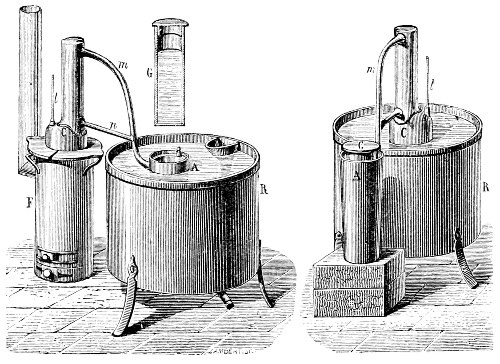
Every refrigerator in this batch so far needs a compressor — a pump, a motor, moving parts, electricity. Carré's machine makes cold with a flame and no moving parts at all.
The insight is that a compressor only exists to do one job: take low-pressure vapour and deliver it at high pressure. A chemical process can do the same job, if you pick two substances with a strong affinity for each other.
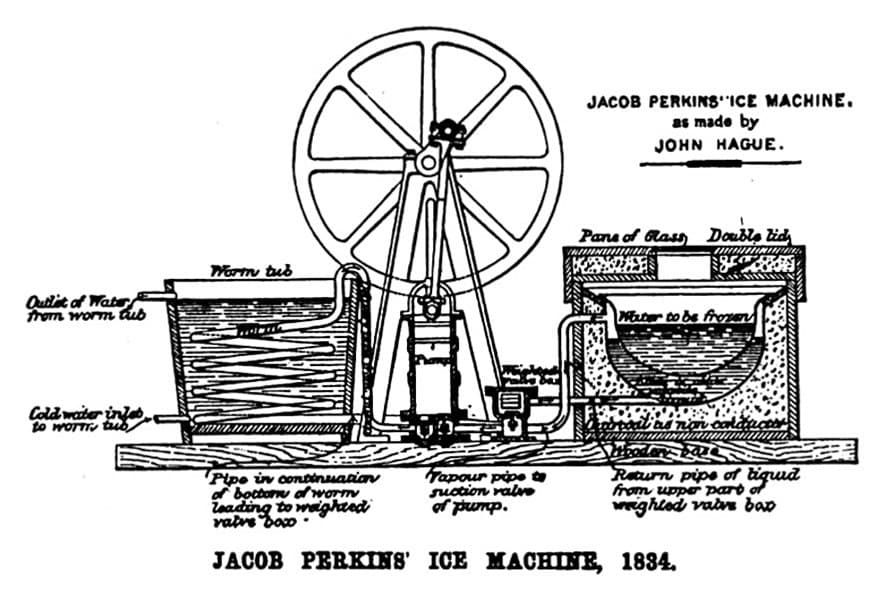
Ammonia dissolves in water enthusiastically. So the vapour leaving the evaporator is not compressed — it is absorbed into water, which swallows it and drops the pressure just as a suction stroke would. A pump then moves that liquid solution, which costs almost nothing because liquids are nearly incompressible. In the generator, heat drives the ammonia back out of the water at high pressure, and from there the cycle is identical to Perkins': condense, expand, evaporate.
So the compressor is replaced by an absorber, a solution pump and a generator — and the energy input changes from work to heat. That is the whole trade: more components, lower efficiency, but it will run on a gas flame, a paraffin wick, waste heat from an engine, or sunlight.
Ferdinand Carré, French patent 1859, US patent 1860, using ammonia as refrigerant and water as absorbent. ⚠ We have not pinned the US patent number to a document; the dates and mechanism are well attested, the number is not cited here.
说明
Feel a gas being swallowed by a liquid
Feel a gas being swallowed by a liquid
Fill a syringe with carbonated water, seal the tip, and pull the plunger. Gas comes out of solution. Push, and it goes back in.
Now do it with cloudy ammonia solution and a little headspace, outdoors or with the window wide open, and note how eagerly the vapour is taken up.
That eagerness is the whole machine. A liquid that will drink a gas can lower the pressure above that gas — which is the only thing a suction stroke actually does.
Household ammonia is an irritant. Work in moving air, never mix it with bleach.
此步骤所需材料:
 家用氨水250 毫升
所需工具:
 注射器套装
注射器套装Measure the heat that absorption releases
Measure the heat that absorption releases
Put a thermometer in water and stir in ammonia solution, logging the temperature.
Expect it to rise.
Absorption is exothermic — dissolving the vapour gives heat back out. That is why a real machine has a separate absorber that must be cooled, and why an absorption fridge is warm in two places rather than one.
Note the consequence now: heat comes IN at the generator and goes OUT at both the condenser and the absorber. Three heat exchanges, not two.
所需工具:
 温度计
温度计Drive the gas back out with heat
Drive the gas back out with heat
Warm the ammonia solution gently and watch vapour come off; smell the difference in the headspace above it as it heats.
Expect the solution to give up its dissolved gas as temperature rises — the reverse of step 1.
This is the generator, and it is where the energy actually enters the machine. Heat separates the pair; the affinity that made absorption easy is exactly what the flame must overcome.
Stop as soon as you have seen it. This step is about the direction of the process, not about collecting anything.
Work out why the pump is nearly free
Work out why the pump is nearly free
Compare two efforts: compress a syringe full of air, then try to compress one full of water with the tip sealed.
The air squashes. The water refuses.
Now note which one the two machines have to move. Perkins' compressor raises the pressure of a vapour, which takes real work. Carré's solution pump raises the pressure of a liquid, which takes very little, because there is nothing to squash — you are only pushing it along.
The energy did not vanish; it moved to the flame. Carré traded expensive mechanical work for cheap heat.
Find the honest cost of running on heat
Find the honest cost of running on heat
Look up or measure the efficiency of a gas-powered absorption fridge — a caravan or hotel minibar unit — against a compressor fridge of similar size.
Expect the absorption unit to move well under half as much heat per unit of energy in.
It is genuinely less efficient, and no arrangement of the components fixes that.
It wins anyway wherever it is chosen, because it is silent, has nothing to wear out, and will run on energy that is free or already wasted. Efficiency is only decisive when the energy has to be bought.
History & Context
History & Context
The patents. Ferdinand Carré patented the ammonia-water absorption machine in France in 1859 and in the United States in 1860. ⚠ The US number is not pinned here — the record for 1860s French inventors is thin and we would rather cite nothing than cite wrongly. His brother Edmond Carré had built an earlier absorption machine in 1850 using water and sulphuric acid; Ferdinand's contribution was the pairing that actually worked at scale.
It went to sea. In 1876 a Carré machine was installed in the ship Paraguay, which carried frozen meat across the Atlantic. That is the beginning of something enormous: the moment food production stopped having to happen near the people eating it.
The American Civil War made it. The Union blockade cut the Confederacy off from Northern natural ice, and Carré machines were imported to make ice locally. A refrigeration technology found its first large market because a war removed the cheaper alternative — the same economics that had kept Cullen's discovery idle for eighty years, running in reverse.
Where it is still the right answer. The Einstein-Szilárd refrigerator of 1926 is an absorption machine, patented by exactly the Einstein you are thinking of, and designed with no moving parts after a Berlin family died from a leaking seal on a compressor fridge. Today: caravan and boat fridges running on bottled gas, hotel minibars that must be silent, off-grid vaccine refrigerators on paraffin or solar heat, and enormous industrial chillers driven by waste heat from power stations, where the fuel has already been paid for.
Honest limits. Low efficiency, as step 5 shows. It is slow to start and dislikes being tilted, because the circulation depends on gravity and on liquids staying where they were designed to sit — which is why a caravan fridge must be level. And ammonia is toxic and corrodes copper, so these machines are built in steel and treated with respect.

CC0 公共领域
此蓝图以 CC0 协议发布。你可以自由复制、修改、分发和使用此作品,无需征得许可。
通过购买蓝图中的产品支持创客,他们将获得 创客佣金 (由供应商设定),或创建此蓝图的新版本并将其作为连接包含在你自己的蓝图中以分享收入。