艺术
美容与健康
工艺
文化与历史
娱乐
环境
食品与饮料
逆向工程
科学
体育
技术
可穿戴设备


Knowing When To Stop: Finding the Peak That Says Full
The sealed cell of rung 1 solved the gas. It did not solve the question that comes straight after it: how does the charger know when to stop?
A sealed nickel cell will accept current indefinitely. Past full it simply turns that current into heat, quietly, until the seal or the separator gives up. It has no fuel gauge, and the only outward sign that it is full is a fall in terminal voltage of a few millivolts — perhaps one part in a hundred.
This rung builds the circuit that finds that signal, in the form David Pacholok patented in 1991: not by differentiating anything, but by racing the battery against a lagging copy of itself. Then it adds the two backstops that make the difference between a clever circuit and a charger you would leave running.
高级
About 4 hours
说明
1
1
Read the claim: three ways to stop, not one
Read the claim: three ways to stop, not one
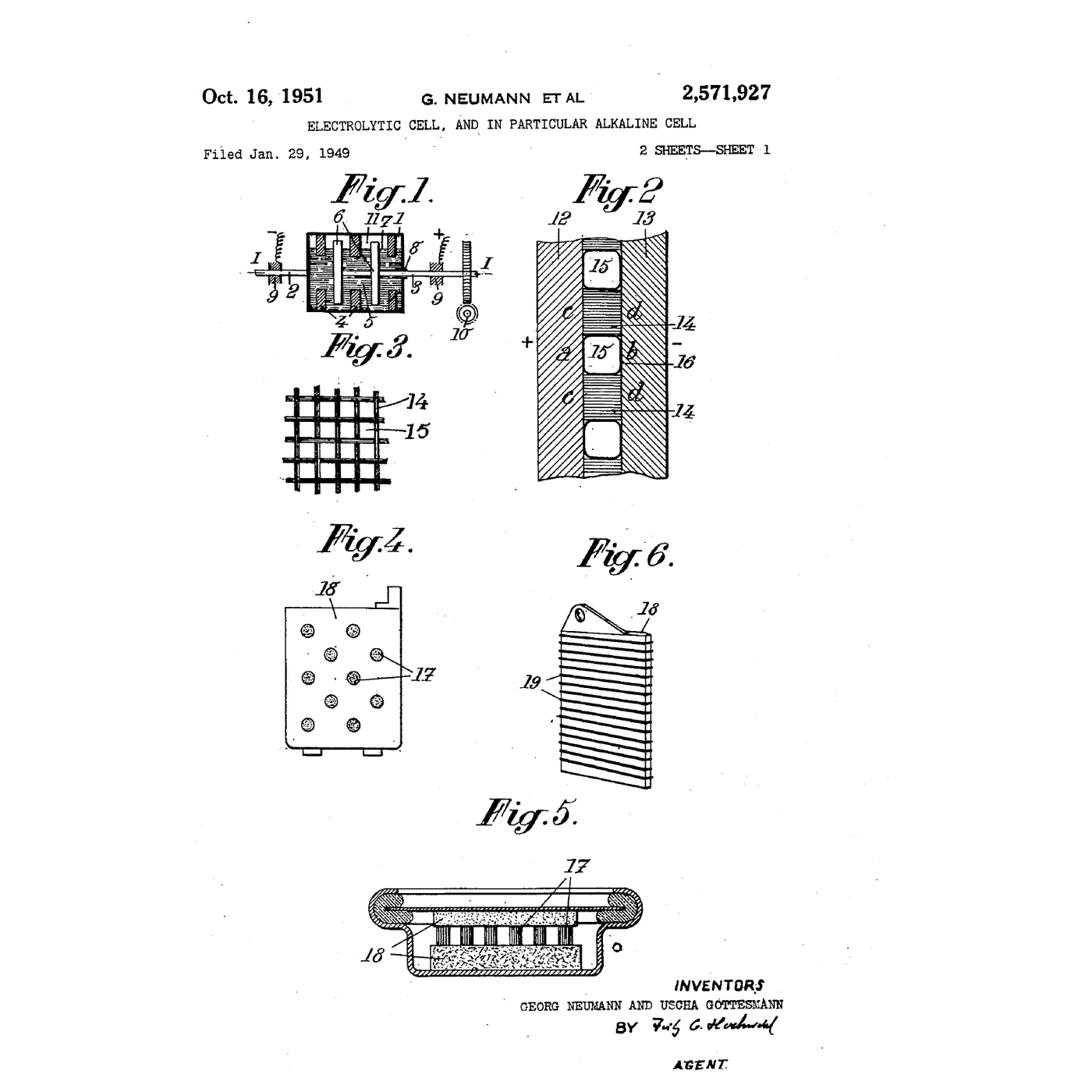
**US 5,196,780**, David R. Pacholok, filed **10 September 1991**, granted **23 March 1993**, expired. The figure on this page is its own sheet 1: FIG. 1 is the voltage-against-time curve with the peak marked, and FIG. 2 is the block diagram — FAST CHARGE and SLOW CHARGE blocks, the RC network into a comparator, and, along the bottom, **TH** and **TIMER**.
Write out the three terminations before you build anything, because the arrangement is the invention, not any one of them:
1. **−ΔV**, detected by a capacitor charged through a resistor from the battery terminal. The capacitor lags. When it *overtakes* the battery voltage, the battery must have turned over. No differentiator, no noise problem.
2. **A timer**, about eighteen minutes on fast charge. If the voltage signal never arrives, the charge still ends.
3. **A thermostat**, set between **40 °C and 60 °C**, on the cells themselves. If they get hot for any reason at all, the charge ends.
Then note what happens after termination: the circuit does not switch off, it drops to a **slow charge** that replaces self-discharge without overcharging. A charger that simply stops leaves you with a pack that is flat again by Thursday.
Sources for this one are clean and the number is verified. Where a later rung says a number could not be pinned, that is a statement about that rung, not a habit.
2
2
See the peak on a real cell before you try to detect it
See the peak on a real cell before you try to detect it
You cannot sensibly build a detector for a signal you have never seen. Log the signal first.
Put one discharged NiMH cell in a holder. Set the bench supply to constant current at **1C** — 2 A for a 2,000 mAh cell — with the voltage limit at 1.8 V so a bad connection cannot produce a surprise. Tape the thermocouple to the can.
Log terminal voltage to **four digits** and can temperature every minute. Four digits is not fussiness: the whole signal you are looking for is about 10 mV, so a three-digit meter reading 1.48 V cannot see it at all.
Expect, over roughly an hour:
- a quick rise in the first minutes as the cell polarises;
- a long, slowly-rising middle;
- a **peak**, then a fall of the order of 5–15 mV for a single cell;
- **temperature climbing sharply** from about the same moment.
Stop at the peak, or at 45 °C, whichever comes first. Mark on your log where the peak was and how many millivolts the fall was. That is the number your circuit has to resolve, and in a twelve-cell pack it is twelve times larger, which is why −ΔV termination works far better on a pack than on a single cell.
此步骤所需材料:
 镍氢电池1 个
所需工具:
 台式电源
台式电源 数字万用表——自动量程、真有效值
 K 型热电偶配 MAX6675 模块
 电池座
电池座 鳄鱼夹测试线
 秒表
秒表 实验记录本(带复写页)
 透明安全眼镜
3
3
Build the lagging copy
Build the lagging copy
Now build Pacholok's detector on the breadboard. It is four parts.
1. **The RC.** A resistor from the battery terminal into a capacitor to ground. Pick R and C so that R×C is the time constant you chose in step 4 — 470 kΩ with 470 µF gives about 220 seconds, near four minutes. Use a film or a low-leakage electrolytic; a leaky capacitor is a second resistor you did not plan for and it will hold the copy down permanently.
2. **The comparator.** An LM393, battery voltage on one input and the capacitor on the other. Its output flips the moment the capacitor wins.
3. **A little hysteresis.** A high-value resistor from the output back to the non-inverting input, a megohm or so, so the output snaps over instead of chattering across the crossing. Without it you will trip repeatedly on millivolt noise.
4. **The switch.** The comparator output drives the gate of the logic-level MOSFET, which carries the charge current. Logic-level matters: an ordinary MOSFET will not turn fully on from a 5 V gate and will dissipate the difference as heat.
Test it without a battery first. Put the function generator on the input with a very slow triangle — a few minutes per cycle, one or two volts peak to peak — and check that the output flips shortly after each apex and not before. A signal generator that you can turn around at will is a far better test than a cell that turns over once an hour.
Then put your logged cell curve in front of it for real. Watch the capacitor voltage on one scope channel and the cell on the other; the crossing is visible and it is the whole point of the circuit.
此步骤所需材料:
 1/4 瓦电阻套件1 个
 电容套件1 个
 连接导线1 个
所需工具:
 面包板
面包板 Dupont 跳线套装(公对母)
 LM393 双比较器集成电路
 IRLZ44N 逻辑电平 MOSFET
 10 千欧线性电位器
 数字示波器
数字示波器 函数发生器数字万用表——自动量程、真有效值
 带烙铁的焊台
 尖头镊子
尖头镊子 剥线钳
剥线钳4
4
Choosing the time constant, and why three detectors beat one
Choosing the time constant, and why three detectors beat one
正在加载 Jupyter 笔记本…
5
5
Add the two backstops
Add the two backstops
A −ΔV detector on its own is a circuit that can fail silently, and the failure mode is a charge that never ends. Add the other two.
**The thermostat.** Use the pack's own thermistor if you have the TH pin from rung 3, or a 10 kΩ NTC taped to the cell. Put it in a divider with a fixed resistor and feed the junction into the second half of the LM393; set the reference with the potentiometer so the comparator trips at about **45 °C**. Calibrate it, do not assume it: warm the thermistor with the heat gun on its lowest setting while watching the infrared thermometer, and adjust until the trip lands where you want it. Wire this comparator's output so it can cut the MOSFET gate **regardless** of what the −ΔV half is saying.
**The timer.** The 555 in monostable mode with a long RC gives you Pacholok's eighteen minutes. Work R and C out for your own charge rate rather than copying his: eighteen minutes is right for the rate his charger used, and a timer set for the wrong rate is worse than none because it will cut short every good charge.
Now test each one **alone**. Disconnect the −ΔV half and prove the thermostat stops the charge. Disconnect the thermostat and prove the timer does. A redundancy you have never tested individually is not redundancy, it is three circuits and a hope.
Finally, add the slow-charge path: a resistor that keeps a trickle flowing after termination, at something like C/40. Measure it with the meter and check it against the cell's own self-discharge rate.
此步骤所需材料:
1/4 瓦电阻套件1 个电容套件1 个镍氢电池1 个所需工具:
面包板Dupont 跳线套装(公对母)LM393 双比较器集成电路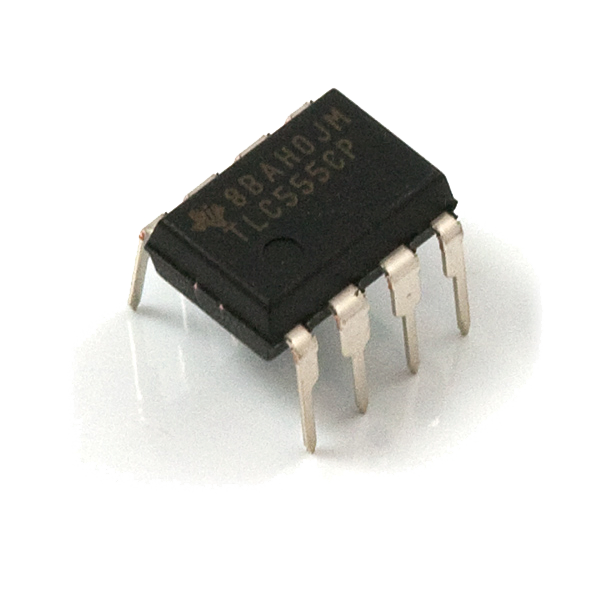 555 Timer
 NTC 热敏电阻套件10 千欧线性电位器IRLZ44N 逻辑电平 MOSFET
 热风枪
热风枪 红外测温仪数字万用表——自动量程、真有效值数字示波器透明安全眼镜
6
6
History and context
History and context
**Attribution.** US 5,196,780, David R. Pacholok, filed 10 September 1991, granted 23 March 1993, expired. The drawing on this page is the patent's own.
**Why 1991 and not 1961.** The −ΔV effect was understood long before this patent; cell makers had been describing it in application notes for years. What was missing was a way to detect a few millivolts of *fall* on a signal riding on more than a volt, cheaply enough to put in a consumer charger, without a microcontroller. The RC-lag trick is the answer to the 'cheaply enough' part, and it is a genuinely elegant one — it replaces a differentiator, which amplifies noise, with a delay, which suppresses it.
**What it changed for makers.** Before reliable termination, the safe charge rate was C/10 overnight, because the recombination cycle could absorb that indefinitely. After it, fast charging became ordinary, and a fast charger is what makes a two-pack workflow work: one in the tool, one on the charger, and no waiting. Rung 3's pack and this rung's charger only make sense together.
**Honest limits.** −ΔV is a nickel-chemistry signal and it does not exist in lithium-ion, whose voltage only ever rises; lithium cells terminate on constant-current to constant-voltage and then on falling current, a different method entirely. −ΔV also gets harder as a pack ages, because the peak flattens, and it is nearly unusable on a single cell for the reason step 2 gives. And the whole scheme is built on the assumption that the cells in a pack reach full together — which, as rung 7 shows, they do not.
所需工具
22- 占位符
- 占位符
- 占位符
- 实验记录本(带复写页)10% 佣金占位符
- 占位符
- 占位符
- 占位符
- 带烙铁的焊台10% 佣金占位符
- 占位符
- 占位符
- 占位符
- 1 vendor sell this, none ship to you yet占位符
- 占位符
相关蓝图
这些蓝图共享知识——技术、材料或原理


CC0 公共领域
此蓝图以 CC0 协议发布。你可以自由复制、修改、分发和使用此作品,无需征得许可。
通过购买蓝图中的产品支持创客,他们将获得 创客佣金 (由供应商设定),或创建此蓝图的新版本并将其作为连接包含在你自己的蓝图中以分享收入。