艺术
美容与健康
工艺
文化与历史
娱乐
环境
食品与饮料
逆向工程
科学
体育
技术
可穿戴设备
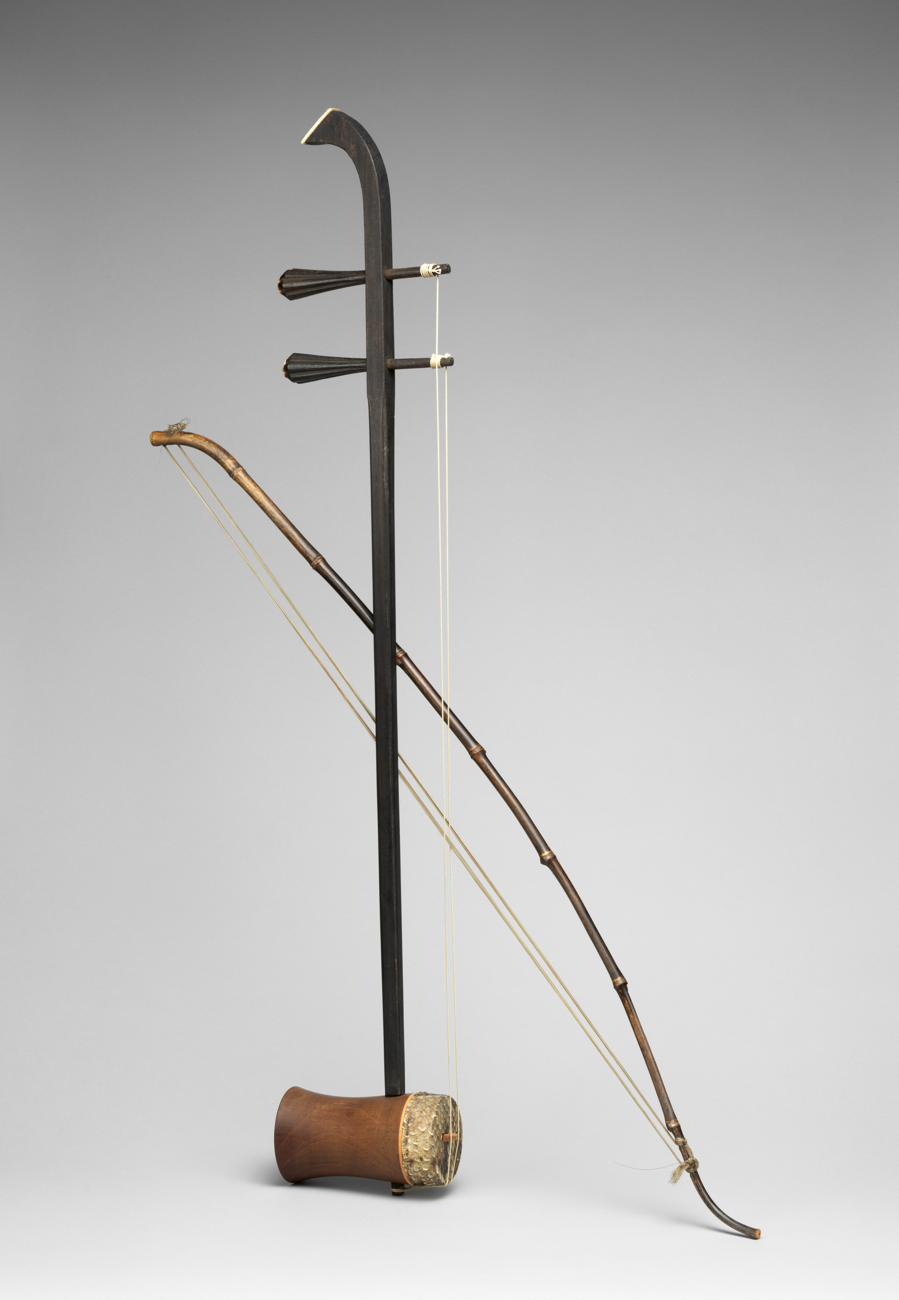


Building an Erhu — The Chinese Two-String Bowed Fiddle
Build an erhu: a two-string Chinese fiddle with a bow trapped between the strings, a little skin-covered drum for a body, and no fingerboard — you press the strings in mid-air and slide between notes. A serious maker build in the bowed string and stick-slip friction, the physics behind every violin.
中级
Several hours over a few sessions
说明
1
1
A fiddle with a drum for a body
A fiddle with a drum for a body
The erhu has just two strings, a bow that lives trapped between them, and a little skin-covered drum for a body. It has no fingerboard, so you press the strings in mid-air and slide to every note between.
2
2
Make the resonator drum
Make the resonator drum
Cut a short, thick length of bamboo about 13 cm long, open at both ends. This little hollow tube is the sound-body of the erhu.
此步骤所需材料:
 竹1 个
竹1 个所需工具:
 钢锯
钢锯3
3
Skin the front
Skin the front
Soak a piece of rawhide, stretch it drum-tight over one end of the tube, glue and lash it down, and let it dry hard. This membrane is what makes the erhu loud, like a banjo head.
此步骤所需材料:
 生皮1 个
生皮1 个 PVA 木工胶1 个
4
4
Fit the neck
Fit the neck
Push a long dowel neck down through the body near the skin end, so it stands up tall and straight from the drum.
此步骤所需材料:
 木榫条1 个PVA 木工胶1 个
5
5
Fit two tuning pegs
Fit two tuning pegs
Bore two holes near the top of the neck and fit a friction tuning peg into each, one above the other.
此步骤所需材料:
 弦轴2 个
弦轴2 个所需工具:
 锥子
锥子6
6
String it
String it
Run two strings from the base of the body up to the two pegs, close together and parallel — the erhu's whole set of strings.
此步骤所需材料:
 0.032 英寸钢制琴钢丝1 个
7
7
Stand the bridge on the skin
Stand the bridge on the skin
Carve a tiny wooden bridge and stand it on the middle of the skin, under the strings, so the strings press down onto the membrane.
所需工具:
 斯洛伊德雕刻刀
8
8
Tune the two strings a fifth apart
Tune the two strings a fifth apart
Tune the inner string to a low note and the outer string a fifth higher, like D and A. Twist the pegs to reach the two notes.
9
9
Make the bow
Make the bow
Tie a flat hank of horsehair between the two ends of a springy stick to make a bow, tight enough to twang.
此步骤所需材料:
 弯曲的树枝(弓)1 个
 弓毛(马尾毛)1 个
10
10
Thread the bow between the strings
Thread the bow between the strings
Slide the bow hair BETWEEN the two strings. On an erhu the bow lives there permanently and cannot be taken out — that is why it plays only its own two strings.
11
11
Rosin the hair
Rosin the hair
Rub hard pine rosin along the bow hair so it grips the strings. Without rosin the hair is too slippery to set a string singing.
12
12
Play a note
Play a note
Draw the bow steadily across a string. Press the hair toward the inner or the outer string to choose which one sounds.
13
13
Slide and bend
Slide and bend
With no fingerboard, press a string in open air and slide your finger up or down the neck to glide smoothly between notes — the erhu's crying, singing voice.
14
14
Compendium — bowing and the skin drum
Compendium — bowing and the skin drum
The erhu makes sound the way every bowed instrument does: by stick-slip friction. The rosined hair grabs the string and drags it sideways until the string's tension tears it free; the string snaps back, is caught again, and the cycle repeats hundreds of times a second. This catch-and-release, called Helmholtz motion, keeps the string vibrating steadily for as long as you bow — which is why a bowed note can sing on and on while a plucked one quickly dies. Unlike a lyre or a guitar, the erhu's soundbox is a little DRUM: the strings press through the bridge onto a stretched skin, and that membrane radiates the sound into the air, exactly as a banjo head does, giving the erhu its bright, nasal, almost human voice. And it has no fingerboard — you stop the strings by pressing them in open air — so there are no fixed frets and you can slide through every pitch, which is why the erhu can weep and sing like a person. It grew from the bowed huqin fiddles of the Tang and Song dynasties more than a thousand years ago, and its two strings are tuned a fifth apart. Its cousins are the whole huqin family and, far to the west, every member of the violin family — all of them stick-slip machines singing through a resonating body.
材料
8- 1 个占位符
- 1 个占位符
- 1 个占位符
- 1 个占位符
- 2 个占位符
- 占位符
- 1 个占位符
- 1 个占位符
相关蓝图
这些蓝图共享知识——技术、材料或原理

CC0 公共领域
此蓝图以 CC0 协议发布。你可以自由复制、修改、分发和使用此作品,无需征得许可。
通过购买蓝图中的产品支持创客,他们将获得 创客佣金 (由供应商设定),或创建此蓝图的新版本并将其作为连接包含在你自己的蓝图中以分享收入。