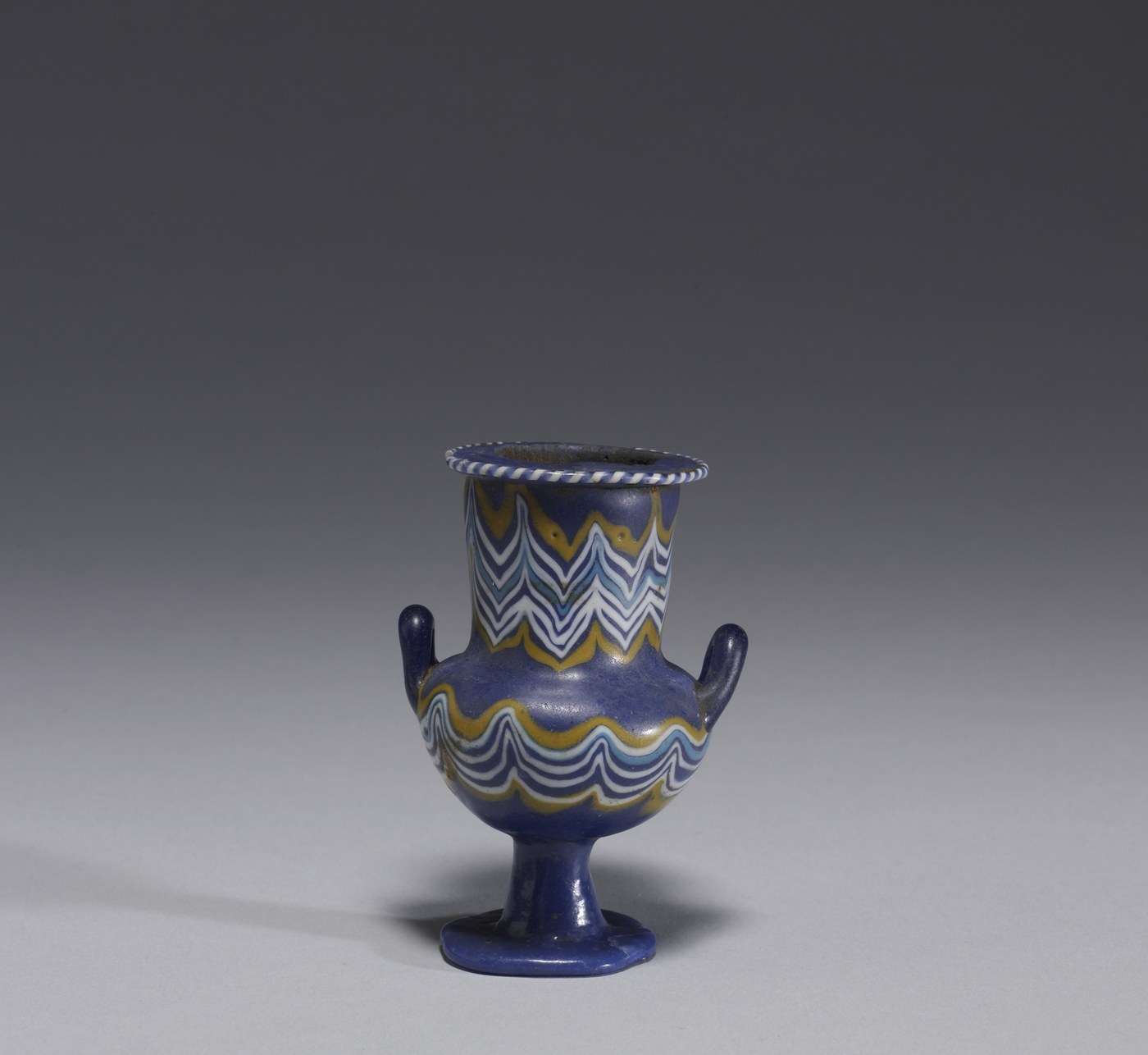


Cobalt Blue Glass
Cobalt is the strongest colourant in the glassmaker's cupboard, and it is not close. Copper needs percent-level additions to give green; iron gives the pale bottle-green of ordinary sand almost by accident. Cobalt gives a deep, saturated blue at 0.05% of the batch weight — five parts in ten thousand. Weigh it carelessly and you get an opaque near-black lump.
That potency is why cobalt blue turns up so early and travels so far. A tiny quantity colours a large melt, so it was worth carrying across continents long before anyone knew what the element was. Egyptian and Mesopotamian blue glass, Roman blue vessels, the blues of medieval cathedral windows and Chinese blue-and-white porcelain all trace back to cobalt-bearing minerals, and chemists today read the trace impurities alongside the cobalt — nickel, zinc, arsenic — as a fingerprint that tells them which ore body a piece of ancient glass came from.
This blueprint melts a small soda-lime batch and colours it. The chemistry is the same at any scale; only the furnace changes.
说明
Set up protection
Set up protection
Safety glasses and a dust mask for the whole batching stage. The raw powders are respirable and the silica fraction is the one that matters — weigh and mix them with as little airborne dust as possible.
所需工具:
 透明安全眼镜
 防尘口罩
防尘口罩Weigh the silica
Weigh the silica
Weigh 300 g of fine silica sand. Silica is the glass former — the network everything else modifies.
此步骤所需材料:
 细砂300 克
Weigh the soda
Weigh the soda
Weigh 100 g of sodium carbonate. Soda is the flux: it drops silica's melting point from about 1700 °C — far beyond a small furnace — to a workable range.
此步骤所需材料:
 碳酸钠(纯碱)100 克
Weigh the lime
Weigh the lime
Weigh 40 g of crushed limestone. Lime is the stabiliser. Leave it out and you get water glass — a silicate that literally dissolves in water.
此步骤所需材料:
 碳酸钙——破碎石灰石40 克
Weigh the cobalt oxide
Weigh the cobalt oxide
Weigh 0.22 g of cobalt oxide — 0.05% of the 440 g batch. Use a scale that reads to 0.01 g. This is the step where guessing ruins the melt: double it and the glass goes so dark it reads black except at a thin edge.
此步骤所需材料:
 氧化钴0.22 克
Mix the batch thoroughly
Mix the batch thoroughly
Mix all four powders for a full 10 minutes until the colour is completely uniform. With a colourant this dilute, poor mixing shows directly as streaks and swirls in the finished glass.
Charge the crucible
Charge the crucible
Fill the crucible to two-thirds. The batch foams hard as the carbonates break down — a full crucible will overflow into the furnace.
所需工具:
 石墨黏土坩埚
Ramp to 1100 °C and hold
Ramp to 1100 °C and hold
Ramp the kiln to 1100 °C and hold 2 hours. The carbonates decompose and release carbon dioxide — this is the foaming stage, and rushing it traps the gas as permanent bubbles.
所需工具:
 窑炉
窑炉Raise to 1300 °C to fine the melt
Raise to 1300 °C to fine the melt
Raise to 1300 °C and hold 3 hours. This is fining: the melt thins enough for the remaining bubbles to rise out and for the cobalt to distribute evenly. Cut it short and the glass stays seedy with fine bubbles.
所需工具:
窑炉Check the colour on a test pull
Check the colour on a test pull
Pull a thread of melt with a steel rod and let it cool. Judge the colour on the thin thread, not on the crucible surface — depth of glass changes apparent colour enormously.
所需工具:
 坩埚钳
坩埚钳 低碳钢圆棒
低碳钢圆棒Cast the melt
Cast the melt
Lift the crucible with long-handled tongs and pour onto a preheated steel plate or into a mould. Everything within reach is at 1300 °C — full face and hand protection, and a clear, rehearsed path.
所需工具:
坩埚钳Anneal down slowly
Anneal down slowly
Move the piece straight into the kiln at 500 °C, hold 1 hour, then cool to room temperature at no more than 50 °C per hour. Skipping the anneal leaves internal stress and the glass cracks, sometimes days later.
所需工具:
窑炉History & Context
History & Context
Five parts in ten thousand. Cobalt's colouring power is extreme — 0.05 wt% is enough to give bulk glass a saturated blue. Compare copper, which needs percent-level additions, or iron, whose pale green comes along free with untreated sand. That ratio is the whole economic story: a small, light, valuable quantity of blue ore could colour an enormous amount of glass, so it was worth trading over very long distances very early.
They had the colour without the element. Cobalt was not isolated and named until Georg Brandt did it in the 1730s, but cobalt-bearing minerals had been colouring glass and glaze for roughly three thousand years before that. Ancient glassmakers were not using cobalt oxide from a jar; they were using ores and roasted mineral preparations whose blue behaviour was known empirically. Be careful with any source that has Egyptians or Romans deliberately adding "cobalt oxide" — they added a blue-making mineral, which is a different claim.
Impurities as a fingerprint. Because different cobalt ore bodies carry different companion elements — nickel, zinc, arsenic, iron, manganese in varying ratios — analysing those trace elements alongside the cobalt lets researchers group ancient blue glass, glaze and enamel by source and trace trade routes. The impurity pattern is more informative than the cobalt itself.
What the blue actually is. In a soda-lime melt cobalt sits as Co²⁺ ions surrounded by four oxygen neighbours. That particular arrangement absorbs strongly in the yellow-to-red part of the spectrum and lets blue through. Change the surrounding chemistry — a different flux, a different coordination — and the same element gives a different colour, which is why cobalt in some glazes reads violet or pinkish rather than blue.
Not a hazardous blueprint, but not a careless one. The blue is a colourant here, in trace quantity, locked into a silicate network in the finished glass. What genuinely deserves respect is the process: 1300 °C molten material, and respirable dust at the batching stage. Handle both properly and this is a normal hot craft, the same category as glassblowing or kiln firing.
此蓝图制作
CC0 公共领域
此蓝图以 CC0 协议发布。你可以自由复制、修改、分发和使用此作品,无需征得许可。
通过购买蓝图中的产品支持创客,他们将获得 创客佣金 (由供应商设定),或创建此蓝图的新版本并将其作为连接包含在你自己的蓝图中以分享收入。