

Ductile Tungsten
Tungsten melts at about 3400 °C, higher than any other metal, which makes it the obvious lamp filament — run it white hot and it does not melt. There was one problem, and the textbooks stated it as settled fact. Coolidge quotes them: tungsten is "a steel-gray to black powder" that is "entirely non-ductile". You cannot draw wire from a metal that shatters.
The trick is that ductility is not fixed — it depends on temperature and on working history. Tungsten is brittle when cold and workable when hot, and each hot working pass leaves the grain structure a little more fibrous and a little tougher, so the next pass can be done slightly cooler. Work it down in stages and you end up with wire that is ductile at room temperature.
Coolidge's own summary: from "this refractory, brittle, nonductile and generally unworkable metal" he produced "a wire which is tough, fibrous and elastic and of high tensile strength".
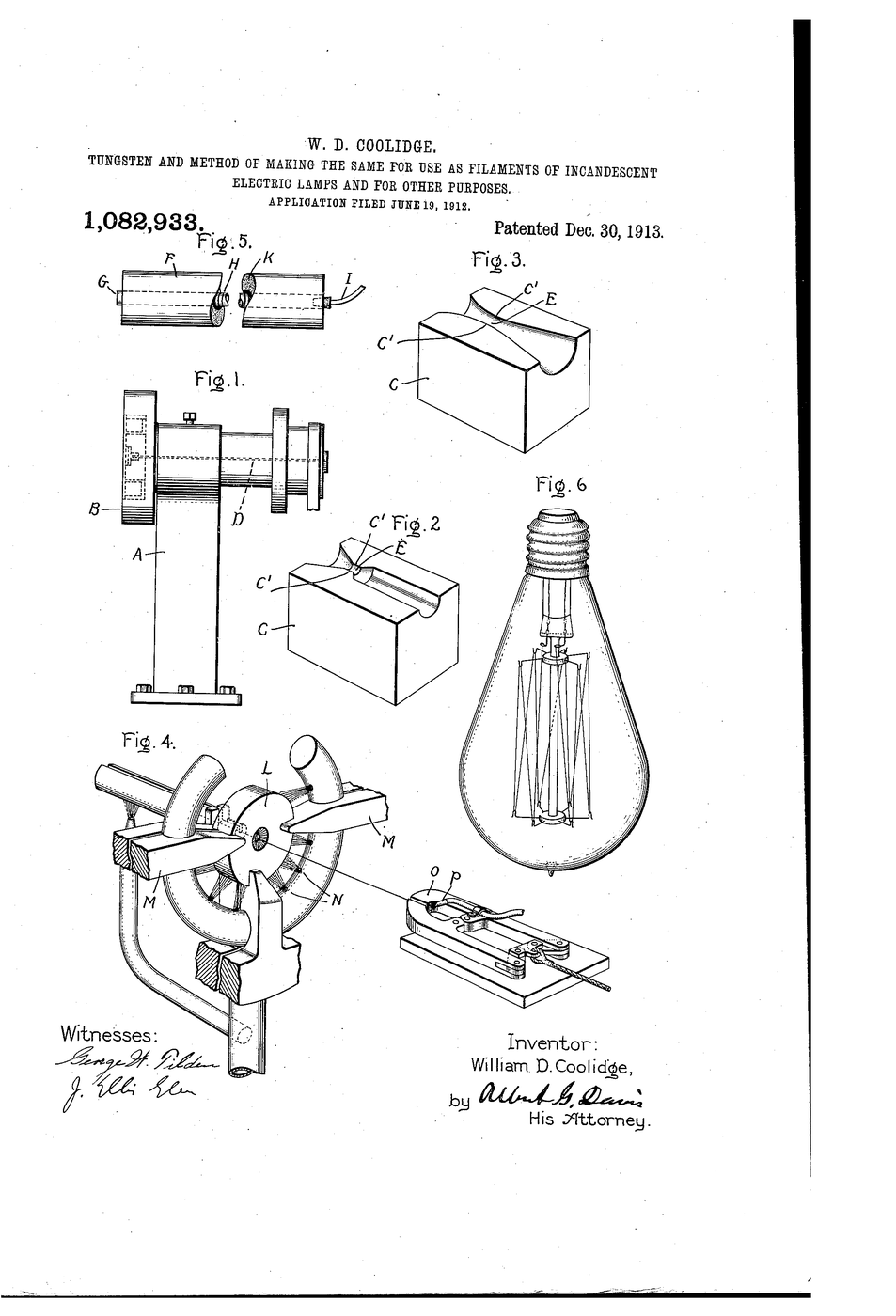
US Patent 1,082,933, filed 19 June 1912 and granted 30 December 1913 to William D. Coolidge of Schenectady, New York.
说明
Read the claim the textbooks contradicted
Read the claim the textbooks contradicted
Coolidge quotes Roscoe and Schorlemmer's Treatise on Chemistry saying tungsten is "entirely non-ductile", then produces ductile wire. Note what he is arguing against.
Glasses on — brittle metal throws splinters
Glasses on — brittle metal throws splinters
You are going to snap brittle wire deliberately. Glasses on for every step, and keep the work over a tray.
所需工具:
 透明安全眼镜
Recover a tungsten filament from a lamp
Recover a tungsten filament from a lamp
Break a clear incandescent lamp inside a bag and recover the coiled filament. That coil is drawn tungsten wire — the product of this patent.
此步骤所需材料:
 灯泡1 个
灯泡1 个Uncoil a short length and bend it cold
Uncoil a short length and bend it cold
Straighten 20 mm and bend it back and forth at room temperature. It takes the bend. Finished tungsten wire is ductile cold.
所需工具:
 钢丝钳
钢丝钳Try to bend a piece of unworked tungsten rod
Try to bend a piece of unworked tungsten rod
Now try the same with a solid tungsten rod. It resists, then snaps without bending. Same element, opposite behaviour.
此步骤所需材料:
 钨棒(纯)1 个
Look at the two fracture faces
Look at the two fracture faces
The rod breaks with a granular face; the drawn wire, if you finally break it, tears with a fibrous one. Coolidge's word is "fibrous" — this is what he means.
Heat the filament and bend it hot
Heat the filament and bend it hot
Heat a length to red with the torch and bend it while hot. It moves far more easily. Temperature, not the element, decides workability.
所需工具:
 硬钎焊喷枪
硬钎焊喷枪Model the powder-metallurgy start with graphite
Model the powder-metallurgy start with graphite
Press graphite powder into a bar in a mould. It holds together but crumbles. This is the pressed powder ingot Coolidge's process begins with — tungsten cannot be cast, so it is pressed.
此步骤所需材料:
 石墨粉20 克
Work out why casting is impossible
Work out why casting is impossible
Tungsten melts near 3400 °C. No crucible survives that. Write down why the route must be press, sinter, then work — not melt and pour.
Draw copper wire through a plate to feel the process
Draw copper wire through a plate to feel the process
Pull annealed copper wire through successively smaller holes. Each pass reduces the diameter a little. Many small reductions, never one large one.
Try one large reduction and break it
Try one large reduction and break it
Skip three sizes and pull. The wire necks and parts. The staged schedule is the process, in copper and in tungsten alike.
Work-harden and anneal the copper
Work-harden and anneal the copper
Bend copper wire repeatedly until it stiffens and cracks, then heat it to red and let it cool. It is soft again. Working changes the metal; heat resets it.
Light the filament and watch it survive
Light the filament and watch it survive
Run the recovered filament briefly at low voltage. It glows without sagging. Everything above exists so this wire can be white hot for a thousand hours.
所需工具:
 实验室级数字万用表
History & Context — the materials advance behind two famous inventions
History & Context — the materials advance behind two famous inventions
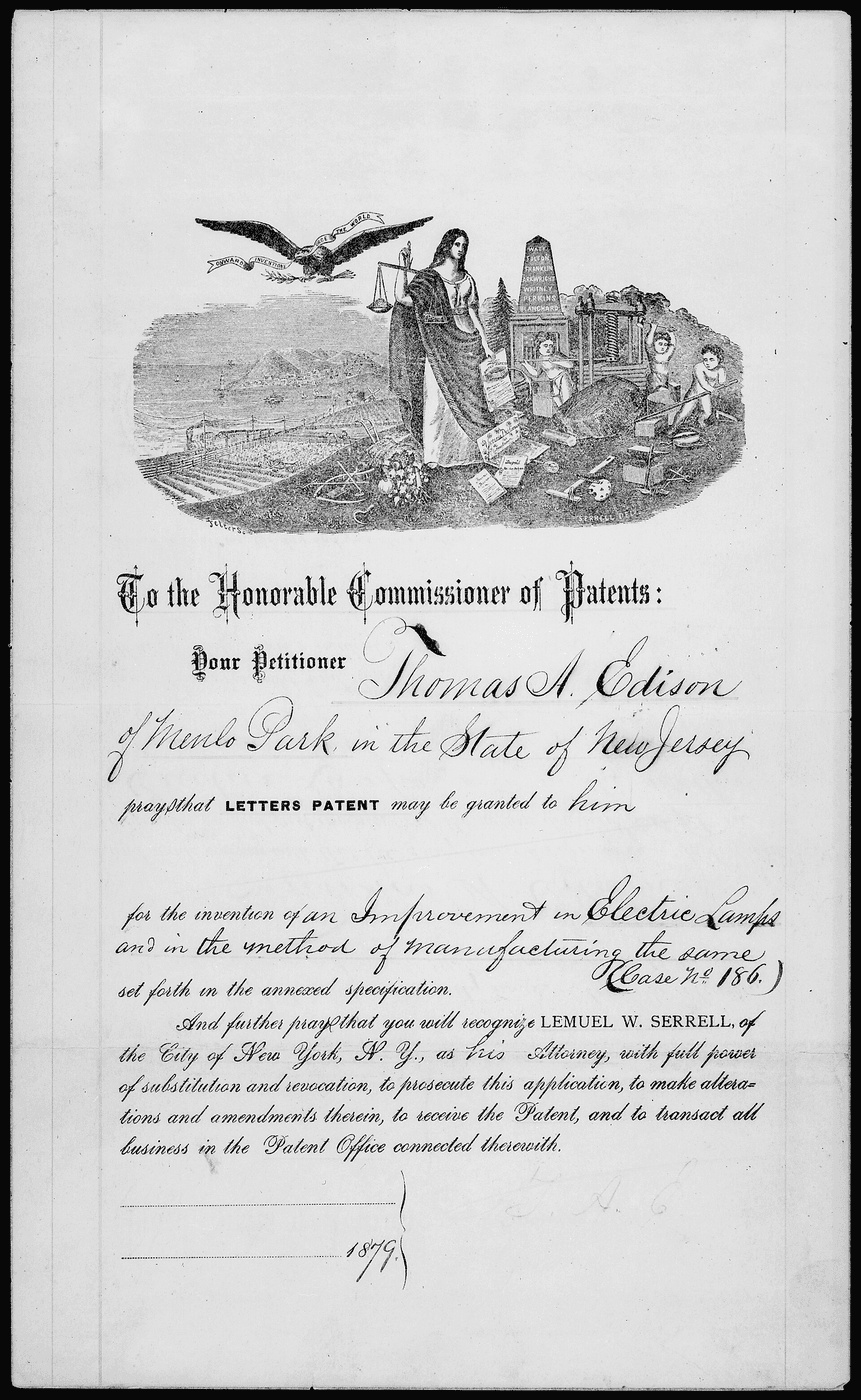
The patent. US 1,082,933, "Tungsten and method of making the same for use as filaments of incandescent electric lamps and for other purposes", filed 19 June 1912 and granted 30 December 1913 to William D. Coolidge of Schenectady, New York. The specification cross-references his earlier applications — Serial No. 545,274 of 23 February 1910 and Serial No. 577,353 of 15 August 1910 — so the work runs from at least 1910, and dating it to the 1913 grant compresses three years of development into a date stamp.
The patent claims a material and a process at once. Coolidge describes "a new incandescent lamp filament of drawn wire made from the metal tungsten, and a process" of making it, and he is careful to say the wire "has found various other applications, and may be used wherever high tensile strength, freedom from corrosion, or ability to withstand high temperatures are of value". He even claims the half-finished state: "an incidental but valuable new product is found at an intermediate stage of my process, in tungsten which is wrought, but in which the working process has been interrupted" before full ductility develops. Claiming the intermediate is a nice piece of drafting — he patents not just the destination but the road.
Why this is a bigger deal than it sounds. The metal did not change; its history changed. A pressed and sintered tungsten ingot is a mass of loosely bonded grains that cracks under load. Working it hot, repeatedly, elongates those grains into fibres aligned along the wire, and a fibrous structure tears rather than cleaves. Because each stage leaves the metal a little tougher, the next stage can be done at a slightly lower temperature, until the finished wire bends cold — which is what steps 4 and 5 put side by side. The general principle, that mechanical properties are a product of processing rather than of composition alone, is one of the foundational ideas of modern metallurgy, and this patent is one of its cleanest demonstrations.
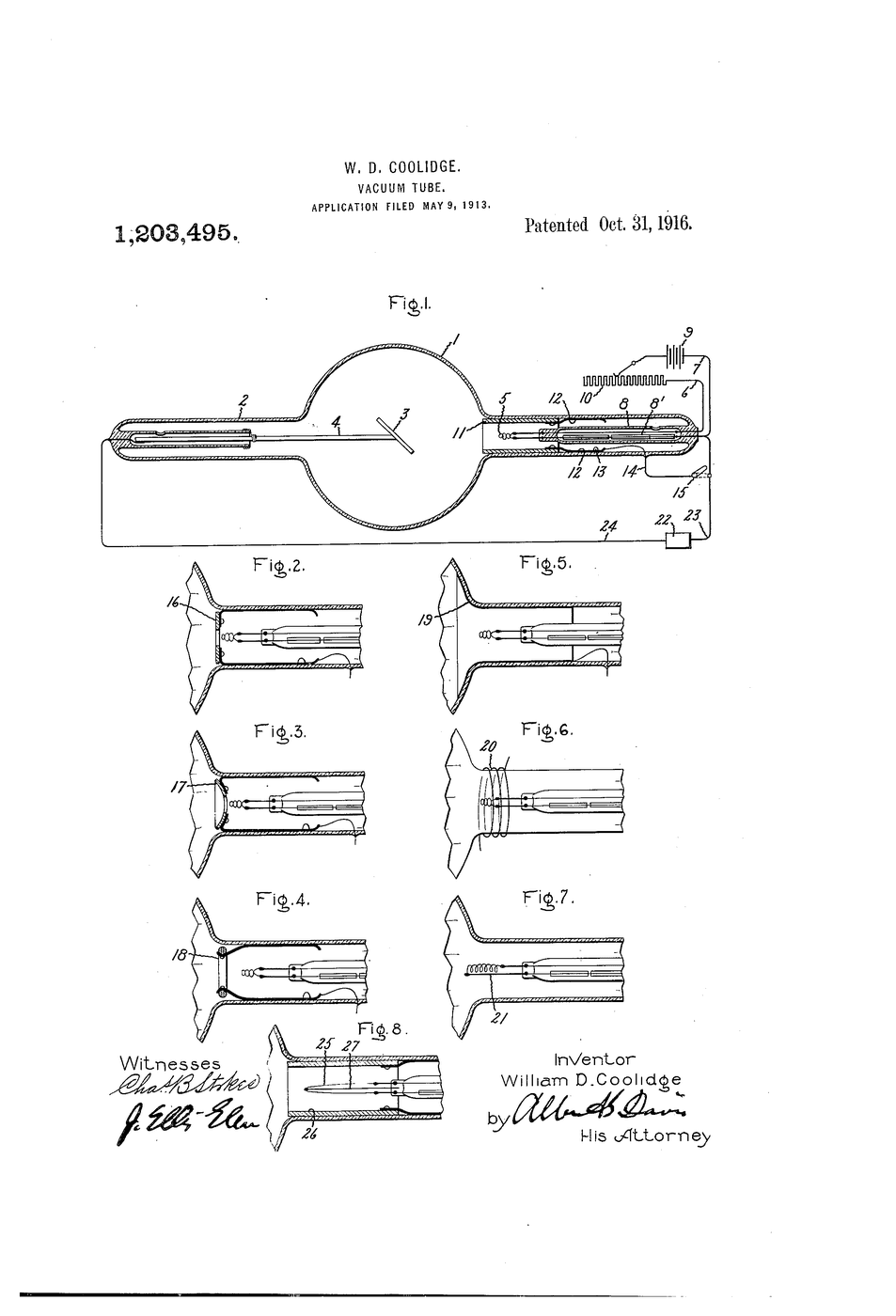
What it enabled. Carbon-filament lamps were dim and blackened their bulbs; tungsten runs far hotter, so it is both brighter and much more efficient, and the drawn-wire filament is what made the tungsten lamp manufacturable rather than merely possible. Coolidge then used the same material in his X-ray tube of 1916, which needs tungsten in the two hottest places at once — as a filament that must emit electrons for thousands of hours, and as a target absorbing a beam that is over 99 % waste heat. Two celebrated inventions rest on one materials advance, and the materials advance is the one nobody names.
Where the drawn wire went next. Lamp filaments were only the start: tungsten wire became the electrodes of TIG welding, the heating elements of vacuum furnaces, and the filaments of electron microscopes and vacuum tubes. Any time something has to stay solid and strong where everything else softens, this 1913 process is somewhere upstream.

CC0 公共领域
此蓝图以 CC0 协议发布。你可以自由复制、修改、分发和使用此作品,无需征得许可。
通过购买蓝图中的产品支持创客,他们将获得 创客佣金 (由供应商设定),或创建此蓝图的新版本并将其作为连接包含在你自己的蓝图中以分享收入。