

Cups and Balls
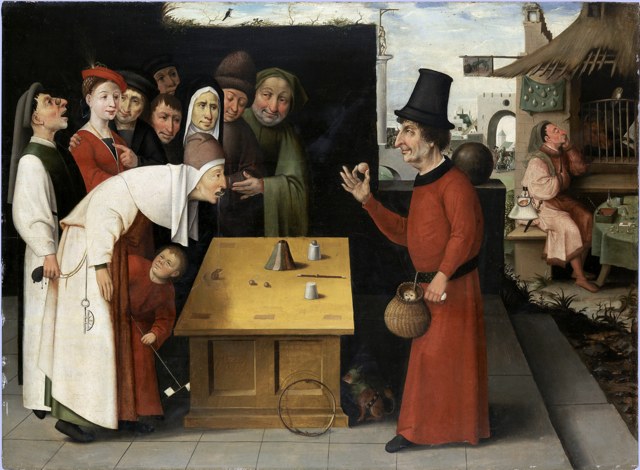
Three cups, three small balls, and a cloth-covered table. It is the oldest documented conjuring routine — Roman performers were doing it two thousand years ago, and Seneca mentions a performer using cups and balls in his letters.
This blueprint builds the props and teaches one move: the load, where a ball arrives under a cup that the audience just watched being empty. Everything else in the routine is repetition and misdirection built on top of it.
The interesting part for a maker is that the deception is mostly engineering, not dexterity. The cups are shaped so a ball can sit hidden in the recess of an upturned cup; the cloth kills the sound a ball would otherwise make; the balls are light enough not to shift the cup's weight noticeably. Build the props correctly and the move becomes easy. Build them badly and no amount of practice will save it.
说明
Choose three identical cups
Choose three identical cups
Get three opaque cups, identical, about 80 mm tall. They must be indistinguishable — an audience that can tell one cup from another can track it.
此步骤所需材料:
 Brass Sheet1 张
Check they nest with a gap
Check they nest with a gap
Stack them. There must be a gap of at least 15 mm between the inside of one cup and the mouth of the one below. That gap is where a hidden ball lives while the cups are stacked.
Recess the base
Recess the base
Make sure each cup has a slight recess or lip on its closed end. A ball placed on an upturned cup sits in that recess instead of rolling off — this is the classic construction and it is what makes several moves possible.
所需工具:
 Needle File Set
Roll cork or wool balls
Roll cork or wool balls
Make four balls about 15 mm across from cork or tightly wound wool. Light and soft — a heavy ball changes the feel of a cup and clatters when it lands.
此步骤所需材料:
 Wool Yarn50 克
Make four, show three
Make four, show three
Four balls, three of them acknowledged. The extra ball is the entire secret of the basic routine, and the audience is never told it exists.
Cover the table with cloth
Cover the table with cloth
Lay a thick cloth over the working surface. It muffles the sound of a ball landing and stops cups ringing — Roman performers used a cloth-covered table for exactly this reason.
此步骤所需材料:
 Felt Table Cloth1 个
Practise holding a ball in finger palm
Practise holding a ball in finger palm
Rest a ball in the curl of your fingers and let the hand hang naturally. Practise in a mirror until the hand looks empty and relaxed. A stiff hand is what people notice, not the ball.
Learn to pick up a cup one-handed
Learn to pick up a cup one-handed
Practise lifting and replacing a cup with the same hand that is palming a ball. This must look completely ordinary before you attempt any load.
Do the load
Do the load
Lift a cup with the palming hand, show it empty, and as you set it down release the palmed ball beneath it. The cup's own shadow hides the drop, and the ball lands silently on the cloth.
Time it to the misdirection
Time it to the misdirection
Load at the moment attention is elsewhere — as you gesture with the other hand, or as you ask a question. The move is invisible because nobody is looking, not because it is fast.
Test it on someone honest
Test it on someone honest
Perform it for one person and ask them afterwards what they saw. Their description tells you where their attention actually was — usually not where you assumed.
History & Context
History & Context
Two thousand years documented. The routine known as acetabula et calculi was performed by Roman conjurers. Acetabulum is Latin for a vinegar cup and calculi are the pebbles or balls. Seneca mentions a performer using cups and balls in his letters, which gives us a literary date as well as the objects. Roman performers are described using leaden cups and light cork balls on a cloth-covered table to muffle sound.
Older still, probably. Indian performers have a version, cheppum panthum, played with coconut shells, and it is often claimed to be far older — possibly Indus Valley, sometimes dated to around five thousand years ago. Treat that with caution: it is repeated widely in magic literature but the evidence is much weaker than for the Roman version. "Oldest documented" is a defensible claim; "five thousand years old" is not, on current evidence.
The props do the work. Cups that nest with a gap can conceal a ball while stacked. A recessed base holds a ball on an upturned cup. Soft light balls make no sound and do not change the cup's heft. Cloth absorbs the noise of a landing. Every one of these is a design decision that removes a way of being caught, which is why the physical form of the props has barely changed in two millennia.
What it actually teaches. The routine works on the gap between what people see and what they believe they saw. Ask a spectator afterwards and they will confidently describe things that did not happen — a cup lifted that was not, a hand that never moved. It is a live demonstration of how much perception is reconstruction, which is the same lesson the camera lucida teaches from the other direction.
The descendants. Later performers used cylindrical boxwood dice shakers instead of cups, and the Italian term il gioco dei bussolotti — the game of the dice shakers — came to mean sleight of hand generally. The street swindle known as the shell game is a direct descendant, with the crucial difference that the conjuring version is honest about being a deception and the swindle is not.
材料
3- 1 张占位符
- 占位符
- 占位符
所需工具
1CC0 公共领域
此蓝图以 CC0 协议发布。你可以自由复制、修改、分发和使用此作品,无需征得许可。
通过购买蓝图中的产品支持创客,他们将获得 创客佣金 (由供应商设定),或创建此蓝图的新版本并将其作为连接包含在你自己的蓝图中以分享收入。