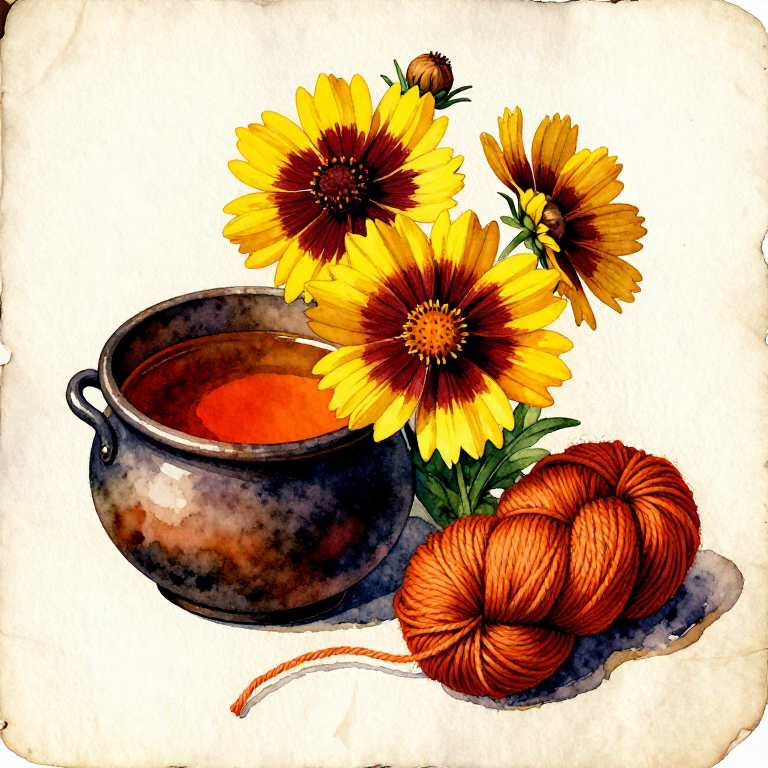


Dyeing Red-Orange with Coreopsis — The Plains Flower That Dyes from Yellow to Rust
Coreopsis tinctoria, commonly called plains coreopsis or calliopsis, is an annual wildflower native to the prairies and open grasslands of North America. Its genus name comes from the Greek koris (bedbug), referring to the seed shape, while tinctoria means 'of the dyers' — a direct acknowledgement of its long history as a dye plant. Indigenous peoples of the Great Plains and the American Southwest used coreopsis to dye textiles, baskets, and body paint, producing colours ranging from yellow to deep rust-red depending on the mordant used.
What makes coreopsis unusual among flower dyes is its ability to produce warm red and rust tones — most flower dyes give yellows and golds, but coreopsis flowers contain a combination of flavonoid and chalcone pigments that lean toward red-orange, particularly from the dark mahogany centres of the bicolored flower heads. On alum-mordanted wool, the whole flowers give a warm burnt orange. With iron modification, the colour shifts to a deep rust-brown. Using only the dark flower centres intensifies the reddish tones.
Coreopsis is an exceptionally generous dye plant. It grows easily from seed, flowers within 60 days of sowing, blooms continuously throughout summer if deadheaded, and produces masses of flower heads. A single patch of coreopsis can supply more dye material in one season than a household dyer could use. The colours are moderately lightfast — better than marigold but not as permanent as madder. For warm reds and oranges from a garden-grown flower, coreopsis is unmatched.
说明
Weigh the dried coreopsis flowers
Weigh the dried coreopsis flowers
Use 100-200% WOF of dried coreopsis flower heads. For 100 g of wool, weigh out 100-200 g of dried flowers. Higher quantities push the colour toward deeper orange-red. Pick flowers at full bloom when the dark centres are fully developed — the mahogany-red centres contain the most pigment. Include the dark centres and the yellow ray petals together for the warmest orange tones. Dry the flower heads on screens in shade for 5-7 days until they are crisp and papery.
此步骤所需材料:
 金鸡菊花(干)150 克
所需工具:
 数字厨房秤
数字厨房秤Soak the flowers in warm water for one hour
Soak the flowers in warm water for one hour
Place the dried coreopsis flowers in a dye pot with 4 litres of warm water and soak for at least one hour. The water will turn a warm golden-orange within minutes as the flavonoid and chalcone pigments dissolve. The dark centres contribute the most intense colour — they may take slightly longer to fully hydrate than the thin ray petals. Press the flowers below the surface to ensure even extraction.
所需工具:
 高汤锅
高汤锅Simmer the flowers for 30-40 minutes
Simmer the flowers for 30-40 minutes
Bring the pot to a gentle simmer (80-85°C) and hold for 30-40 minutes. Stir occasionally. The liquid will deepen to a rich orange-red — noticeably warmer and more red-toned than typical flower dye baths. Do not boil. The flower heads will lose their colour during simmering, with the dark centres being the last to fade. Once the centres have paled to brown, extraction is essentially complete.
所需工具:
 烹饪温度计
烹饪温度计 木质搅拌勺
木质搅拌勺Strain out the flowers
Strain out the flowers
Strain the dye liquor through a fine mesh strainer into a clean pot. Coreopsis flowers disintegrate readily during simmering and become pulpy — strain carefully and consider a second straining through muslin for the cleanest bath. Press the spent flowers to extract all the orange-red liquid. The strained liquor should be a warm, clear burnt orange.
所需工具:
 细目筛
细目筛Dye alum-mordanted wool at 80°C for 45 minutes
Dye alum-mordanted wool at 80°C for 45 minutes
Pre-wet the alum-mordanted wool in lukewarm water for 15 minutes, squeeze gently, and lower it into the coreopsis dye bath at room temperature. Slowly raise to 80°C over 15 minutes, then hold for 45 minutes. Turn gently every 10 minutes. The wool will absorb colour rapidly, developing a warm burnt orange to terracotta. The alum mordant enhances the orange tones. This is one of the warmest reds achievable from a flower dye — most flower dyes top out at yellow, making coreopsis unusual and valued.
此步骤所需材料:
 羊毛线绞100 克
 明矾(钾明矾)10 克
Cool, rinse, and dry
Cool, rinse, and dry
Turn off the heat and let the wool cool in the dye bath overnight for deepest colour. Remove, squeeze gently, and rinse in lukewarm water until the runoff is mostly clear. The final colour ranges from warm burnt orange to soft terracotta, depending on flower concentration and the ratio of dark centres to ray petals. Lightfastness is moderate — similar to marigold. For items that will see direct sunlight, pair with iron modification for darker tones that resist fading better. Dry in shade.
已连接蓝图材料
相关蓝图
这些蓝图共享知识——技术、材料或原理
CC0 公共领域
此蓝图以 CC0 协议发布。你可以自由复制、修改、分发和使用此作品,无需征得许可。
通过购买蓝图中的产品支持创客,他们将获得 创客佣金 (由供应商设定),或创建此蓝图的新版本并将其作为连接包含在你自己的蓝图中以分享收入。