艺术
美容与健康
工艺
文化与历史
娱乐
环境
食品与饮料
逆向工程
科学
体育
技术
可穿戴设备
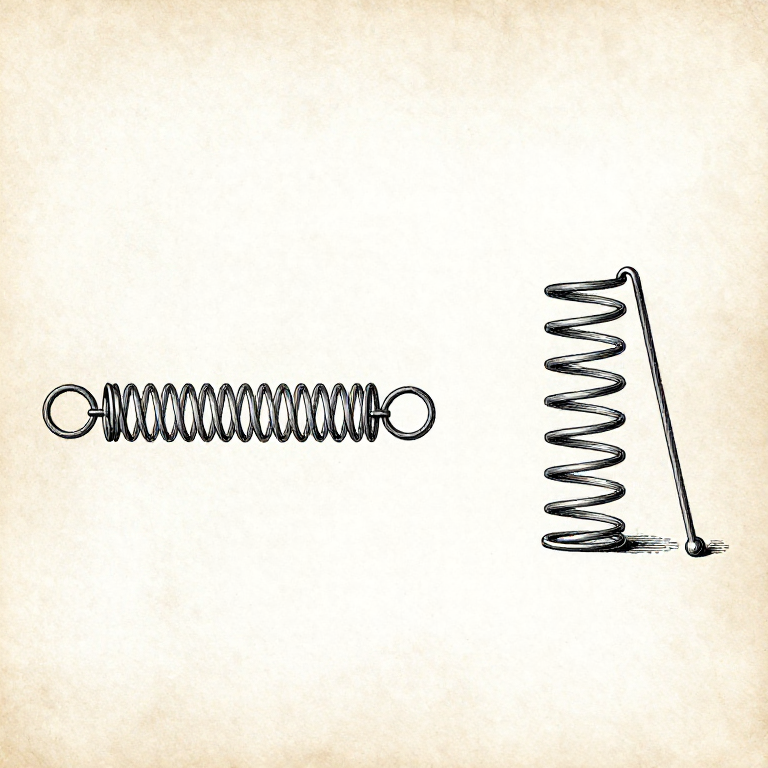


Extension and Torsion Springs: Initial Tension, Hooks and Handedness
An extension spring is not a compression spring turned round, and a torsion spring is not either of them. Both break the assumptions the first rungs were built on.
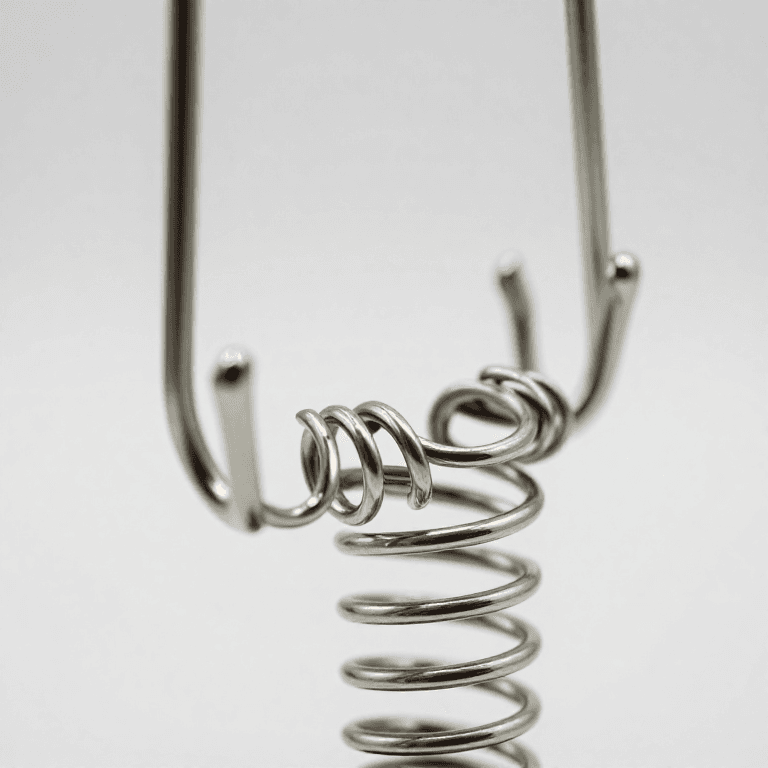
An extension spring is wound with its coils already touching, so it starts with force in it — the initial tension — and nothing moves at all until that force is exceeded. Its force-extension line does not pass through the origin, which means a single measurement cannot tell you its rate. And it has hooks: bent wire, working in bending where the body works in torsion, on a tighter radius than the coil, which is why the hook is almost always where it fails.
A torsion spring, despite its name, works its wire in **bending**, so its rate depends on Young's modulus and not the shear modulus. It must be wound the way that closes the coil, and the coil shrinks onto its shaft as it is wound up — which is a clearance you have to calculate, not guess.
中级
4 hours
说明
1
1
Extension springs: what initial tension is
Extension springs: what initial tension is
**It is force wound in, not force applied.** When an extension spring is coiled, the wire can be fed on with the coils pressed hard against each other. The residual twist in the wire keeps them pressed together, and that press has to be overcome before the spring will open at all.
**It is a property of the coiling, not of the design.** You cannot order a particular initial tension the way you order a rate; you specify a range and the spring maker hits it by feel and by machine setting. Typical values are between about 10% and 25% of the maximum working load, and the tolerance on it is wide.
**It cannot be adjusted afterwards.** Stretching a spring to 'loosen' it removes initial tension by taking a set, and takes free length with it. The spring is then a different spring, permanently.
**A compression spring has no equivalent**, and a compression spring that seems to have one is a compression spring with coils touching — which is a fault.
**Why it is useful.** A spring that does nothing until a threshold force is a very handy thing: a screen door that stays shut until you push, a latch that holds until it is asked. And on a machine it means the spring is doing nothing at all in the rest position, which is one fewer thing creeping.
**Why it is a nuisance.** It makes a single force-and-length measurement useless, it has a loose tolerance, and it drifts in service as the spring relaxes.
此步骤所需材料:
 拉伸弹簧1 个
所需工具:
 测力计(弹簧秤)
 校准砝码组
校准砝码组 直尺
直尺2
2
Initial tension, hook stress, and the torsion spring derived
Initial tension, hook stress, and the torsion spring derived
正在加载 Jupyter 笔记本…
所需工具:
 台式电脑
台式电脑3
3
Ends, and choosing between them
Ends, and choosing between them
**Machine loop or machine hook.** The last coil bent up into the axis and left as a loop, or bent further into a hook. Cheap, standard, made on the same machine as the spring. The bend radius is small, so these are the weakest ends there are — fine for light loads and wrong for heavy ones.
**Crossover loop.** The end coil crosses the axis and loops on the far side. Slightly better aligned with the load and no stronger where it matters.
**Extended hook.** The end wire is carried out beyond the body before being formed. Lets the bend radius be generous, which is the whole point, and adds length.
**Side loop.** The loop is formed to one side rather than on the axis. Easy to hook onto something, and it loads the spring off-centre, which adds a bending moment to the body. Avoid where the load is high.
**Threaded insert or swivel end.** A plug screwed into the end coils, with a tapped hole or an eye. No bent wire at all, so the ends are no longer the weak point and the load is taken into the body directly. More expensive, and the correct answer whenever the hook stress is the thing limiting the design.
**The choice, briefly:** light duty and cost matters, use a machine loop. High load or many cycles, get the bend radius up or get rid of the bend. And whatever you choose, make the two ends the same orientation unless you have a reason — a spring with its loops at 90 degrees to each other twists as it is pulled.
此步骤所需材料:
拉伸弹簧2 个 弹簧钢丝1 个
所需工具:
 尖嘴钳
尖嘴钳 钢芯轴
钢芯轴 放大目镜
放大目镜 游标卡尺
游标卡尺4
4
Fitting a torsion spring so it works
Fitting a torsion spring so it works
**Get the hand right first.** A torsion spring must be loaded so that the coils wind TIGHTER. Fit it backwards and the coil opens out under load, the ends unwind, the diameter grows into whatever is around it, and the rate is wrong because the coils are no longer helping each other. Left hand and right hand springs are not interchangeable and look almost identical in the box.
**Size the shaft for the wound-up diameter**, as the notebook computes — then take about another 10% of the wire diameter as clearance on top. A shaft that fits the relaxed spring will be gripped at full deflection.
**Support both legs properly.** A torsion spring leg bearing on a sharp corner concentrates the load at one point and will eventually notch itself there. Give each leg a flat face or a rounded post to bear against.
**Do not let the legs slide.** If a leg can creep along its bearing surface, the effective leg length changes and so does the torque, and the spring will appear to have an inconsistent rate. Capture the ends, or bend them so they cannot travel.
**Allow for the spring getting LONGER.** As the coils wind tighter the spring also grows in length by roughly one wire diameter per turn wound on. If it is trapped between two faces it will bind.
**Never let it go past its designed turns.** A torsion spring wound too far yields in bending on the inside fibre and takes a set, which shows up as the free angle between the legs having opened out. That is the measurement to check: not the torque, the free angle.
此步骤所需材料:
 扭转弹簧1 个钢芯轴1 个
所需工具:
游标卡尺 千分尺
千分尺相关蓝图
这些蓝图共享知识——技术、材料或原理


CC0 公共领域
此蓝图以 CC0 协议发布。你可以自由复制、修改、分发和使用此作品,无需征得许可。
通过购买蓝图中的产品支持创客,他们将获得 创客佣金 (由供应商设定),或创建此蓝图的新版本并将其作为连接包含在你自己的蓝图中以分享收入。