
Extracting Arsenic from Arsenopyrite — The Poison King of the Elements
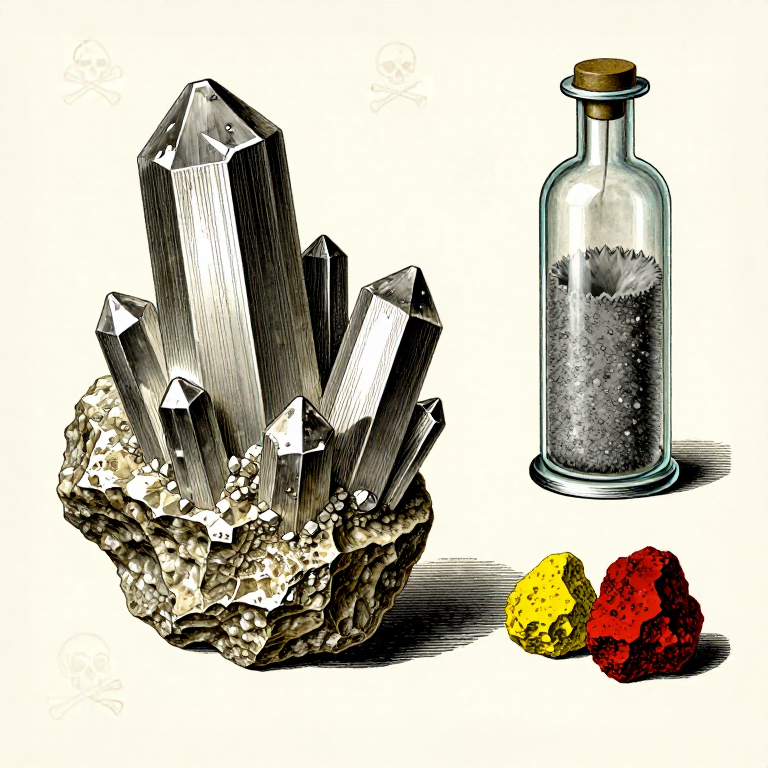
Arsenic (As, element 33) is one of the most infamous elements in history — its compounds were the preferred poison of the Borgias and countless murderers throughout the ages, earning it the title 'inheritance powder.' Yet arsenic has been known since antiquity: arsenic sulfide minerals (orpiment, As₂S₃, and realgar, As₄S₄) were used as pigments in ancient Egypt, and metallic arsenic was reportedly isolated by Albertus Magnus around 1250 CE by heating arsenopyrite (FeAsS) with soap.
Arsenopyrite (iron arsenic sulfide, FeAsS) is the most common arsenic mineral, containing 46% arsenic by mass. When heated strongly in a sealed vessel, arsenopyrite decomposes: the arsenic sublimes (passes directly from solid to gas without melting) and can be condensed as a grey, metallic solid on a cool surface. This thermal decomposition is the simplest route to elemental arsenic.
EXTREME HAZARD — LETHAL POISON: Arsenic and all its compounds are severely toxic. Arsenic trioxide (As₂O₃, 'white arsenic') is lethal at doses as low as 70–180 mg — less than a quarter teaspoon. Chronic exposure causes cancer (lungs, skin, bladder), peripheral neuropathy, and organ damage. Arsine gas (AsH₃), which can form if arsenic contacts acids, is among the most toxic gases known. This blueprint is presented for historical and educational purposes. Any practical work with arsenic requires professional-grade containment, respiratory protection, and hazardous waste disposal. Check local regulations — possession of arsenic compounds is restricted in many jurisdictions.
CC0 公共领域
此蓝图以 CC0 协议发布。你可以自由复制、修改、分发和使用此作品,无需征得许可。
通过购买蓝图中的产品支持创客,他们将获得 创客佣金 (由供应商设定),或创建此蓝图的新版本并将其作为连接包含在你自己的蓝图中以分享收入。