

Feather and Wedge
说明
Prove stone is weak in tension
Prove stone is weak in tension
Establish the asymmetry the method exploits.
- Stand on a small slab of stone laid flat on the ground — it takes the compression easily.
- Support the same slab at both ends only and load the middle.
- It breaks at a fraction of the load.
此步骤所需材料:
 耐火砖2 个
Read the grain before you mark the line
Read the grain before you mark the line
Granite has directional weakness, and quarrymen have names for it.
- Look for the rift — the direction it splits most easily.
- Find the grain — the next easiest.
- The hardway is the third, and you avoid it.
此步骤所需材料:
 凸透镜1 个
Drill the row and set the feathers
Drill the row and set the feathers
Evenly spaced, equal depth, all in line.
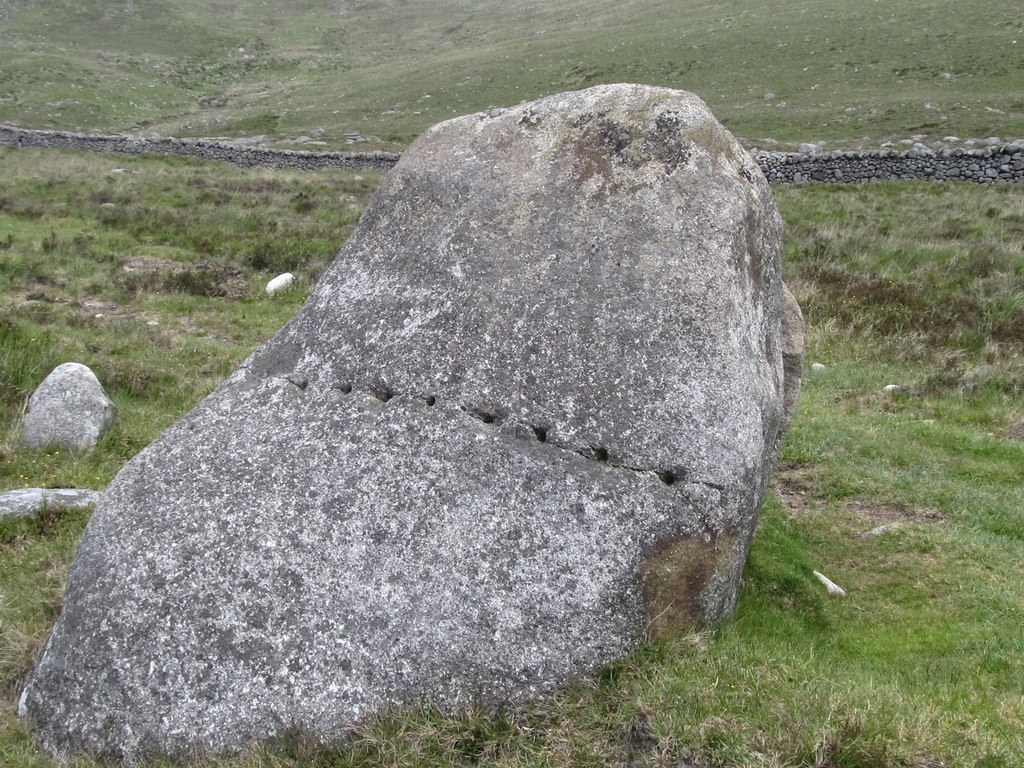
- Drill holes along the marked line, typically 100-150 mm apart in granite.
- Drop two feathers into each hole, with their flat backs facing along the line.
- Insert a plug between each pair, leaving it standing proud.
此步骤所需材料:
 钢楔6 个
钢楔6 个 尖头冷錾1 个
Tap along the row, and listen
Tap along the row, and listen
Patience is the technique. Eye protection throughout.
- Tap each plug once, lightly, working along the row.
- Return to the start and repeat, again and again.
- Listen — the note changes and a hairline appears before it goes.
此步骤所需材料:
 雕刻木槌1 个
History and context
History and context
Splitting stone with wedges is ancient. Egyptian and Roman quarries show wedge slots, and there is a long-running argument about whether wooden wedges were soaked to swell and split the stone — the evidence is genuinely mixed, and dry wooden wedges hammered in work perfectly well, so the soaking story should be treated as plausible rather than established.
The modern plug-and-feather set is a nineteenth-century refinement associated with New England granite quarrying, where it replaced the older method of cutting a continuous slot with a chisel. It is far faster and wastes almost no stone — a slot turns a line of material into dust, while a split consumes only the drill holes.
Look for the marks. Half-round grooves along the edge of a granite kerbstone, bridge abutment or old building block are the remains of the drill holes, sliced in two by the split. They are all over nineteenth-century masonry once you know to look, and they date the stone as surely as a tool mark can.
Still current. Quarries use hydraulic splitters and diamond wire now, but plug and feather remains standard for trimming, for work where vibration matters, and for conservation — and a set of feathers and wedges costs very little and needs no power. It is one of those techniques that industrialisation improved without ever replacing.
Safety: eye protection without exception — steel-on-steel throws chips, and the stone releases suddenly. Keep hands clear of the split line and expect the two halves to move.
CC0 公共领域
此蓝图以 CC0 协议发布。你可以自由复制、修改、分发和使用此作品,无需征得许可。
通过购买蓝图中的产品支持创客,他们将获得 创客佣金 (由供应商设定),或创建此蓝图的新版本并将其作为连接包含在你自己的蓝图中以分享收入。