艺术
美容与健康
工艺
文化与历史
娱乐
环境
食品与饮料
逆向工程
科学
体育
技术
可穿戴设备
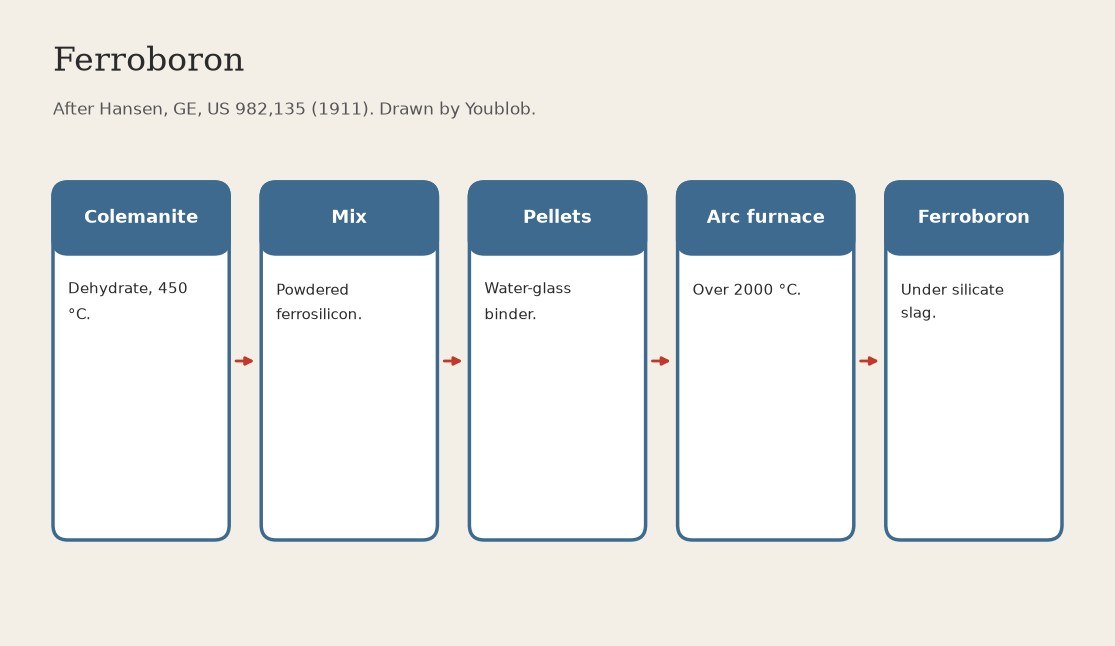


Ferroboron: Colemanite Reduced by Ferrosilicon above 2000 °C in an Arc Furnace (Hansen, GE, US 982,135, 1911)
Ferroboron should carry little carbon, so Hansen reduced the boron mineral colemanite with silicon instead of coke. The silicon takes the oxygen, joins the lime as a calcium silicate slag, and the boron goes into the iron of the ferrosilicon.
Result: ferroboron, low in carbon, under a clean slag.
Source: Hansen, US 982,135 (1911). Not given: weights, boron content. Picture drawn by Youblob.
高级
1 day
说明
1
1
Dehydrate the colemanite at 450 °C
Dehydrate the colemanite at 450 °C
Heat colemanite to about 450 °C in a suitable container to drive off its water.
此步骤所需材料:
 硬硼钙石1 as required
所需工具:
 马弗炉
2
2
Powder and mix with ferrosilicon
Powder and mix with ferrosilicon
Grind it and mix with powdered ferrosilicon: enough silicon to reduce all the boron and slag off the lime. The amount depends on the silicon content of the ferrosilicon.
此步骤所需材料:
 硅铁1 as required
所需工具:
 研钵与研杵
3
3
Bind and press into pellets
Bind and press into pellets
Mix the powder with a binder, e.g. water glass, and press it into pellets.
所需工具:
 水玻璃(硅酸钠溶液)
 压丸机
4
4
Reduce above 2000 °C
Reduce above 2000 °C
Heat the pellets above 2000 °C, e.g. in a Moissan arc furnace (a ferrosilicon-type resistance furnace also works). Silicon reduces the boron; the calcium silicate slag separates cleanly from the ferroboron.
所需工具:
 电弧炉
此蓝图制作
CC0 公共领域
此蓝图以 CC0 协议发布。你可以自由复制、修改、分发和使用此作品,无需征得许可。
通过购买蓝图中的产品支持创客,他们将获得 创客佣金 (由供应商设定),或创建此蓝图的新版本并将其作为连接包含在你自己的蓝图中以分享收入。