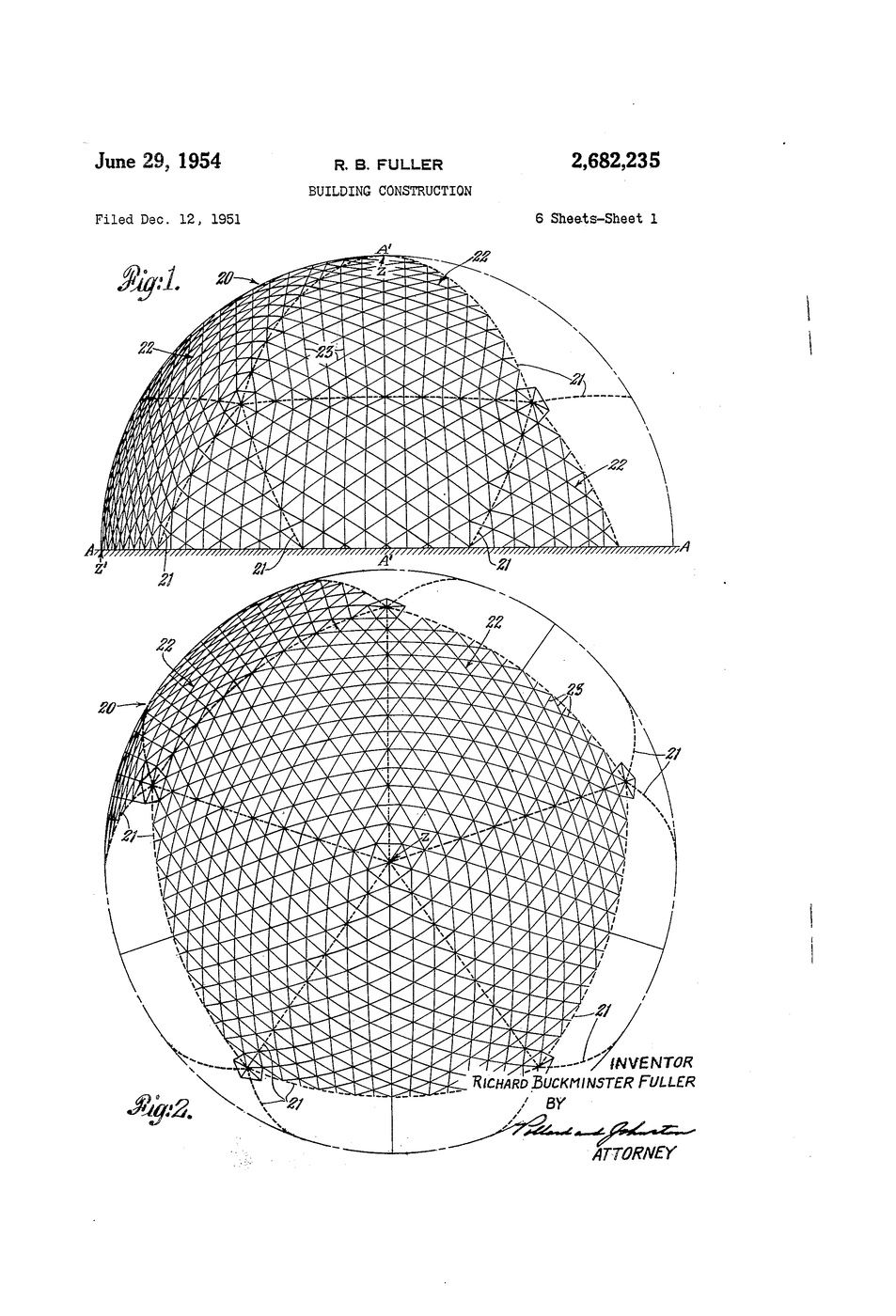


Geodesic Dome
A traditional building fights gravity with brute mass — thick walls and heavy beams — and a conventional frame weighs around 50 pounds for every square foot of floor it shelters. Fuller asked a different question: what is the least structure that can enclose the most space and still stand up to wind and weight?
His answer is the geodesic dome: a sphere approximated by a three-way grid of triangles laid along great-circle arcs. Because the pattern is triangulated, every member carries its load as pure tension or compression — triangles cannot distort — and because the load spreads through the whole three-way grid, the structure behaves almost like a continuous skin, or membrane, with every strut sharing the stress evenly.
The result is astonishing efficiency: Fuller's patent claims about 0.78 pounds per square foot — dozens of times lighter than a conventional frame — a dome you could carry in a bundle yet that withstands 150-mph winds.
US Patent 2,682,235, "Building construction", filed 1951 and granted 29 June 1954 to Richard Buckminster Fuller.
说明
Read the claim and the number
Read the claim and the number
Fuller claims a frame of great-circle arcs forming a three-way grid of triangles with "substantially uniform stressing of all members" — and quotes about 0.78 lb per square foot versus ~50 for a normal frame. Note that ratio.
Build a square from four struts and push it
Build a square from four struts and push it
Pin four sticks into a square with loose corners and push a corner sideways. It collapses into a diamond — a square frame has no stiffness of its own.
此步骤所需材料:
 巴尔沙木条1 包
所需工具:
 手工刀
手工刀Add one diagonal to make triangles
Add one diagonal to make triangles
Add a diagonal across the square, making two triangles, and push again. Now it is rigid. A triangle cannot change shape without changing a side's length — the root of all this.
Join triangles into a curved surface
Join triangles into a curved surface
Connect several triangles edge to edge and let them curve. Flat triangles tiled together approximate a sphere — this is the geodesic idea. Use clay balls as the joints.
此步骤所需材料:
 聚合物黏土套装1 套
Measure the two strut lengths you need
Measure the two strut lengths you need
A simple geodesic dome uses just two slightly different strut lengths in a fixed ratio. Cut a batch of each with a protractor and ruler; the exact ratio is what makes the triangles close into a sphere.
所需工具:
 量角器/角度尺
Assemble a small dome
Assemble a small dome
Build up rings of triangles into a hemisphere, joining struts at clay nodes. The dome takes shape and stiffens as it closes — half-built it is floppy, closed it is rigid.
Weigh the finished dome
Weigh the finished dome
Weigh your dome and note the floor area it covers. Compute weight per unit area — it is tiny. This is the number Fuller was proudest of.
所需工具:
 天平
天平Press down on the top and feel the load spread
Press down on the top and feel the load spread
Push down on the crown. The load fans out through the whole grid to the base ring — no single member is overloaded. The dome acts almost like a solid shell.
所需工具:
 测力计(弹簧秤)
Load it to failure and compute strength-to-weight
Load it to failure and compute strength-to-weight
Pile weight on until it buckles. Divide the failure load by the dome's own weight. A geodesic dome holds many times its own weight — Fuller's patent cites 7 lb supported per ounce of structure.
Try to rack it sideways
Try to rack it sideways
Push the dome from the side, as wind would. It barely deflects — every triangle resists, and there is no weak direction. Compare with how the square in step 2 folded.
Remove one strut and re-test
Remove one strut and re-test
Take out a single member and load again. The dome redistributes the load around the gap and mostly holds — the many-membered grid is redundant, so no single failure drops it. Note this resilience.
Why it gets relatively stronger as it gets bigger
Why it gets relatively stronger as it gets bigger
A dome's enclosed volume grows faster than its surface. So the bigger the geodesic dome, the less structure per unit of space — the opposite of a beam-and-column building. Write down why this makes huge domes so efficient.
History & Context — the most structure from the least
History & Context — the most structure from the least
The patent. US 2,682,235, "Building construction", filed 12 December 1951 and granted 29 June 1954 to Richard Buckminster Fuller. The specification is unusually candid about its aim: it opens by naming the right measure of a building frame — "the structural weight required to shelter a square foot of floor from the weather" — puts the conventional figure at "often 50 lbs. to the sq. ft.," and claims to do the job "at around 0.78 lb. per sq. ft." That sixty-fold improvement is the whole invention stated as a number.
The physics is triangulation plus distribution. A quadrilateral frame has no shape-stability — push it and it folds (step 2) — while a triangle is rigid because you cannot change its shape without stretching a side (step 3). Fuller's dome tiles the surface of a sphere with triangles laid along geodesics (great-circle arcs, the shortest paths on a sphere), forming a three-way grid in which, as the patent says, the members are "substantially uniformly stressed" and "the framework itself acts almost as a membrane in absorbing and distributing loads" (step 8). Two things follow: every strut does its fair share (no heavily loaded members to over-build), and the structure is highly redundant, so losing one member barely matters (step 11). And because a sphere encloses the most volume for the least surface, the design gets relatively lighter as it gets larger (step 12) — a giant geodesic dome is fantastically efficient.
Fuller did not invent the geometry alone. A geodesic dome had been built decades earlier by Walther Bauersfeld for the Zeiss planetarium in Jena (c. 1922), and the underlying geometry is older still. Fuller's contribution was to develop the mathematics into a general, buildable system, to patent and promote it relentlessly, and to demonstrate its extraordinary strength-to-weight — the patent's "8C270 Weatherbreak" is a 49-foot dome that packs into a 2×4×5-foot bundle weighing about half a tonne yet withstands 150-mph winds. Over 300,000 geodesic domes were built in his lifetime.
Where it went. Geodesic domes housed radar stations across the Arctic (the DEW Line radomes), covered the US pavilion at Expo 67, sheltered auditoriums, greenhouses and homes, and the geometry lent its name to the buckminsterfullerene molecule — the C60 "buckyball" — whose atoms sit at the vertices of a geodesic pattern. It is one of the purest demonstrations in engineering that form, not mass, is what makes a structure strong: the same handful of little sticks that folded flat as a square (step 2) hold many times their own weight once you arrange them as triangles on a sphere.
相关蓝图
这些蓝图共享知识——技术、材料或原理


CC0 公共领域
此蓝图以 CC0 协议发布。你可以自由复制、修改、分发和使用此作品,无需征得许可。
通过购买蓝图中的产品支持创客,他们将获得 创客佣金 (由供应商设定),或创建此蓝图的新版本并将其作为连接包含在你自己的蓝图中以分享收入。