合作
艺术
美容与健康
工艺
文化与历史
娱乐
环境
食品与饮料
逆向工程
科学
体育
技术
可穿戴设备
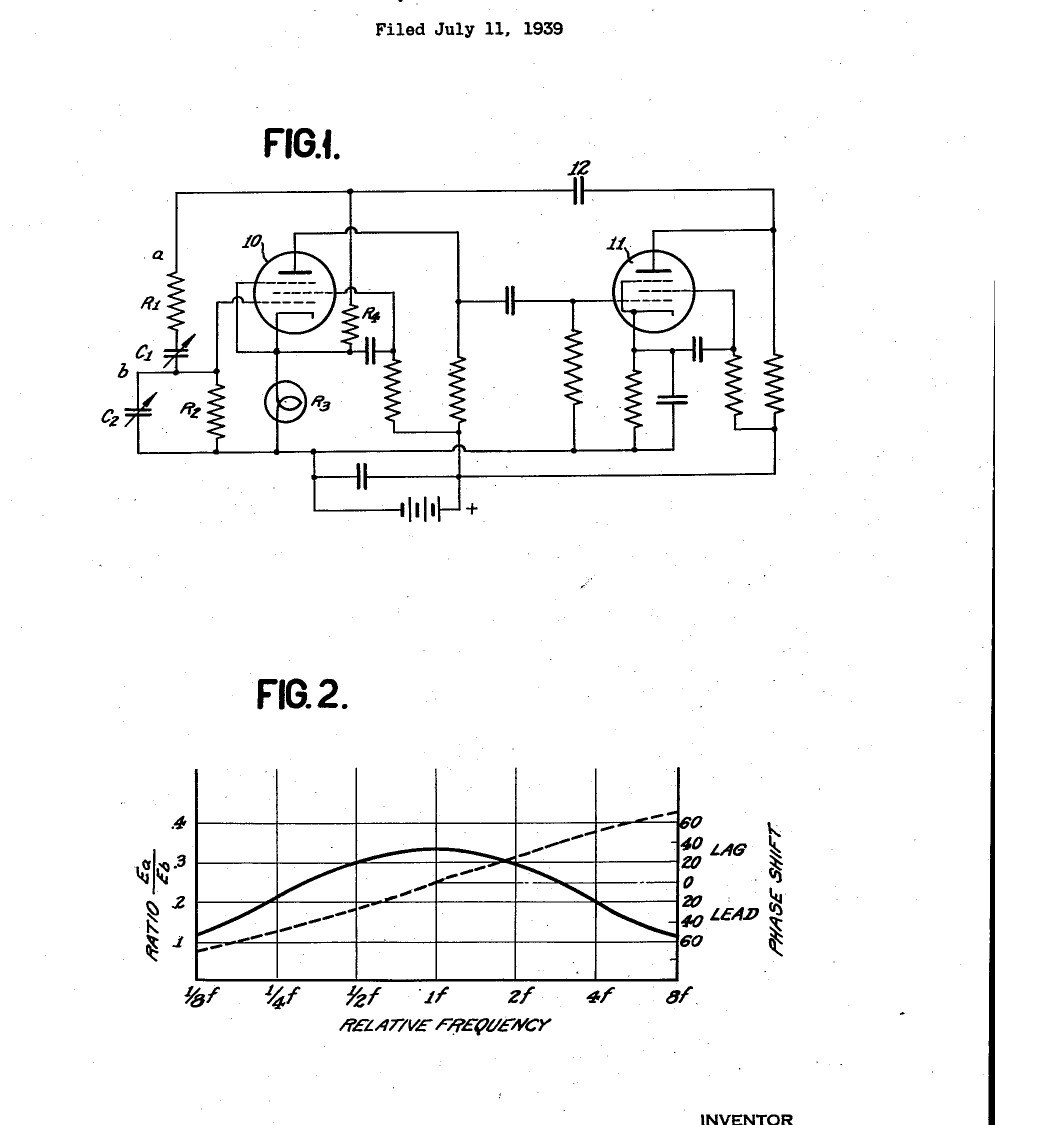


Function Generator: Resistance-Capacity Tuned Audio Oscillator with Lamp Amplitude Control (Hewlett, US 2,268,872, 1942)
The first Hewlett-Packard product: a test oscillator tuned by resistors and capacitors instead of coils. Two valve amplifiers feed their output back to their input through a series and a parallel R-C pair, which passes only one frequency in phase, so the circuit oscillates there. A second, negative feedback path through a small lamp holds the amplitude steady: as the swing grows the lamp warms, its resistance rises and the gain falls. One dial covers ten to one in frequency.
Result: a sine-wave signal generator covering 20 to 20,000 cycles in three ranges, about 0.25 % distortion.
Source: W. R. Hewlett, US 2,268,872 (1942). Unknown: valve types and component values. Picture: the patent drawing.
高级
Unknown
说明
1
1
Build the two-stage amplifier
Build the two-stage amplifier
Wire two amplifying valves in cascade with resistance-capacity coupling, the first's anode to the second's grid, run as class A amplifiers. Not given: valve types, values, the supplies. Ours: pentode valves in sockets.
此步骤所需材料:
 五极管2 个
 管座2 个
 电阻1 套
 电容套件1 coupling and by-pass
 铝制外壳盒1 case
 焊锡丝1 as needed
所需工具:
 电烙铁
2
2
Fit the tuning network
Fit the tuning network
From the second valve's anode, through a coupling capacitor, feed back to the first valve's grid through a resistor R1 in series with a variable capacitor C1, with a resistor R2 and variable capacitor C2 from the grid to ground. Make R1 = R2 and C1 = C2: the frequency is then 1/(2 pi R C), set by the capacitors, giving 10 to 1 on one dial. For the capacitors use a four-gang tuning capacitor with its sections paired in parallel. Switch three sets of resistors in for the ranges 20-200, 200-2000 and 2000-20,000 cycles. Ours: a rotary switch.
此步骤所需材料:
 可变电容(空气介质)1 four-gang电阻1 three sets of R1, R2
 旋转开关1 range switch
所需工具:
电烙铁 螺丝刀套装
3
3
Fit the lamp feedback and use it
Fit the lamp feedback and use it
From the same output, through the coupling capacitor, feed back to the first valve's cathode across a resistor R4 and a small incandescent lamp R3. As the oscillation grows, the lamp heats, its resistance rises, the negative feedback increases and the gain falls, so the amplitude settles below the point of grid current with no clipping. The negative feedback also steadies the gain against valve and supply changes. Take the output from the terminals; Hewlett's test unit held its output within about 10 % over 20-20,000 cycles, with about 0.25 % distortion and under 0.1 % frequency shift with supply changes.
此步骤所需材料:
 灯泡1 small incandescent lamp电阻1 R4
 接线柱2 output
所需工具:
 直流电源电烙铁
材料
10- 2 个占位符
- 2 个占位符
- 1 R4占位符
- 1 coupling and by-pass占位符
- 1 case占位符
- 1 as needed占位符
- 1 four-gang占位符
- 1 range switch占位符
- 1 small incandescent lamp占位符
- 占位符
此蓝图制作

CC0 公共领域
此蓝图以 CC0 协议发布。你可以自由复制、修改、分发和使用此作品,无需征得许可。
通过购买蓝图中的产品支持创客,他们将获得 创客佣金 (由供应商设定),或创建此蓝图的新版本并将其作为连接包含在你自己的蓝图中以分享收入。