艺术
美容与健康
工艺
文化与历史
娱乐
环境
食品与饮料
逆向工程
科学
体育
技术
可穿戴设备
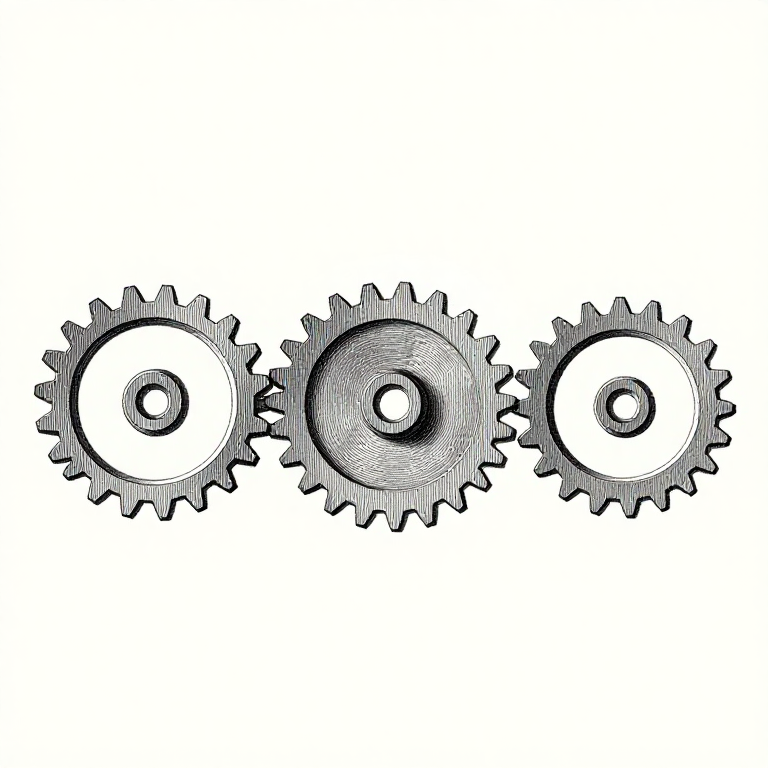


Gear Trains: Idlers, Compounding and Hitting a Given Ratio
One gear pair gives one ratio and there is a practical limit to how large it can be. Beyond about 6:1 the wheel becomes absurd beside its pinion, so ratio is built up in stages — and how the stages are arranged decides whether they multiply or cancel.
A line of gears each on its own shaft multiplies nothing: every gear between the first and the last appears once as driven and once as driver and drops straight out of the arithmetic. Those are idlers, and they earn their place by reversing direction and bridging distance, not by changing ratio. Pairing two gears on one shaft is what compounds.
This rung is the arithmetic of trains, what an idler is for, and the classic problem of hitting a ratio that is given to you rather than chosen — why a screwcutting lathe needs a 127 tooth gear, and how far an approximate ratio can be trusted.
中级
4 hours
说明
1
1
Simple, compound and reverted
Simple, compound and reverted
**A simple train** has one gear per shaft. The overall ratio is the last tooth count divided by the first, whatever is in between.
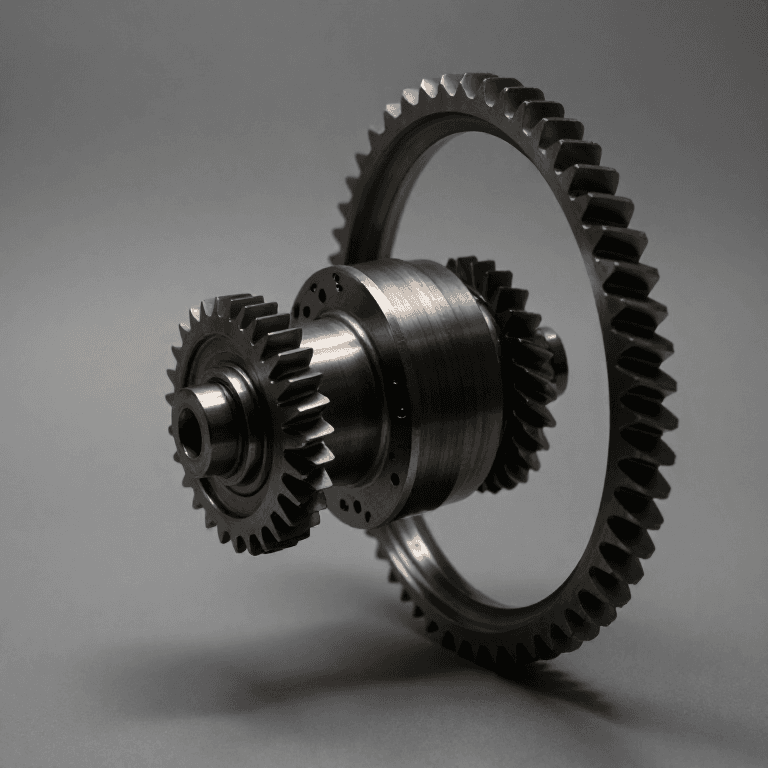
**A compound train** has two gears keyed to the same shaft. The pair turns together, so the ratio of the first mesh is carried into the second and the stages multiply. Every large reduction is a compound train.
**A reverted train** is a compound train whose input and output are on the same axis. It is the awkward one to design, because the centre distances of both stages must be equal — z₁ + z₂ = z₃ + z₄ at a common module — which constrains the tooth counts far more than the ratio does. Clocks and lathe headstocks are full of them.
**Per stage, keep the ratio sensible.** Spur and helical stages are usually held between about 1:1 and 6:1. Below 1:1 the pinion drives the wheel backwards and nothing is gained; above about 6:1 the wheel is large, heavy and expensive beside a pinion that is now the weak part, and a second stage costs less than the oversized wheel would.
**Split the ratio between stages, roughly evenly.** Two stages of 5:1 give 25:1 in a smaller box than 10:1 followed by 2.5:1, because the large wheel of the first arrangement is smaller. A common rule puts slightly more reduction in the first stage, where the torque is lowest.
此步骤所需材料:
 正齿轮组(钢,20 齿)4 个
 30 毫米钢轴2 个
 滚珠轴承4 个
所需工具:
 6 英寸数显卡尺
2
2
Train arithmetic, idlers and change gears
Train arithmetic, idlers and change gears
正在加载 Jupyter 笔记本…
所需工具:
 台式电脑
台式电脑3
3
Laying out a train that fits
Laying out a train that fits
**Start from the output.** The output torque and speed are given; the input is usually a motor with a catalogue of standard speeds. The ratio is fixed before anything is drawn.
**Choose the module from the most loaded pinion**, which is the last stage, where the torque is highest. A module chosen for the input stage will be too small at the output.
**Then the centre distances are no longer free.** Each stage's centres follow from m(z₁+z₂)/2, and the shafts must land where the housing can hold them. Adjusting a tooth count by one or two teeth to make a centre distance convenient is normal and costs nothing — and it is a good moment to make the counts coprime.
**Check the gears physically clear each other.** In a compound train the large wheel of one stage and the large wheel of the next are on adjacent shafts, and they can overlap in plan even though they never mesh. Draw the tip circles.
**Check the direction at the output.** Count the external meshes. Discovering after machining that the output turns the wrong way is an expensive idler.
**Leave room for bearings on both sides of every gear.** An overhung gear — one outboard of both its bearings — deflects under load and tips out of alignment, which is the subject of the mounting rung.
此步骤所需材料:
正齿轮组(钢,20 齿)4 个30 毫米钢轴2 个滚珠轴承4 个所需工具:
6 英寸数显卡尺 直尺台式电脑
4
4
Where trains go wrong
Where trains go wrong
**Tolerances add up along a train.** Each stage contributes its own backlash and its own transmission error, and at the output they sum. A four-stage train with a comfortable 0.08 mm of backlash per stage has, referred to the output, the sum of each stage's backlash divided by the ratio between it and the output — so the last stage dominates and the first barely matters. This is why a precision drive is built with the accurate stage last.
**Efficiency multiplies, it does not average.** A stage at 98% is excellent; four of them give 0.98⁴ = 92%. A worm stage at 60% in a four-stage train leaves 55% overall whatever the other stages do.
**The heat goes somewhere.** The lost 8% is watts in the oil, and a sealed box with no path to air will keep warming until the oil thins and the film fails.
**A common factor in the tooth counts wastes the train.** Two stages of 20:60 share every factor there is, so the same teeth meet for ever in both. Making one stage 20:61 costs nothing.
**An idler between two gears that already mesh correctly can still be wrong.** It must be the same module and pressure angle as both, and its own tooth count should share no factor with either, or it hunts in neither mesh.
此步骤所需材料:
正齿轮组(钢,20 齿)4 个 齿轮减速电机1 个
所需工具:
 百分表台式电脑
材料
4- 4 个占位符
- 2 个占位符
- 占位符
- 占位符
相关蓝图
这些蓝图共享知识——技术、材料或原理

CC0 公共领域
此蓝图以 CC0 协议发布。你可以自由复制、修改、分发和使用此作品,无需征得许可。
通过购买蓝图中的产品支持创客,他们将获得 创客佣金 (由供应商设定),或创建此蓝图的新版本并将其作为连接包含在你自己的蓝图中以分享收入。