
Greek Black-Figure Pottery — Painting Black-Figure Pottery with Iron Slip
说明
Prepare the Iron-Rich Slip
Prepare the Iron-Rich Slip
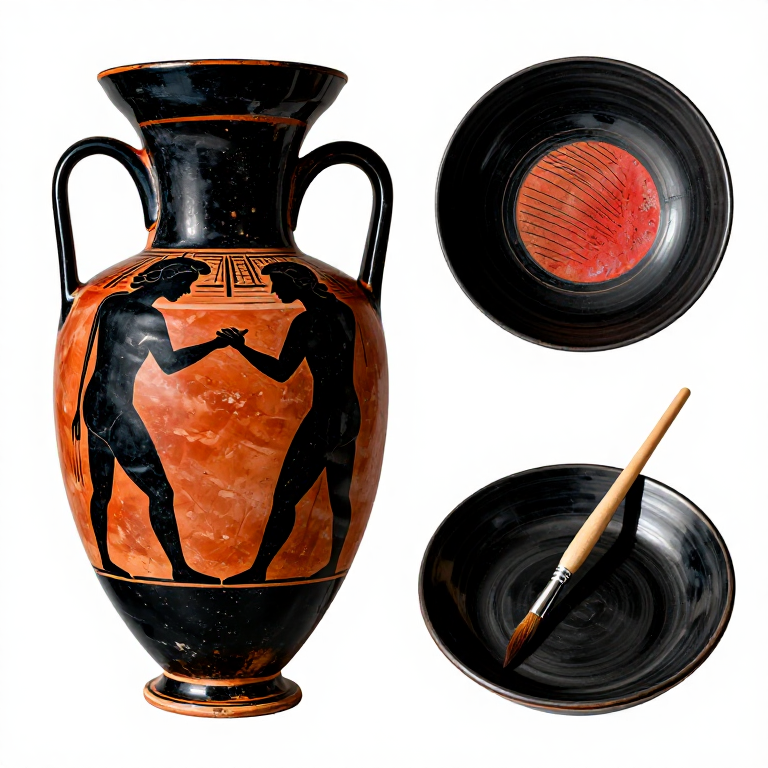
The key to black-figure technique is a refined clay slip with very high iron content and extremely fine particle size. Take iron-rich clay (ideally Attic-type illite clay with 8-12% iron oxide content), mix it with water, and let it settle. Decant the top layer of fine suspended particles, which are colloidally fine (less than 1 micron). This ultra-fine fraction is the painting slip. Its small particle size allows it to sinter (fuse into a glassy surface) at lower temperatures than the coarser body clay, which is why it becomes glossy and impervious during firing while the body remains matte and porous. Add a small amount of wood ash as flux to lower the sintering temperature further. The slip should be the consistency of thick cream.
此步骤所需材料:
 皮革硬状态的红陶器皿1 vessel 个
 野生黏土100-200 ml 毫升
 红赭石化妆土small amount 个
 白色化妆土small amount 个
所需工具:
 画笔套装
画笔套装 窑炉
窑炉 指南针
指南针Paint the Figures in Silhouette
Paint the Figures in Silhouette
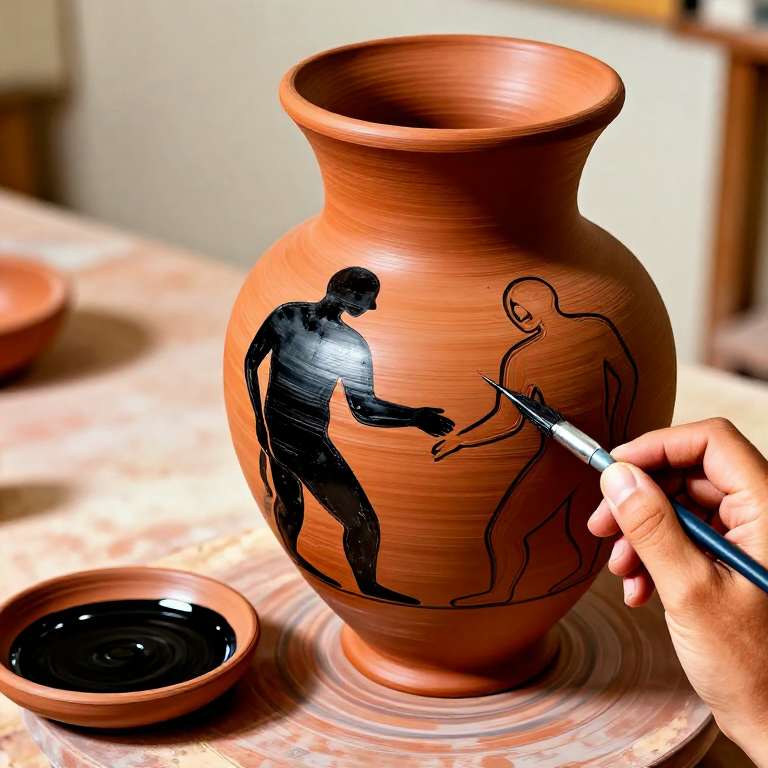
Using fine brushes, paint the figural scenes onto the leather-hard clay vessel in solid silhouette using the refined slip. Work confidently with steady strokes — the slip cannot be easily corrected once applied. Greek vase painters used a remarkable range of line widths, from bold filled areas to hairline details, all with the same slip at different dilutions. Outline the figures first with a thin line, then fill in the silhouettes with thicker slip. Reserve (leave unpainted) the areas that will remain the natural red color of the fired clay — these form the background. Common black-figure subjects included mythological scenes, athletic contests, and daily life activities. Apply slip evenly, approximately 0.1-0.3 mm thick.
Incise Details into the Slip
Incise Details into the Slip
Once the slip has dried to a firm consistency but before firing, use a sharp pointed tool (burin or stylus) to incise fine lines through the black slip, revealing the red clay body beneath. These incised lines define the internal details of the figures — muscle lines, drapery folds, facial features, hair, and armor details. This incision technique is what distinguishes black-figure from earlier silhouette styles and gives the figures their characteristic sharp, linear detail. The quality of incised line work varied enormously among painters — the finest, like Exekias and the Amasis Painter, achieved extraordinary precision and expressiveness. Apply added colors: white slip for female skin and details, red ochre for hair, beards, and decorative borders.
Fire in a Three-Phase Kiln Cycle
Fire in a Three-Phase Kiln Cycle
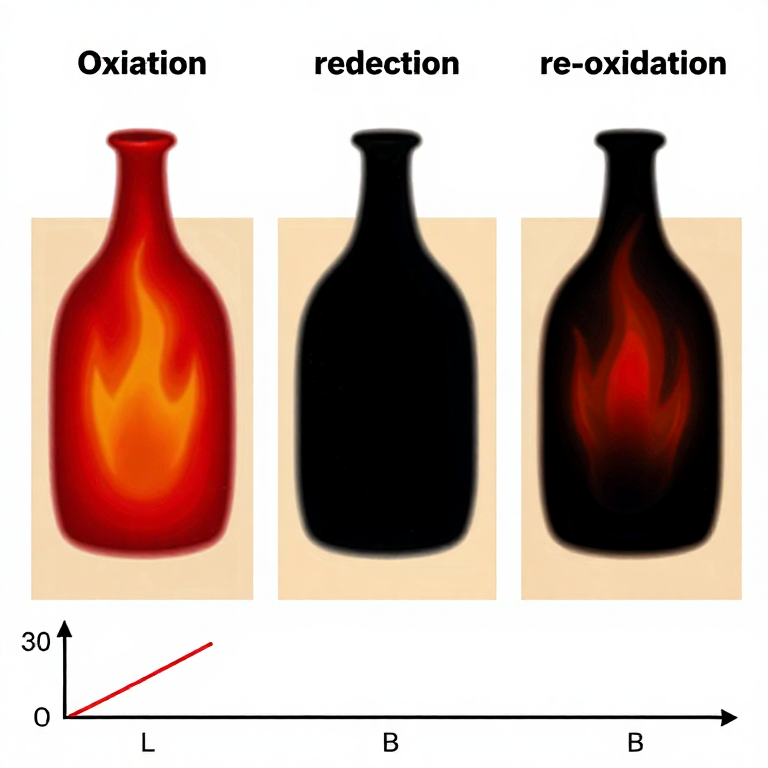
The critical step is the three-phase firing that produces the color contrast. Phase 1 (Oxidation): Fire to approximately 800 degrees Celsius with plenty of air — both slip and body turn red from oxidized iron (Fe2O3). Phase 2 (Reduction): Close the kiln vents and introduce green wood or damp fuel to create smoke. The oxygen-poor atmosphere reduces iron oxide to black magnetite (Fe3O4) and wustite (FeO) at approximately 950 degrees Celsius — everything turns black. Phase 3 (Re-oxidation): Open the vents and reduce temperature. The porous body clay re-oxidizes back to red, but the sintered slip, having fused into an impervious glassy surface during the reduction phase, cannot re-oxidize and remains permanently black. This elegant chemistry creates black figures on a red ground from a single firing.
Cool and Inspect the Finished Vessel
Cool and Inspect the Finished Vessel
Allow the kiln to cool slowly over 12-24 hours before opening. Rapid cooling causes thermal shock cracking in the ceramic body. The finished vessel should display glossy black figures with fine incised red details against a warm orange-red background. The black slip areas should have a slight metallic sheen when viewed at an angle, indicating proper sintering. If the black areas appear matte or brownish, the reduction phase was insufficient; if the red background areas are grey or black, the re-oxidation phase was too short. The black-figure technique dominated Athenian pottery from approximately 630 to 480 BCE, when it was gradually superseded by the red-figure technique, which reversed the color scheme for greater artistic flexibility.
材料
7- 100-200 ml 毫升占位符
- small amount 个占位符
- 1 vessel 个占位符
- 100-200 ml 个占位符
- small amount 个占位符
- small amount 个占位符
- 1 batch占位符
此蓝图制作

相关蓝图
这些蓝图共享知识——技术、材料或原理

CC0 公共领域
此蓝图以 CC0 协议发布。你可以自由复制、修改、分发和使用此作品,无需征得许可。
通过购买蓝图中的产品支持创客,他们将获得 创客佣金 (由供应商设定),或创建此蓝图的新版本并将其作为连接包含在你自己的蓝图中以分享收入。