

Haber-Bosch Process
说明
The bond that makes it hard
The bond that makes it hard
Atmospheric nitrogen is abundant and almost completely unreactive.
- N₂ is held by a triple bond of about 945 kJ/mol.
- Almost nothing at ordinary conditions will break it.
- Only lightning and certain bacteria fix nitrogen naturally.
Fighting the equilibrium
Fighting the equilibrium
The reaction is reversible, and the conditions that help one way hurt the other.
N₂ + 3 H₂ ⇌ 2 NH₃ (exothermic)
- Four molecules become two, so high pressure pushes toward ammonia.
- It gives out heat, so low temperature favours ammonia at equilibrium.
- But low temperature makes the reaction unusably slow.
此步骤所需材料:
 氮1 cylinder
 氢3 cylinder
The catalyst and the conditions
The catalyst and the conditions
The compromise, roughly as run today.
- Temperature 400-500 °C.
- Pressure 150-250 atmospheres.
- Catalyst: iron, from reduced magnetite, promoted with potassium and aluminium oxides.
- Unreacted gas is separated and recycled.
此步骤所需材料:
 压力表1 个
Where the hydrogen comes from
Where the hydrogen comes from
Nitrogen is free from the air. Hydrogen is not, and it dominates the process's footprint.
- Today it is made mostly by steam reforming natural gas: CH₄ + H₂O → CO + 3 H₂.
- Early plants used coal and water gas instead.
- Nitrogen comes from air separation.
History and context
History and context
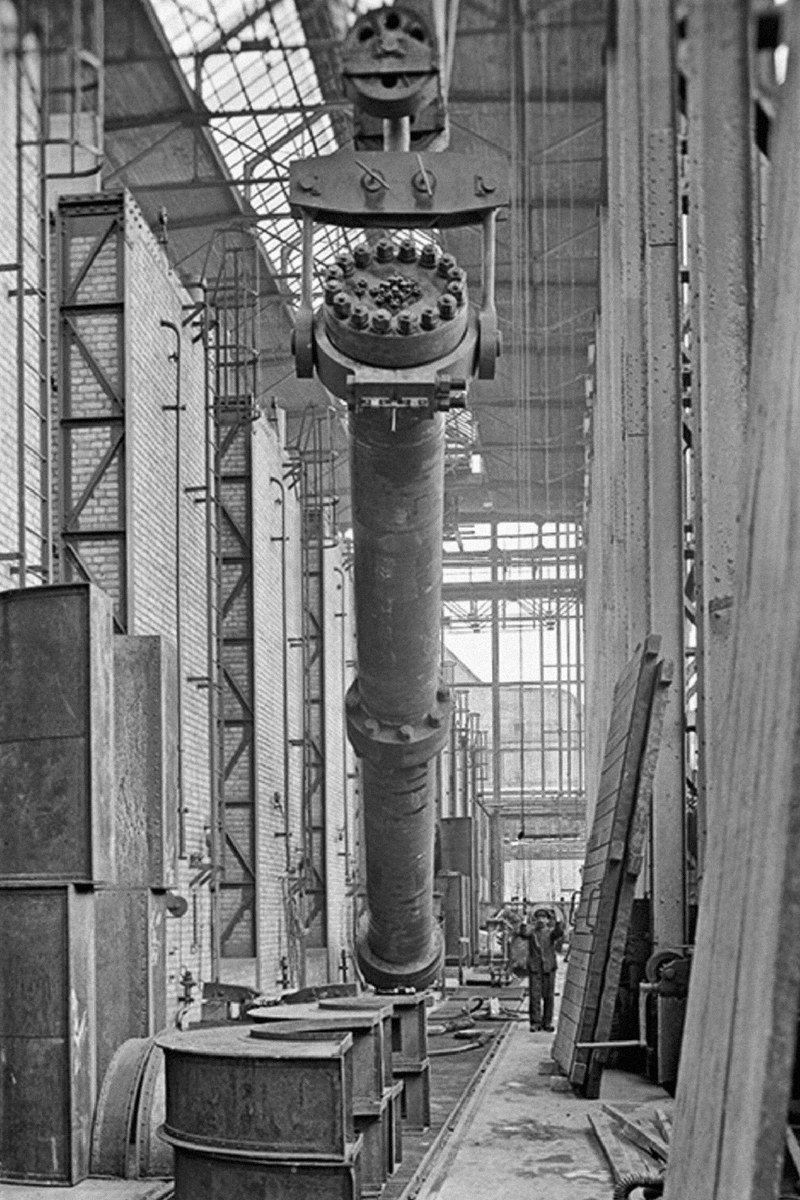
Fritz Haber, at Karlsruhe, demonstrated a bench apparatus producing ammonia continuously in July 1909 — a few grams an hour, at pressure, over an osmium catalyst. Carl Bosch at BASF took on the scale-up, which was arguably the harder problem: no vessel then existing could hold hundreds of atmospheres at red heat, because hydrogen at those conditions attacks steel and embrittles it. Bosch's answer was a lined double-walled reactor with a soft iron inner liner and a vented outer shell. Alwin Mittasch tested thousands of catalyst formulations to replace scarce osmium with iron. The Oppau plant started in 1913. Both Haber and Bosch received Nobel Prizes, in 1918 and 1931.
The honest accounting. Nitrogen fertiliser is estimated to sustain around half the world's population; without it, current global agriculture is not possible. The same plants made nitric acid for explosives, which allowed Germany to continue fighting the First World War after the Allied blockade cut off Chilean nitrate. Haber also personally directed Germany's chemical weapons programme and was present at the first chlorine attack at Ypres in 1915; his wife Clara Immerwahr, herself a chemist, killed herself days afterwards. Haber, who was Jewish, was driven out of Germany in 1933 and died in exile the following year.
The environmental tail. Nitrogen that runs off fields drives algal blooms and coastal dead zones, and nitrous oxide from soils is a potent greenhouse gas. Fixing more nitrogen than the biosphere does is a genuinely new condition for the planet.
Why there is no build here. 200 atmospheres at 450 °C in a hydrogen atmosphere is not a scale that can be reduced. There is no honest bench version, and the related blueprints on the Solvay process and on lime give safe examples of industrial chemistry that can be shown.
相关蓝图
这些蓝图共享知识——技术、材料或原理


CC0 公共领域
此蓝图以 CC0 协议发布。你可以自由复制、修改、分发和使用此作品,无需征得许可。
通过购买蓝图中的产品支持创客,他们将获得 创客佣金 (由供应商设定),或创建此蓝图的新版本并将其作为连接包含在你自己的蓝图中以分享收入。