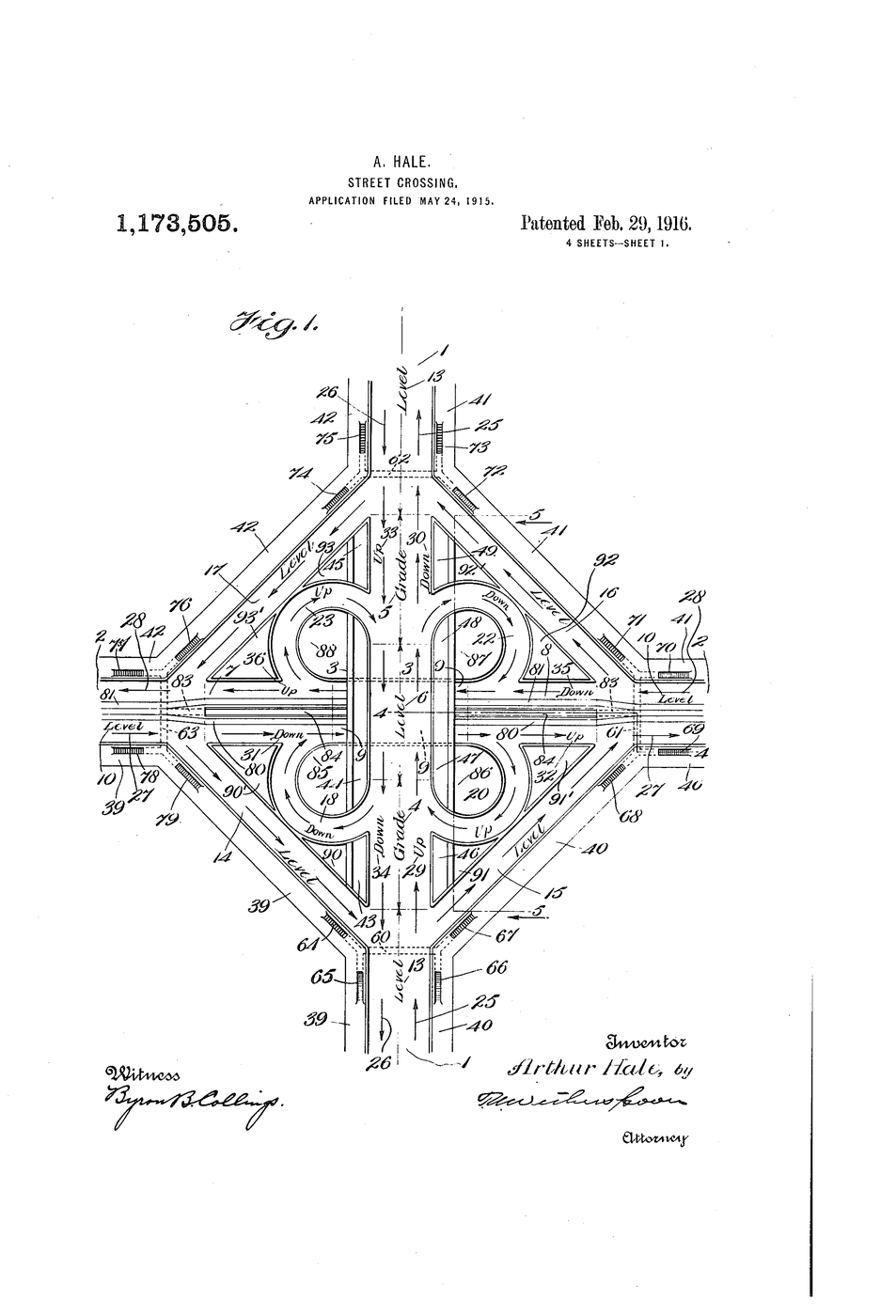


Cloverleaf Interchange
Where two roads cross on the flat, every vehicle that wants to turn must at some point drive across the path of someone going the other way. Traffic engineers call those places conflict points, and a plain four-way crossing has a startling number of them. Signals do not remove conflict points — they take turns at them.
Hale's answer is to remove the crossings entirely by using the third dimension. One street rises onto a viaduct, the other dips beneath it, and four curved passage ways connect the two levels so that a driver can get from any approach to any exit without ever crossing an opposing stream. Nobody waits, because nobody is in anybody's way.
Because those four curves loop back on themselves in each quadrant, the plan drawn on paper looks like a four-leaf clover — which is where the name comes from. The patent also provides subways and safety islands for people on foot.
US Patent 1,173,505, "Street-crossing.", granted 29 February 1916 (filed 24 May 1915) to Arthur Hale.
This blueprint is a counting exercise as much as a building one: you will count the conflict points before and after, and the difference is the invention.
说明
Read the claim: a viaduct plus four curves
Read the claim: a viaduct plus four curves
Hale claims raised grades to a viaduct, depressed grades on the crossing street, and four curved passage ways joining them — so traffic goes any direction without meeting another stream at grade.
Draw a plain four-way crossing
Draw a plain four-way crossing
On graph paper draw two roads crossing at right angles, each with two lanes in each direction. Label the four approaches N, E, S, W.
此步骤所需材料:
 坐标纸1 张
所需工具:
 建筑师比例尺套装
List every movement
List every movement
From each approach a driver may turn left, go straight, or turn right. Write them all out: 4 approaches × 3 choices = 12 movements. Ignore U-turns.
Draw all 12 paths in colour
Draw all 12 paths in colour
Draw each of the 12 movements as a line across your junction. The page becomes a mesh — every intersection of two lines is a place two cars could occupy at once.
Mark the crossing conflicts
Mark the crossing conflicts
Put a red dot everywhere two paths cross. These are the dangerous ones — a side-impact collision. Count them.
Mark the merges and the diverges
Mark the merges and the diverges
Put a blue dot where two paths join and a green dot where one splits. Count each colour separately.
Total them and check
Total them and check
Add up. A standard four-leg crossing has 32 conflict points: 16 crossing, 8 merging, 8 diverging. If your count differs, find the paths you missed.
Build the lower road
Build the lower road
Cut a 400 mm card strip and lay it flat on the base as the depressed street.
此步骤所需材料:
 瓦楞纸板1 张
所需工具:
 手工刀
手工刀Build the viaduct over it
Build the viaduct over it
Cut a second strip and prop it 60 mm above the first, crossing at right angles, with ramps sloping down to the base at both ends.
此步骤所需材料:
瓦楞纸板1 张所需工具:
 热熔胶枪
热熔胶枪Add the four loops
Add the four loops
Cut four curved card ramps, one in each quadrant, each looping through about 270° to connect one road to the other. Now the clover is visible from above.
此步骤所需材料:
 卡纸4 张
卡纸4 张所需工具:
 量角器/角度尺
Drive all 12 movements
Drive all 12 movements
Run a counter through every one of the 12 movements from step 3. Confirm each is possible — and note that a left turn is now made by turning right and looping.
Count the conflict points again
Count the conflict points again
Mark every remaining conflict on the model. Crossing conflicts: zero. Merges and diverges remain. Compare with step 7.
Find the weaving section — the flaw
Find the weaving section — the flaw
Follow a car joining from one loop while another leaves for the next. Between the two loops they must swap lanes in a short distance. Measure that length on your model: it is the cloverleaf's weak point.
所需工具:
 卷尺
卷尺History & Context — trading crossings for weaving
History & Context — trading crossings for weaving
The patent. US 1,173,505, "Street-crossing.", granted 29 February 1916 to Arthur Hale, filed 24 May 1915. The specification describes a grade-separated crossing using a viaduct, with raised grades on one street and depressed grades on the other, four curved passage ways connecting them, further level passages, and subways and safety islands for pedestrians — so that traffic from either street may proceed in any direction without encountering other streams at ground level.
The arithmetic is the argument. Twelve movements through a flat crossing generate 32 conflict points, of which 16 are crossings — the ones that cause side impacts (steps 5-7). Traffic signals do not remove a single one of them; they simply forbid conflicting movements from happening simultaneously, which is why signals cost time. Hale's geometry removes all 16 crossings outright (step 12), so nothing has to wait for anything. The remaining merges and diverges are far more forgiving, because the vehicles involved are travelling roughly the same way.
The trick is that a left turn becomes a right turn. Turning left across oncoming traffic is the movement responsible for most of the crossing conflicts. A cloverleaf loop takes you 270° round to the right instead, joining the other road from the near side. You travel further to go the same way — the price paid in distance for the conflicts removed (step 11).
And it has a real flaw, which is why it fell out of favour. Between two adjacent loops, drivers entering and leaving must cross paths in a short stretch of road (step 13). That is called weaving, and it limits capacity badly: as traffic grows, the weaving sections jam even though no one is technically crossing anyone. Engineers now add collector-distributor roads to move the weaving off the main carriageway, or build stack interchanges with flyovers instead. Many older cloverleaves have been rebuilt for exactly this reason. Cloverleaves also take up a great deal of land — four large loops need a lot of ground.
Hale himself got very little from it. He was a civil engineer from Maryland, and he appears never to have built one or been paid for the idea. The first cloverleaf constructed in the United States opened in 1928 at Woodbridge, New Jersey, twelve years after the grant, and the form then spread across the American highway system and beyond.
Where it sits. The deeper idea long outlived the clover shape: if two flows must cross, either take turns (a signal), or separate them in space (a bridge). Railways learned it first with the flying junction; pedestrians get it as a footbridge or subway; and in software, the same reasoning is why we design systems to avoid contention rather than lock and wait at it.
CC0 公共领域
此蓝图以 CC0 协议发布。你可以自由复制、修改、分发和使用此作品,无需征得许可。
通过购买蓝图中的产品支持创客,他们将获得 创客佣金 (由供应商设定),或创建此蓝图的新版本并将其作为连接包含在你自己的蓝图中以分享收入。