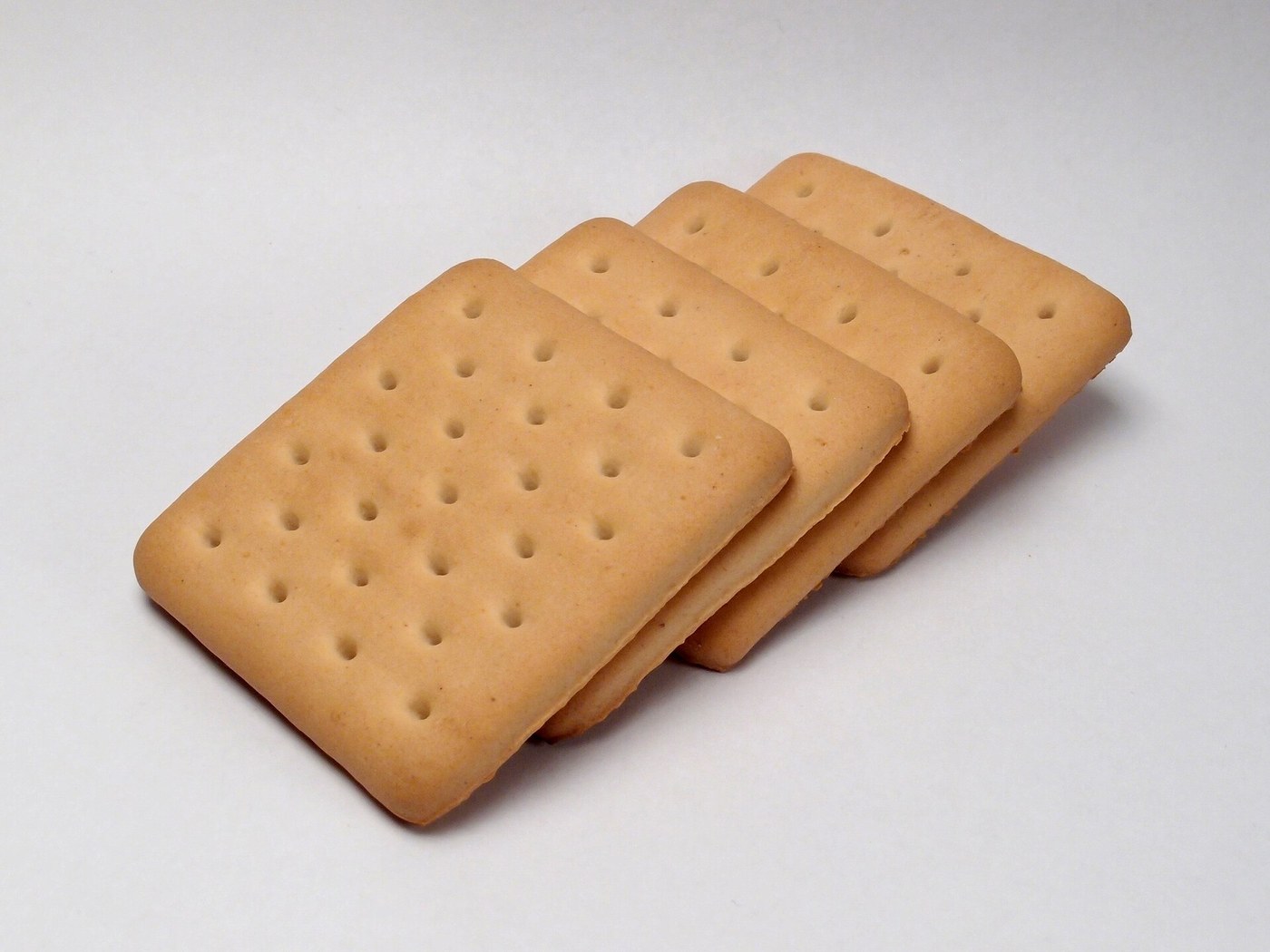


Hardtack
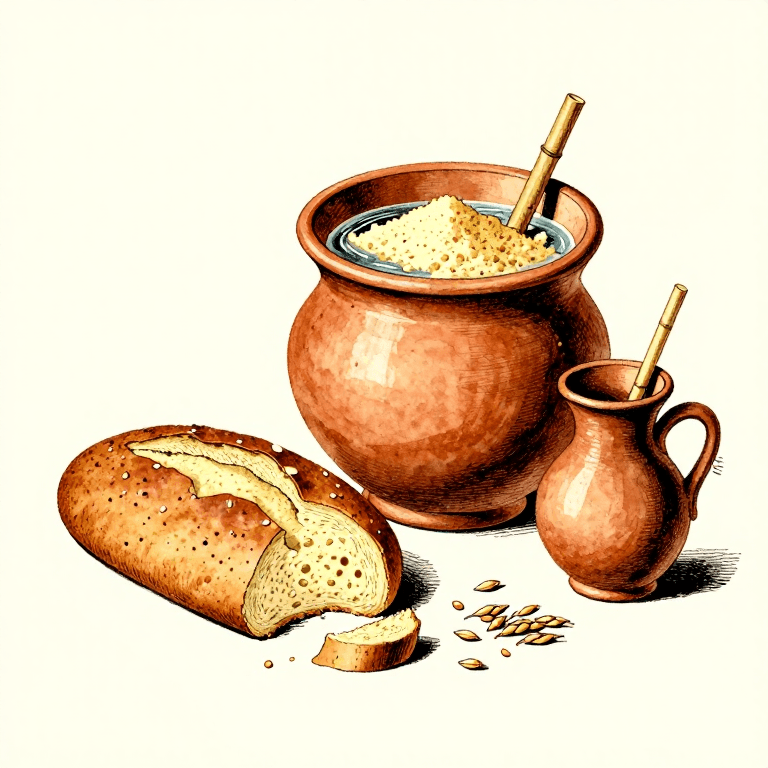
Three ingredients — flour, water, salt — and one requirement: it must still be edible after a year at sea. Everything strange about ship's biscuit follows from that. No fat, because fat goes rancid. No leavening, because air pockets hold moisture. Baked twice and then dried further, because anything that can support mould has to be driven out entirely.
The word biscuit is literally bis coctus, twice-cooked, and this is the food it was coined for. It fed the Roman army, every European navy through the age of sail, and both sides of the American Civil War. Properly made specimens survive in museums after two hundred years, still recognisably bread.
It is also the simplest baking project there is, and the least forgiving about drying.
说明
Weigh 500 g of plain flour
Weigh 500 g of plain flour
Use plain white or wholemeal flour. Wholemeal is closer to what was actually issued but keeps less well, because the wheatgerm oil in it can go rancid.
此步骤所需材料:
 中筋面粉500 克
所需工具:
 数字天平
数字天平Add 10 g of salt and mix dry
Add 10 g of salt and mix dry
Stir the salt through the flour thoroughly. Salt is for flavour and marginal preservation; some naval recipes omitted it entirely.
此步骤所需材料:
 粗海盐10 克
Add no fat and no raising agent
Add no fat and no raising agent
No butter, no oil, no yeast, no baking powder. Fat turns rancid and leavening makes air pockets that hold moisture — both destroy the keeping quality this food exists for.
Add about 250 ml of water, a little at a time
Add about 250 ml of water, a little at a time
Work in cold water gradually until it just comes together. Aim for the stiffest dough you can still manage — far drier than bread dough, close to modelling clay.
Knead only until it is uniform
Knead only until it is uniform
Work it for two or three minutes, just until there are no dry patches. Long kneading develops gluten and gives a tougher, chewier biscuit rather than a crisp one.
Roll out to 10 mm thick
Roll out to 10 mm thick
Roll the dough to an even 10 mm. Even thickness matters more than exact thickness — a thick patch stays damp inside and that patch is where mould starts.
所需工具:
 直尺
直尺Cut into 75 mm squares or rounds
Cut into 75 mm squares or rounds
Cut regular pieces about 75 mm across. Uniform size means uniform drying, which is the whole game.
Dock each biscuit right through
Dock each biscuit right through
Pierce a grid of holes — sixteen or so per biscuit — all the way through with a skewer or fork. Docking stops it puffing and, more importantly, lets moisture escape from the centre.
Bake at 175 °C for 30 minutes
Bake at 175 °C for 30 minutes
Bake on an ungreased tray until firm and only just coloured. This is the first of the two bakings.
Turn them over and bake 30 minutes more
Turn them over and bake 30 minutes more
Flip each biscuit and return it to the oven. Both faces need equal exposure or one side stays softer than the other.
Drop the oven to 120 °C and dry for 2 hours
Drop the oven to 120 °C and dry for 2 hours
Reduce the heat and leave them to dry out rather than bake. This slow stage is what drives the residual water off. Prop the oven door slightly so humid air escapes.
Cool completely on a rack
Cool completely on a rack
Cool in free air on a wire rack, never stacked. Trapped steam between hot biscuits re-wets the surfaces you just dried.
Test one by snapping it
Test one by snapping it
Break one in half. It should snap cleanly with a sharp crack and be uniformly pale and dry right through. Any softness or darker colour at the centre means it is not dry — return the whole batch to a low oven.
Store airtight, cool and dark
Store airtight, cool and dark
Keep them in a sealed tin once absolutely cold. Correctly dried hardtack keeps for years; the failure mode is always moisture, never age.
Eat it soaked, not bitten
Eat it soaked, not bitten
Break it up and soak in coffee, soup or stew, or stew it into a mash. Biting hardtack dry genuinely breaks teeth, and always did — the jokes in sailors' and soldiers' letters are not exaggeration.
History & Context — the food that made distance possible
History & Context — the food that made distance possible
Twice-cooked, and named for it. Biscuit comes through Old French from Latin bis coctus, twice-cooked, and this is the food that earned the name. Roman armies carried bucellatum; every European navy of the age of sail ran on ship's biscuit; Union and Confederate soldiers ate it by the crate and called it hardtack, tooth-dullers and worm castles. It is arguably the single most consequential preserved food in history, because a ship's range is set by how long its provisions last, and nothing else combined that shelf life with that much energy per kilogram.
Every omission is deliberate. Fat is what makes ordinary baked goods pleasant and it is precisely what spoils — unsaturated fats oxidise and turn rancid, so a food meant to last years cannot contain them. Leavening creates a light open crumb, which is a large internal surface area and a lot of trapped moisture. Water is what mould and bacteria need; below roughly ten per cent moisture content almost nothing can grow. Hardtack is a food engineered by subtraction, and its awfulness is the direct price of its shelf life.
The weevils were real, and so was the routine. Ship's biscuit was reliably infested with the larvae of biscuit beetles and weevils, and the standard practice — tapping the biscuit on the table to knock them out, or eating in the dark — appears too consistently across independent accounts to be folklore. Infestation was tolerated as normal; genuine spoilage from damp was the serious problem, because a wet biscuit store could rot an entire voyage's provisions.
What it could not do. Hardtack solved calories and it solved shelf life. It did nothing about vitamin C, and scurvy killed more sailors in the age of sail than combat and shipwreck combined. James Lind's 1747 trial pointed at citrus, but the Royal Navy did not adopt lemon juice service-wide until the 1790s, and the reasoning stayed muddled for decades after — the actual vitamin was not identified until the 1930s. The biscuit is a triumph of food preservation and simultaneously a demonstration that preservation and nutrition are different problems.
相关蓝图
这些蓝图共享知识——技术、材料或原理


CC0 公共领域
此蓝图以 CC0 协议发布。你可以自由复制、修改、分发和使用此作品,无需征得许可。
通过购买蓝图中的产品支持创客,他们将获得 创客佣金 (由供应商设定),或创建此蓝图的新版本并将其作为连接包含在你自己的蓝图中以分享收入。