艺术
美容与健康
工艺
文化与历史
娱乐
环境
食品与饮料
逆向工程
科学
体育
技术
可穿戴设备
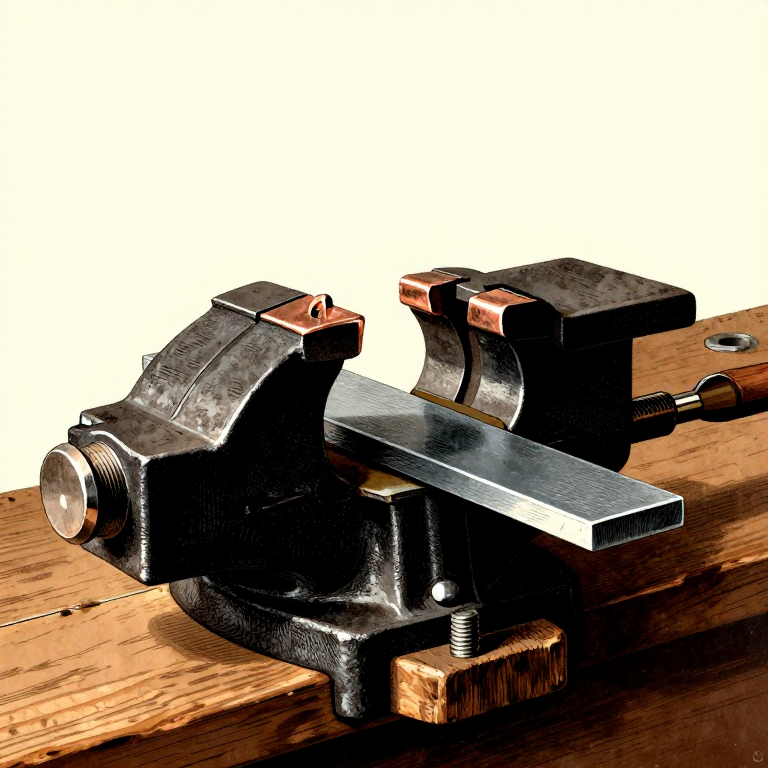


Holding the Work: If It Moves or Rings, You Cannot File It
Before the first stroke, two things must be true: the work cannot move, and it cannot vibrate. Both are easy to get wrong and both are usually blamed on the file.
Work that shifts under the stroke files out of square, because the workpiece rotates a fraction each time and you never notice. Work that RINGS is worse: the chatter throws the teeth off the surface, they land back on it unevenly, and the result is a rippled finish no amount of careful stroking will improve.
The fix for both is the same three things — grip it low, grip it short, and grip it with something soft enough not to mark it.
初学者
2 hours
说明
1
1
Set the vice to your elbow
Set the vice to your elbow
Stand at the vice and let your arm hang; the top of the jaws should be at about elbow height. Higher and you cannot get your weight over the stroke; lower and you bend your back for every cut.
That one measurement decides whether you can file flat. A flat stroke needs the file to travel level, and that needs your forearm roughly horizontal at the middle of the stroke. Too high a vice forces the wrist up at the end of the stroke, which rounds the end of the work — the commonest filing fault, and it is a posture problem, not a technique problem.
For fine finishing work some people prefer the vice a little higher, at the bottom of the ribcage, because it brings the surface closer to the eye. Set it for the work in front of you rather than once and for all.
所需工具:
 重型台钳
重型台钳 低碳钢板
低碳钢板2
2
Grip short — the work should not be able to ring
Grip short — the work should not be able to ring
Clamp the work so only as much of it stands above the jaws as you actually need to file. A part standing 100 mm proud of the vice is a tuning fork.
Tap the work with a fingernail after clamping. A dead thud means it is held; a ring means it will chatter and the finish will be rippled. Lowering the part until only 5 or 10 mm stands proud usually kills the ring completely, and it is faster than any other fix.
For a long thin part that cannot be lowered, back it with a block of hardwood clamped alongside it. The wood damps the vibration without adding a hard surface the file can catch on.
此步骤所需材料:
 硬木板1 个
所需工具:
重型台钳 低碳钢条
低碳钢条3
3
Soft jaws: the vice must not mark the work
Soft jaws: the vice must not mark the work
Hard serrated vice jaws will print their teeth into brass, aluminium, mild steel and anything else soft enough to file. Those marks are then in the finished part and getting them out means filing the whole face down past them.
Slip a pair of soft jaws over the steel ones — copper, aluminium or hardwood liners bent to hook over the top. They grip well enough for filing, which is not a high-force operation, and they leave nothing behind.
For a round part, soft jaws with a V cut in them hold it without crushing. For a finished surface that must not be touched at all, a wrap of thick leather or a strip of the same material the part is made from works.
所需工具:
 台钳软钳口重型台钳
 黄铜板
黄铜板4
4
Get the line where you can see it — and level
Get the line where you can see it — and level
Clamp the work so the line you are filing to is horizontal and just above the jaws, where the light falls on it and your eye is over it.
A line you cannot see clearly is a line you will file past. Set the part, then step back and look: if the scribed line is in shadow or at an awkward angle, re-clamp it. Thirty seconds spent there saves a ruined part, and it is the step people skip because it feels like fussing.
Using parallels under the work in the vice sets it level and to a repeatable height — the same trick a machinist uses in a milling vice, and it works just as well for hand filing.
所需工具:
 平行垫铁重型台钳
 划针
划针 固定角尺
固定角尺相关蓝图
这些蓝图共享知识——技术、材料或原理
CC0 公共领域
此蓝图以 CC0 协议发布。你可以自由复制、修改、分发和使用此作品,无需征得许可。
通过购买蓝图中的产品支持创客,他们将获得 创客佣金 (由供应商设定),或创建此蓝图的新版本并将其作为连接包含在你自己的蓝图中以分享收入。