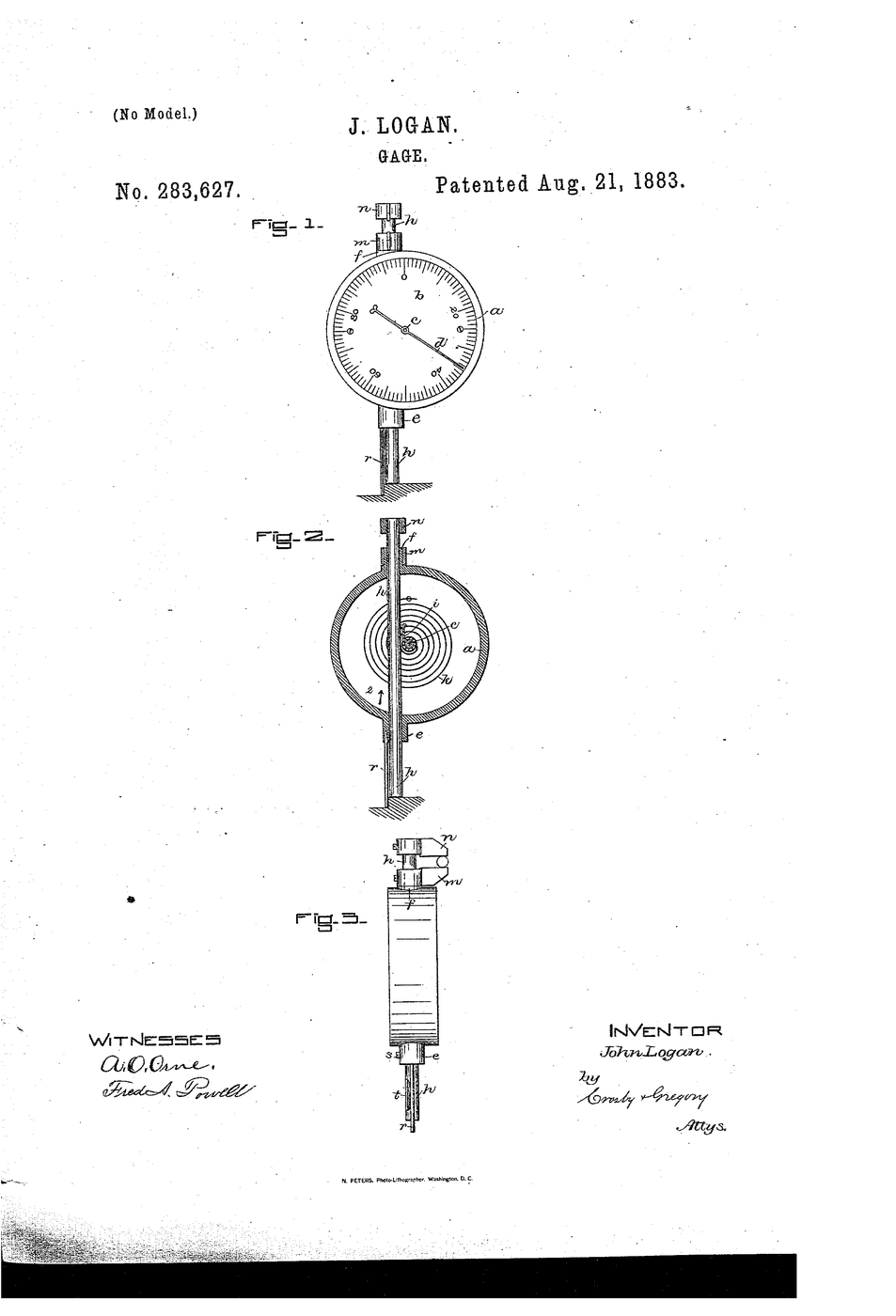


Dial Indicator
A micrometer answers “how big is this?”. A dial indicator answers a different and often more useful question: “how much has this moved?” It does not measure size at all. It measures deviation.
US 283,627, “Improvement in Gages”, John Logan of Waltham, Massachusetts, filed 15 May 1883 and granted 21 August 1883. The claim is mechanical amplification: a tiny movement of a plunger is geared up into a large sweep of a pointer, so the eye reads a distance it could never see directly.
Waltham is not a coincidence. This is watchmaking country, and a watch is a machine for turning small regular motions into readable ones. Logan applied the movement-maker's habit of mind to the machine shop.
说明
Read the claim before you build
Read the claim before you build
Logan claims amplification. Write down the difference between measuring a size and measuring a deviation — the two need different instruments.
Handle a real indicator
Handle a real indicator
Press the plunger of the dial indicator gently and watch the needle. Estimate how many times larger the needle's travel is than the plunger's.
所需工具:
 百分表
百分表Build a lever amplifier
Build a lever amplifier
Cut a 200 mm card strip. Pin it to the board 20 mm from one end with a screw. The long end now moves nine times as far as the short end.
此步骤所需材料:
 坐标纸1 张
 #6-32 机螺钉1 个
所需工具:
 剪刀
剪刀Calculate your amplification ratio
Calculate your amplification ratio
Ratio = long arm divided by short arm. Write it down before you test it, then check it.
此步骤所需材料:
坐标纸1 张所需工具:
 直尺
直尺Feed a known input with a feeler leaf
Feed a known input with a feeler leaf
Slide a 0.05 mm feeler leaf under the short end. Measure how far the long end rises.
所需工具:
 塞尺套装直尺
Check measured against predicted
Check measured against predicted
Compare the measured rise with ratio × 0.05 mm. Any shortfall is lost motion in your pivot — the enemy Logan's gearing had to defeat.
此步骤所需材料:
坐标纸1 张Build a scale for the long end
Build a scale for the long end
Mark a card scale where the long end sweeps, graduated in millimetres. Each millimetre now stands for a fraction of one at the input.
此步骤所需材料:
坐标纸1 张所需工具:
直尺 油性记号笔
油性记号笔Measure the whole feeler set
Measure the whole feeler set
Run every leaf from 0.05 to 0.50 mm through your amplifier, recording the output each time.
此步骤所需材料:
坐标纸1 张所需工具:
塞尺套装Plot input against output
Plot input against output
Plot the pairs. A good instrument gives a straight line. Curvature means your ratio changes with position — a real and common defect.
此步骤所需材料:
坐标纸1 张Find the backlash
Find the backlash
Approach one leaf thickness from below, then from above. The two readings differ. That gap is backlash, and it is why indicators are read in one direction only.
所需工具:
塞尺套装Measure flatness with the real indicator
Measure flatness with the real indicator
Rest the indicator on the surface plate and sweep it across the board's face. Watch the needle wander. You are seeing the board's error, magnified.
此步骤所需材料:
 平木板1 个
所需工具:
百分表 平板(基准平台)
Measure run-out on a rod
Measure run-out on a rod
Roll the brass rod under the indicator tip. The needle sweep is the rod's out-of-roundness — invisible to the eye, obvious to the dial.
所需工具:
百分表 黄铜棒
黄铜棒Try the same job with a micrometer
Try the same job with a micrometer
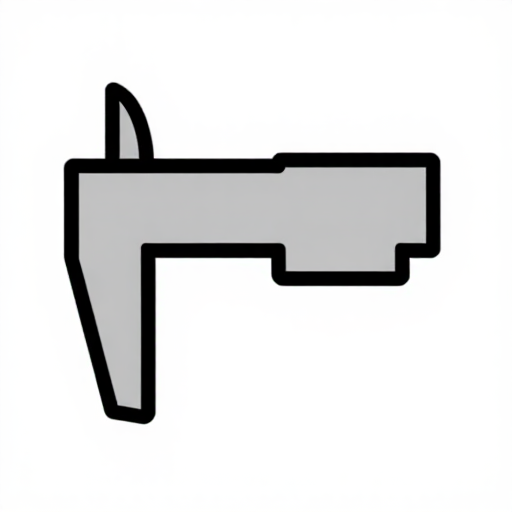
Attempt step 11 with the micrometer instead. It is slow and awkward, because it answers the wrong question. Two instruments, two jobs.
所需工具:
 千分尺
千分尺History & Context
History & Context
US 283,627, “Improvement in Gages”, John Logan of Waltham, Massachusetts, filed 15 May 1883, granted 21 August 1883.
A date correction. Several respectable secondary sources give this patent as 21 August 1886. The patent document itself is dated 1883, and the number is consistent with 1883 issues. Where a secondary source and the document disagree, the document wins.
What happened to it. Frank Randall, a watchmaker at the E. Howard Watch Company, bought Logan's patent rights in 1896 and went into partnership with Francis Stickney; Randall & Stickney of Waltham then manufactured dial indicators for general industry. The rack-and-pinion arrangement Logan developed is still the mechanism inside most mechanical dial indicators.
Why deviation matters more than size. On a production line nobody re-measures every dimension of every part. They set a master, zero an indicator against it, and then read only the difference for every part after. Reading a difference is faster, needs less skill, and is less error-prone than reading an absolute size — which is what let unskilled operators hold skilled tolerances. The gauge blocks and the comparator later in this batch are both built on the same insight.


CC0 公共领域
此蓝图以 CC0 协议发布。你可以自由复制、修改、分发和使用此作品,无需征得许可。
通过购买蓝图中的产品支持创客,他们将获得 创客佣金 (由供应商设定),或创建此蓝图的新版本并将其作为连接包含在你自己的蓝图中以分享收入。