合作
艺术
美容与健康
工艺
文化与历史
娱乐
环境
食品与饮料
逆向工程
科学
体育
技术
可穿戴设备
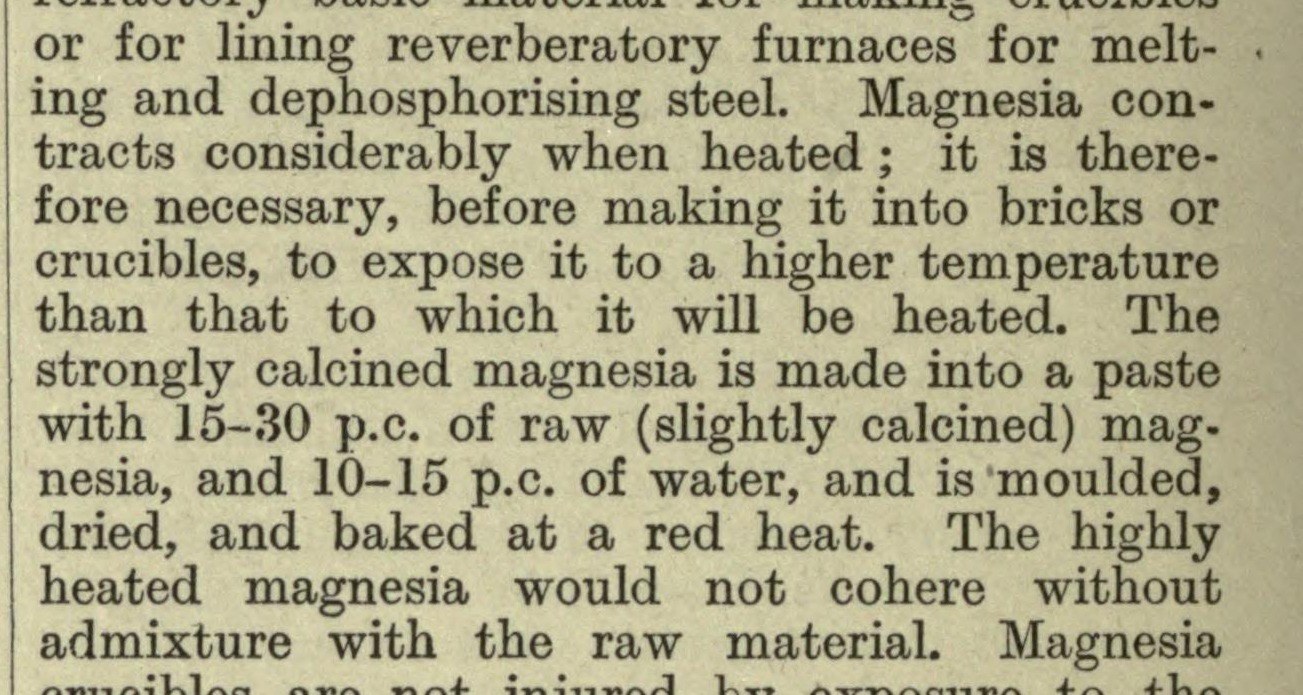


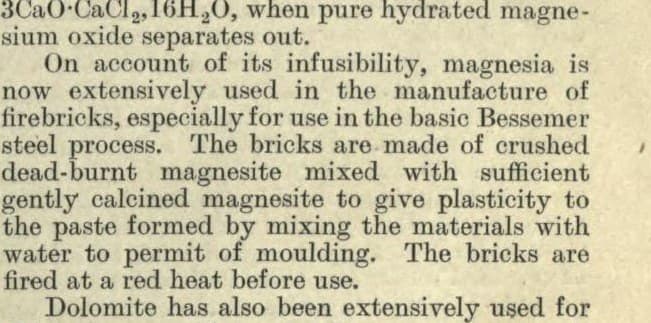
Magnesia Crucible: Strongly Calcined Magnesia Bound with Raw Magnesia and Baked at a Red Heat (Thorpe 1912)
A magnesia crucible is a pot of magnesia, a basic refractory. Thorpe's Dictionary of Applied Chemistry (1912) gives the recipe introduced by Caron: magnesia shrinks a great deal when heated, so it is first calcined hotter than it will ever be used, then bound with 15-30 per cent of raw, slightly calcined magnesia and 10-15 per cent of water, moulded, dried and baked at a red heat.
He gives no calcining temperature, mould or size; those are unknown here.
Source: Thorpe, Dictionary of Applied Chemistry vol. II (1912), CRUCIBLES, p. 170. Picture: that passage.
中级
Two to three days
说明
1
1
Read Thorpe
Read Thorpe
"The highly heated magnesia would not cohere without admixture with the raw material."
2
2
Calcine most of the magnesia hard
Calcine most of the magnesia hard
Magnesia contracts considerably when heated, so before making it into a crucible expose it to a higher temperature than the crucible will meet in use. The temperature itself is not given. Keep back a part of the magnesia only slightly calcined.
此步骤所需材料:
 氧化镁1 as required
所需工具:
 窑炉
 耐热手套
3
3
Make the paste
Make the paste
Grind the strongly calcined magnesia and mix it with 15-30 per cent of the raw (slightly calcined) magnesia and 10-15 per cent of water into a paste. The raw part is what makes it hold together.
此步骤所需材料:
 水1 10-15 per cent
所需工具:
 研钵和研杵
 精密数字天平
 防尘口罩
4
4
Mould the crucible
Mould the crucible
Mould the paste into crucibles. Thorpe does not describe the mould or give sizes (unknown).
所需工具:
 未知材料
 未知尺寸
5
5
Dry and bake
Dry and bake
Dry the crucibles, then bake them at a red heat. Thorpe notes that magnesia crucibles are not harmed by standing in the air.
所需工具:
窑炉耐热手套6
6
History and honest limits
History and honest limits
Thorpe credits Caron with introducing magnesia for crucibles and for lining reverberatory furnaces in which steel was melted and dephosphorised. He also lists magnesia-bauxite crucibles (Gaudin) and calcined magnesite with a boron compound (Rawson and Littlefield, 1900).
The calcining temperature, the mould, the size and the drying are not given; the tools are ours.
此蓝图制作
相关蓝图
这些蓝图共享知识——技术、材料或原理
CC0 公共领域
此蓝图以 CC0 协议发布。你可以自由复制、修改、分发和使用此作品,无需征得许可。
通过购买蓝图中的产品支持创客,他们将获得 创客佣金 (由供应商设定),或创建此蓝图的新版本并将其作为连接包含在你自己的蓝图中以分享收入。