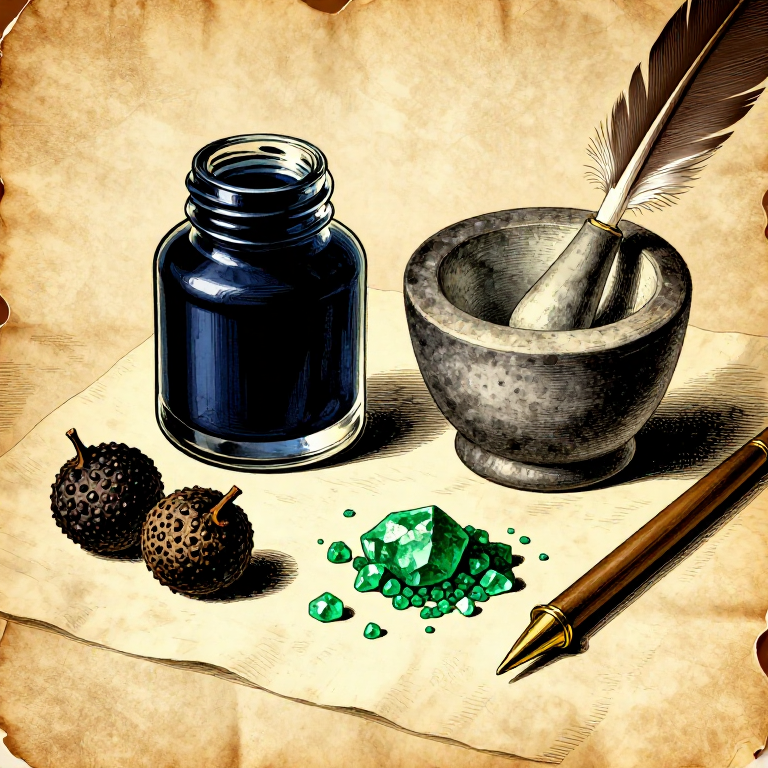


Making Iron Gall Ink from Oak Galls
说明
Identify and Source Oak Galls
Identify and Source Oak Galls
Oak galls are abnormal growths on oak trees caused by cynipid wasps (Cynips gallae-tinctoriae and related species) laying eggs in the leaf buds. The tree surrounds the larva with a hard, round growth rich in tannic acid (gallotannin), which can comprise 50-70% of the gall's dry weight. Aleppo galls (from Quercus infectoria, found in Turkey and the Middle East) are historically the gold standard because of their extremely high tannin content. European oak galls from Quercus robur or Quercus petraea also work well. Collect galls that are hard, dry, and brown — green galls still contain the live larva and have lower tannin. You can also purchase dried oak galls from calligraphy or natural dye suppliers.
Crush the Oak Galls
Crush the Oak Galls
Place the dried oak galls in a mortar and crush them into small fragments using the pestle. You do not need a fine powder — pieces of approximately 3-5mm are sufficient, as the tannins dissolve readily in hot water. If using a mortar is difficult, place the galls inside a thick cloth bag and strike with a hammer on a hard surface. The goal is to break open the hard outer shell and expose the interior, which maximises the surface area for tannin extraction. You should have approximately 30g of crushed gall material (a roughly 3:1 ratio of gall to iron sulfate by weight — this is the traditional medieval proportion documented in numerous historical recipes).
此步骤所需材料:
 五倍子(栎瘿)30 克
所需工具:
 研钵与研杵
研钵与研杵Extract Tannins by Soaking and Heating
Extract Tannins by Soaking and Heating
Place the crushed galls into a saucepan or heat-resistant glass jar and add 250ml of distilled water or rainwater. Tap water contains chlorine and minerals that can interfere with the ink chemistry. There are two extraction methods: (1) Cold extraction: let the galls soak for 2-3 days at room temperature, stirring occasionally — this produces a lighter-coloured but often purer extract. (2) Hot extraction: bring the mixture to a gentle simmer (not a rolling boil) and maintain for 30-60 minutes — this extracts tannins faster and more completely. Historical recipes varied: some soaked in wine or vinegar instead of water, and some left the galls in rainwater on a windowsill for weeks. For a reliable first batch, use the hot method: simmer for 45 minutes, then let cool to room temperature.
此步骤所需材料:
 蒸馏水250 毫升
所需工具:
 高壁炖锅
高壁炖锅Strain the Tannin Extract
Strain the Tannin Extract
Once the extraction is complete and the liquid has cooled to room temperature, strain it through a fine sieve or cheesecloth into a clean glass jar. Squeeze the cheesecloth to extract as much liquid as possible from the gall fragments. The liquid should be a dark amber-brown colour — this is the tannin-rich extract containing primarily gallotannin and gallic acid (gallotannin hydrolyses into gallic acid and glucose in water). Discard the solid gall residue. You should have approximately 150-200ml of tannin extract (some water evaporates during simmering).
所需工具:
 细纹奶酪滤布
 玻璃储物罐套装
Dissolve Ferrous Sulfate into the Extract
Dissolve Ferrous Sulfate into the Extract
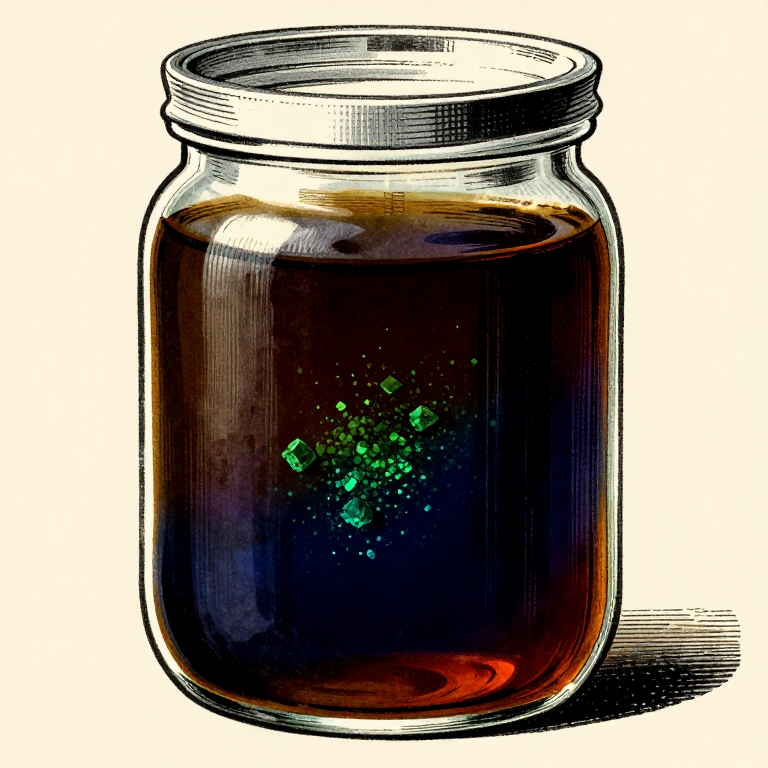
Weigh out 10g of ferrous sulfate (FeSO4·7H2O). The crystals should be pale green — if they are brown or rust-coloured, the iron has already oxidised to ferric sulfate (Fe2(SO4)3) and will produce a different, less useful ink. Add the ferrous sulfate to the warm tannin extract and stir until completely dissolved. The liquid will immediately darken, shifting from amber-brown to a deep purple-grey or blue-black. This colour change indicates the formation of ferrous gallate (iron(II) gallotannate), a soluble complex. Over the next hours and days, this compound slowly oxidises in air to form ferric gallate (iron(III) gallotannate), which is insoluble and deeply black — this oxidation is what makes the ink permanent on paper.
此步骤所需材料:
 硫酸亚铁10 克
所需工具:
 数字天平
数字天平 玻璃搅拌棒
玻璃搅拌棒Add Gum Arabic as a Binder
Add Gum Arabic as a Binder
Dissolve 5g of gum arabic in a small amount of warm water (about 20ml), stirring until it forms a smooth, honey-like solution. Gum arabic is the dried sap of the Acacia senegal tree and serves two purposes in the ink: it acts as a binder (helping the ink particles adhere to the paper surface) and it adds viscosity (giving the ink a smooth flow from the nib). Add the dissolved gum arabic to the ink and stir thoroughly. Too much gum makes the ink glossy and prone to cracking when thick; too little makes it watery and pale. The traditional proportion is roughly 10-15% of the gall weight. If the ink later proves too thick, add small amounts of water; if too thin, dissolve more gum arabic and add it.
此步骤所需材料:
 阿拉伯胶5 克
所需工具:
玻璃搅拌棒Add Preservative and Strain the Final Ink
Add Preservative and Strain the Final Ink
Iron gall ink is an organic solution that can develop mould over weeks or months, especially in warm conditions. Add 2-3 drops of clove oil or a tiny crystal of thymol as a preservative — both are traditional antimicrobial agents used in ink-making for centuries. Stir well. Strain the ink one final time through fine cheesecloth or a coffee filter into your storage jar to remove any undissolved particles or precipitates that could clog a pen nib. The finished ink should flow freely — test it by dipping a pen nib and writing a few words on scrap paper.
此步骤所需材料:
 丁香油3 滴
所需工具:
细纹奶酪滤布Test the Ink and Allow Oxidation
Test the Ink and Allow Oxidation
Write several lines of text with the fresh ink. It will appear pale grey-purple when wet — this is normal. Iron gall ink darkens over 12-48 hours as the ferrous gallate oxidises to ferric gallate on the paper. After 24 hours, the writing should be deep blue-black and completely waterproof (the ferric gallate is insoluble in water and bonds to the cellulose fibres). Test water resistance by placing a drop of water on a dried line — it should not dissolve or blur. The ink in the jar will also darken over time; shake or stir before each use, as heavier particles settle. Store in a sealed glass jar away from direct sunlight. Well-made iron gall ink can last years if kept sealed. Medieval manuscripts written with iron gall ink remain legible after 800+ years.

所需工具:
玻璃储物罐套装Troubleshooting Common Issues
Troubleshooting Common Issues
If the ink is too pale after drying: increase the ferrous sulfate by 2-3g in the next batch, or extend the gall extraction time. If the ink turns brown instead of black: the ferrous sulfate may have already oxidised before use — source fresh green crystals. If the ink is gritty and clogs the nib: strain more thoroughly and dilute slightly with distilled water. If mould forms on the surface: remove the mould, add more clove oil, and store in a cooler location. If the ink corrodes through the paper (visible as brown holes): you have used too much ferrous sulfate relative to gall — the excess free iron acid attacks the cellulose. This problem (known as iron gall ink corrosion) has damaged many historical documents. Reduce ferrous sulfate in the next batch. The traditional 3:1 gall-to-iron ratio exists precisely to prevent this excess.
所需工具:
数字天平已连接蓝图材料

相关蓝图
这些蓝图共享知识——技术、材料或原理


CC0 公共领域
此蓝图以 CC0 协议发布。你可以自由复制、修改、分发和使用此作品,无需征得许可。
通过购买蓝图中的产品支持创客,他们将获得 创客佣金 (由供应商设定),或创建此蓝图的新版本并将其作为连接包含在你自己的蓝图中以分享收入。