

Mechanical Face Seal
说明
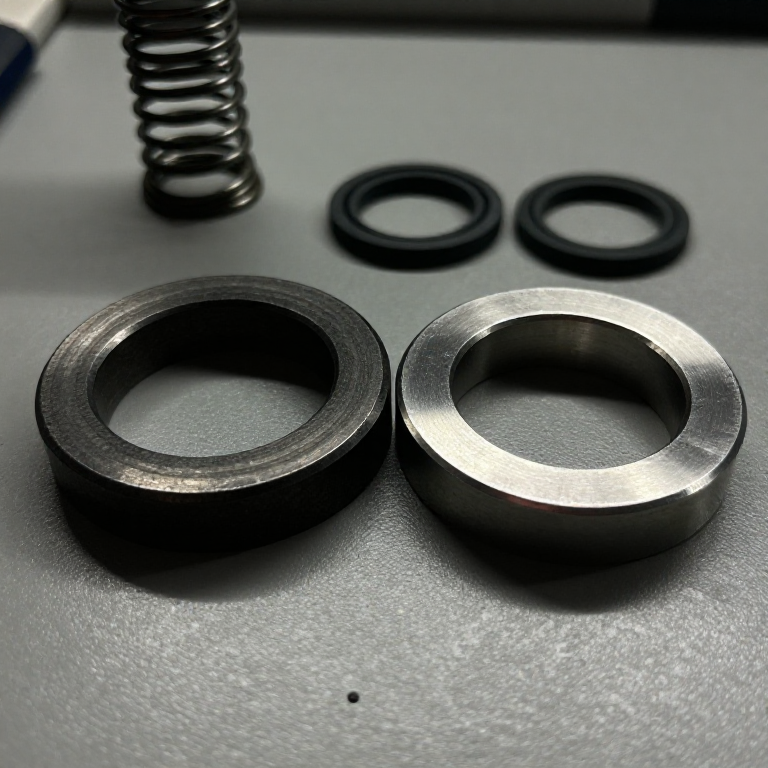
Make the two seal rings
Make the two seal rings
Two flat annular faces — and flatness here is the entire specification.
- Cut two rings from 40 mm aluminium bar, each 12 mm long, bored 16.5 mm.
- Face both mating ends as flat and square as you can achieve.
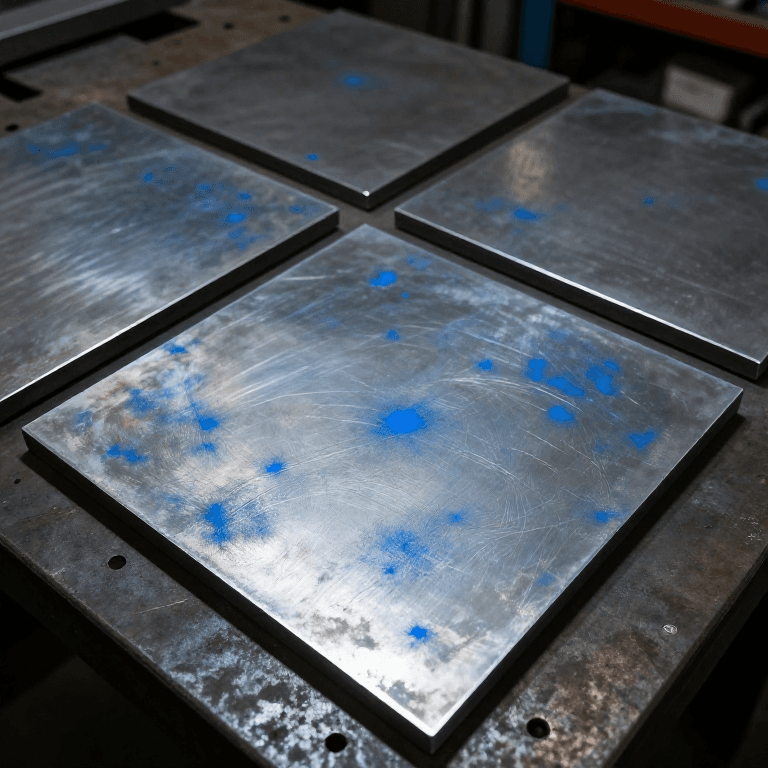
- Lap the two faces against each other with fine abrasive on a flat plate, rotating and reversing them regularly.
- Check the result with a marker transfer — contact should be continuous all the way round the annulus.
This is the three-plate method's lesson applied. Lapping two rings against each other alone can produce a matched convex-and-concave pair that mate perfectly and are both wrong. Lapping BOTH against a third flat surface — your surface plate — is what forces them toward true flatness. Real seal faces are lapped to optical flatness and inspected with a monochromatic light and an optical flat.
Do not skip the marker check. A partial contact ring means the faces touch on a band rather than everywhere, and a face seal that touches on a band leaks and wears through fast.此步骤所需材料:
 铝圆棒2 个
 铝板1 个
铝板1 个所需工具:
 钢锯弓配锯条
 台虎钳
台虎钳 锉刀套装
锉刀套装 充电式电钻
充电式电钻 钻头套装
钻头套装 6 英寸数显卡尺
 组合角尺
组合角尺Fit the static O-rings — the sealing that is NOT at the faces
Fit the static O-rings — the sealing that is NOT at the faces
Each ring needs sealing to its own part, and those joints never move.
- Cut a shallow O-ring groove in the bore of the rotating ring, where it sits on the shaft.
- Cut a matching groove on the outside of the stationary ring, where it sits in the housing.
- Fit an O-ring in each.
- Check both rings still slide axially a little — they must be free to follow face wear.
This is the clever division of labour. The hard problem — sealing across relative rotation — is handled by the lapped faces. The two easy problems — sealing each ring to a part that never moves relative to it — are handled by ordinary O-rings, doing the static job they are perfect at. The design uses each element only where it excels.
Axial freedom is essential. As the faces wear, the spring must be able to push the rings together to take up the loss. An O-ring that grips too hard locks the ring and the seal opens up as it wears.此步骤所需材料:
 棉平纹细布1 metre
所需工具:
锉刀套装6 英寸数显卡尺充电式电钻Add the spring and set the face load
Add the spring and set the face load
Enough force to keep the faces closed, and not one newton more.
- Fit a compression spring behind the rotating ring, bearing against a collar on the shaft.
- Fix the collar with M5 cup point set screws × 2.
- Set the spring so the faces are held together with light, even pressure.
- Turn the shaft — it should turn easily, with a faint smooth drag and no squeal.
Face load is a genuine balance. Too little and pressure inside opens the faces and it leaks. Too much and the fluid film between them is squeezed out, the faces run dry, and they heat-check and crack. Commercial seals are engineered so that fluid pressure itself contributes part of the closing force — a balanced seal — so the load stays right across a range of pressures.
A squeal means the faces are running dry. Stop immediately; a dry face seal destroys itself in seconds rather than minutes.此步骤所需材料:
 压缩弹簧套装1 套
 凹端紧定螺钉2 个铝圆棒1 个
所需工具:
 内六角扳手组6 英寸数显卡尺锉刀套装充电式电钻
Compare leakage and drag against the gland
Compare leakage and drag against the gland
Three seals, one shaft, measured the same way.
- Assemble the face seal on the test rig, fill with water and turn the shaft for five minutes.
- Collect and measure any leakage.
- Repeat with the packing gland from blueprint 1 at its correct drip setting.
- Repeat with the labyrinth.
- Tabulate leakage, turning torque and temperature rise for all three.
所需工具:
 秒表6 英寸数显卡尺
Why it fails all at once, and history
Why it fails all at once, and history
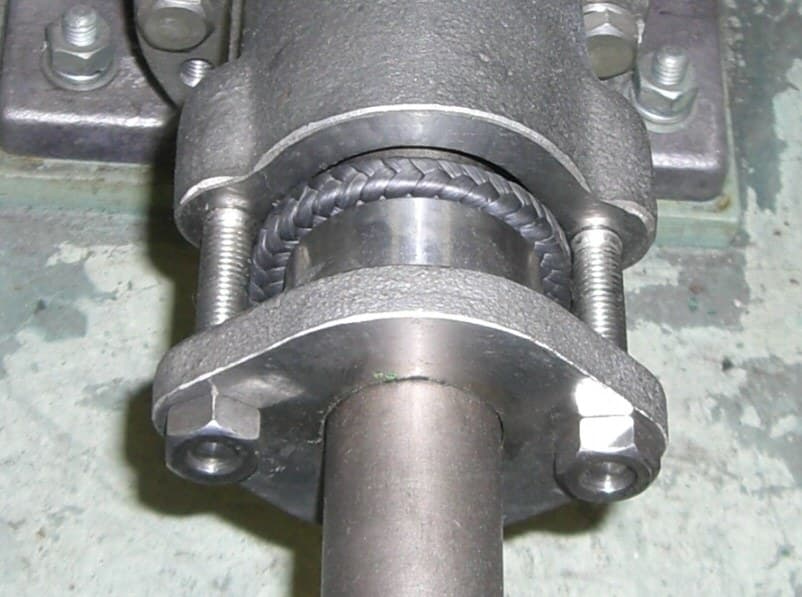
Mechanical seals replaced packed glands through the twentieth century wherever leakage became unacceptable — chemical plants handling anything toxic, refrigeration compressors that must not lose refrigerant, and eventually the ordinary domestic water pump. The driver was rarely efficiency; it was that a drip of water is a nuisance and a drip of ammonia or benzene is not.
The failure mode is genuinely different from everything else in this batch. A gland tells you it needs attention by dripping faster. A lip seal weeps and then leaks. A labyrinth simply keeps doing what it always did. A mechanical seal runs perfectly until the film breaks down, then the faces touch, heat, crack, and it goes from sealed to open in seconds. Modern plants monitor them precisely because there is no gradual warning.
Its economics are the reverse of the gland's: expensive to buy, cheap to run, and it needs no attention at all until it dies. The gland is cheap, endlessly repairable with a few pence of cord, and demands regular adjustment. Choosing between them is a maintenance-philosophy decision as much as an engineering one — which is a real and underappreciated category of engineering choice.
Honest limit of this build: aluminium lapped by hand will not achieve a true fluid film. Expect it to demonstrate the geometry, the spring loading and the O-ring division of labour, and to leak more than a real seal by a wide margin. Commercial faces are carbon against silicon carbide or tungsten carbide, lapped to a flatness this workshop cannot reach.
CC0 公共领域
此蓝图以 CC0 协议发布。你可以自由复制、修改、分发和使用此作品,无需征得许可。
通过购买蓝图中的产品支持创客,他们将获得 创客佣金 (由供应商设定),或创建此蓝图的新版本并将其作为连接包含在你自己的蓝图中以分享收入。