
Menoreh Getah Asli — Dari Pokok Getah ke Kepingan Getah Asap
说明
Kenali pokok getah (Hevea brasiliensis)
Kenali pokok getah (Hevea brasiliensis)
Pokok getah (Hevea brasiliensis) berasal dari lembangan Amazon, Brazil. Ia dibawa ke Asia Tenggara pada tahun 1876 oleh Sir Henry Wickham melalui Kew Gardens, London. Pokok getah boleh mencapai ketinggian 25-30 meter, dengan daun bersusun tiga (trifoliate), dan kulit pokok berwarna kelabu-coklat. Pokok mula mengeluarkan lateks yang mencukupi untuk ditoreh pada umur 5-7 tahun, apabila lilitan batang mencapai 45 cm pada ketinggian 150 cm dari tanah. Satu pokok boleh menghasilkan lateks selama 25-30 tahun.
Sediakan peralatan menoreh
Sediakan peralatan menoreh
Peralatan asas untuk menoreh getah: (1) Pisau toreh (pisau menoreh khas berbentuk melengkung dengan hujung tajam) — dua jenis utama ialah pisau tarik (pull knife) untuk torehan ke bawah dan pisau tolak (push knife) untuk torehan ke atas, (2) Mangkuk lateks (cawan pengumpul, biasanya diperbuat daripada seramik, plastik, atau tempurung kelapa), (3) Sudu lateks untuk mengumpul lateks beku di mangkuk, (4) Baldi untuk mengumpulkan lateks daripada semua mangkuk. Pastikan semua peralatan bersih — kontaminasi menyebabkan lateks membeku awal (prakoagulasi).
所需工具:
 剥皮刀
剥皮刀 胶乳承接杯
胶乳承接杯 刮胶勺
刮胶勺 采集桶
采集桶Tandakan panel torehan pada batang pokok
Tandakan panel torehan pada batang pokok
Panel torehan ialah bahagian kulit batang yang akan ditoreh. Tandakan panel bermula pada ketinggian 150 cm dari tanah. Lukiskan garisan panduan menggunakan tali dan kapur pada sudut 30 darjah daripada garisan mendatar (menyerong dari kiri atas ke kanan bawah untuk penoreh tangan kanan). Sudut 30 darjah ini penting kerana saluran lateks (laticifer vessels) dalam kulit getah berjalan pada sudut kira-kira 3-7 darjah dari menegak — torehan 30 darjah memotong bilangan saluran lateks yang optimum. Panjang torehan biasanya separuh lilitan batang (S/2 system).
此步骤所需材料:
 划线粉笔1 个
 放线用细绳2 米
所需工具:
 卷尺
卷尺Pasangkan mangkuk dan pancang saliran
Pasangkan mangkuk dan pancang saliran
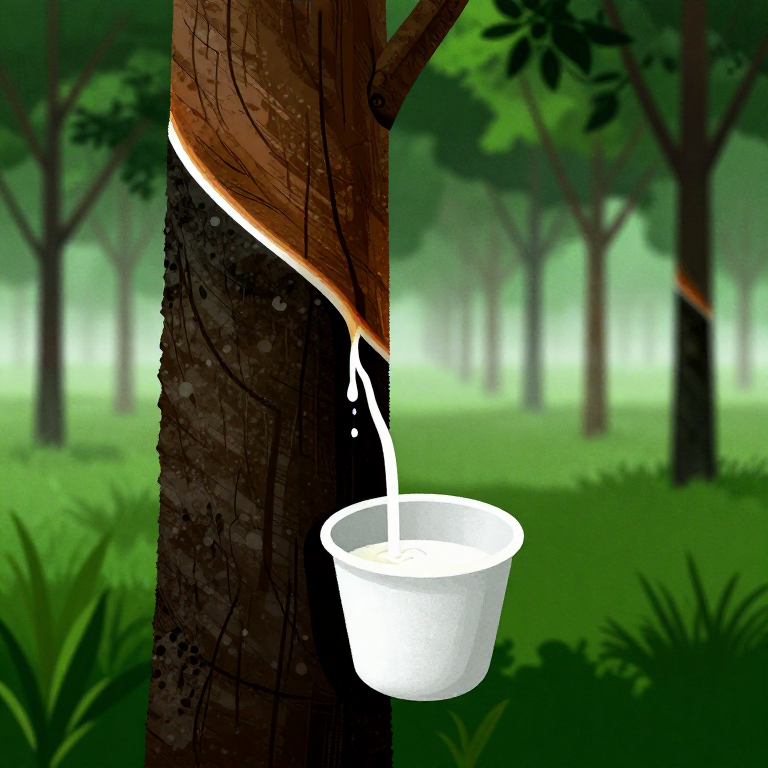
Pasangkan mangkuk lateks pada pokok di bawah hujung bawah garisan torehan. Gunakan dawai pengikat atau penyangkut mangkuk yang dibenamkan ke dalam kulit pokok. Letakkan pancang saliran (spout) — kepingan zink atau plastik yang dipakukan ke kulit pokok tepat di hujung bawah torehan — supaya lateks mengalir ke dalam mangkuk tanpa menitik ke tanah. Mangkuk mestilah bersih dan kering.
此步骤所需材料:
胶乳承接杯1 piece per tree 引流嘴1 piece per tree
 挂杯铁丝1 piece per tree
所需工具:
 小锤
小锤Menoreh pada waktu awal pagi
Menoreh pada waktu awal pagi
Menoreh dilakukan pada awal pagi (5:00-7:00 pagi) kerana tekanan turgor dalam saluran lateks paling tinggi pada waktu ini — hasil lateks boleh 20-30% lebih banyak berbanding menoreh pada waktu tengah hari. Pegang pisau toreh dengan tangan dominan. Letakkan mata pisau pada hujung atas garisan torehan. Tarik pisau ke bawah mengikut garisan panduan 30 darjah dengan tekanan sederhana dan sekata. Kedalaman torehan mestilah tepat — potong melalui kulit luar (bark) sehingga lapisan kambium lateks (latex cambium), tetapi JANGAN sampai ke kayu. Kedalaman tipikal ialah 1.0-1.5 mm sebelum kayu. Torehan yang terlalu dalam merosakkan kambium dan membunuh pokok.
所需工具:
剥皮刀 额灯
额灯Biarkan lateks mengalir
Biarkan lateks mengalir
Selepas menoreh, lateks putih susu mula menitis keluar daripada torehan dan mengalir turun melalui pancang saliran ke dalam mangkuk. Satu pokok biasanya menghasilkan 30-80 ml lateks setiap kali torehan, bergantung kepada klon, umur, dan keadaan cuaca. Aliran lateks berterusan selama 2-4 jam sebelum luka membeku secara semula jadi (koagulasi semula jadi oleh protein dalam lateks). Dalam cuaca hujan, jangan menoreh — air hujan mencairkan lateks dan menyebabkan kualiti rendah.
Kumpulkan lateks dari mangkuk
Kumpulkan lateks dari mangkuk
3-4 jam selepas menoreh, kumpulkan lateks dari semua mangkuk ke dalam baldi besar. Tuangkan lateks cecair terlebih dahulu, kemudian kikis lateks separuh beku (cuplump) dari mangkuk dengan sudu lateks. Lateks cecair segar mengandungi kira-kira 30-35% kandungan getah kering (DRC — dry rubber content). Tapis lateks melalui penapis mesh 40-60 untuk membuang serpihan kulit pokok dan kotoran.
所需工具:
采集桶刮胶勺 网筛
网筛Tambahkan asid formik untuk pembekuan
Tambahkan asid formik untuk pembekuan
Untuk membuat kepingan getah, lateks perlu dibekukan (dikoagulasikan). Tuangkan lateks ke dalam bekas pembekuan yang rata (dulang aluminium atau acuan kayu). Cairkan asid formik (HCOOH) kepada kepekatan 1-2% — campurkan 15-20 ml asid formik pekat (85%) dalam 1 liter air untuk setiap 1 liter lateks. Kacau perlahan dan rata, kemudian biarkan selama 2-4 jam. Lateks akan membeku menjadi jeli putih yang kenyal. AMARAN: Asid formik pekat boleh menyebabkan luka terbakar pada kulit — pakai sarung tangan getah dan cermin mata keselamatan semasa mengendalikannya.
此步骤所需材料:
 甲酸(浓度 85 %)20 milliliter per liter of latex
 清洁水(用于漂洗)1 升
所需工具:
 凝固盘
凝固盘 橡胶手套
橡胶手套 密闭式护目镜
 量筒
量筒Gilas koagulum menjadi kepingan
Gilas koagulum menjadi kepingan
Keluarkan koagulum (lateks beku) yang kenyal dari dulang. Lalukan melalui mesin pengisar (hand mangle/roller) beberapa kali, bermula dengan jurang roller 3-4 mm dan mengurangkan secara beransur kepada 1-2 mm. Ini mengeluarkan air (serum) yang terperangkap dalam koagulum dan membentuk kepingan getah yang sekata setebal 2-3 mm. Bilas kepingan dengan air bersih setiap kali gilasan untuk membuang serum asid. Jika tiada mesin pengisar, tekan koagulum dengan papan rata atau belantan kayu di atas permukaan keras.
此步骤所需材料:
清洁水(用于漂洗)10 升所需工具:
 手摇压片机
手摇压片机Rendam kepingan dalam air
Rendam kepingan dalam air
Rendam kepingan getah yang telah digilas dalam air bersih selama 2-4 jam untuk membuang sisa asid formik dan protein larut air. Ini menghalang pembusukan dan bau busuk pada produk akhir. Tukar air sekali selepas 2 jam. Kepingan yang betul-betul bersih tidak berbau masam.
此步骤所需材料:
清洁水(用于漂洗)20 升所需工具:
 浸泡槽
浸泡槽Sidai kepingan untuk ditiriskan
Sidai kepingan untuk ditiriskan
Gantung kepingan getah pada palang kayu atau dawai di tempat teduh yang berangin selama 1-2 hari. JANGAN keringkan di bawah cahaya matahari langsung kerana sinaran UV menyebabkan pengoksidaan dan perubahan warna kekuningan yang mengurangkan gred getah. Kepingan perlu dianginkan sehingga permukaan tidak lagi berair tetapi masih lembap sedikit sebelum proses pengasapan.
所需工具:
 木制晾晒架
木制晾晒架Asapkan kepingan dalam rumah asap
Asapkan kepingan dalam rumah asap
Gantung kepingan getah di dalam rumah asap (smokehouse) pada palang kayu. Nyalakan api daripada kayu getah kering, tempurung kelapa, atau kayu keras di bahagian bawah rumah asap. Suhu di dalam rumah asap mestilah dikekalkan pada 50-60 darjah Celsius selama 4-7 hari. Asap mengandungi kreosot dan fenol yang bertindak sebagai pengawet semula jadi — ia mencegah pertumbuhan kulat dan bakteria pada getah. Kepingan getah bertukar warna dari putih kepada kuning keemasan (gred terbaik, RSS Grade 1) atau coklat muda (RSS Grade 3-4).
此步骤所需材料:
 薪柴30 kilogram
所需工具:
 熏制房
熏制房 烤箱温度计
烤箱温度计Periksa kualiti kepingan getah asap
Periksa kualiti kepingan getah asap
Kepingan getah asap (Ribbed Smoked Sheet, RSS) yang berkualiti dinilai berdasarkan: (1) Warna — kuning keemasan lutsinar (RSS 1) hingga coklat gelap (RSS 5), (2) Kejelasan — pegang kepingan di hadapan cahaya; kepingan gred tinggi hampir lutsinar tanpa gelembung atau bendasing, (3) Bau — bau asap kayu yang sedap, bukan busuk atau masam, (4) Keanjalan — kepingan mestilah kenyal dan tidak rapuh atau melekit. Piawai penggredan mengikut Green Book (International Standards of Quality and Packing for Natural Rubber Grades).
Bungkus dan simpan kepingan getah
Bungkus dan simpan kepingan getah
Lipat kepingan getah asap dan susun dalam bungkusan (bale) seberat 33.3 kg atau 111.1 kg mengikut piawai perdagangan antarabangsa. Balut dengan kepingan getah gred rendah sebagai pembalut luar untuk melindungi daripada habuk dan cahaya. Simpan di tempat yang sejuk (di bawah 35 darjah Celsius), kering, dan gelap. Getah asli merosot jika terdedah kepada cahaya matahari, haba, dan ozon. Kepingan getah asap yang disimpan dengan betul kekal berkualiti selama beberapa bulan sebelum digunakan dalam kilang pembuatan tayar, sarung tangan, atau produk getah lain.
所需工具:
 称重秤
称重秤 包裹胶片(低等级橡胶)
Jaga pokok untuk torehan seterusnya
Jaga pokok untuk torehan seterusnya
Selepas menoreh, pokok memerlukan masa 2-3 hari untuk memulihkan tekanan lateks. Sistem torehan piawai ialah setiap 2 hari (d/2) atau setiap 3 hari (d/3) — menoreh setiap hari memenatkan pokok dan mengurangkan hasil jangka panjang. Setiap kali menoreh, torehan baharu dibuat 1.5-2 mm di bawah torehan sebelumnya, memakan kulit ke bawah secara beransur. Satu panel torehan bertahan 5-7 tahun sebelum habis — kemudian beralih ke panel bertentangan pada batang. Sapukan bahan perangsang lateks (Ethrel/ethephon 2.5%) pada panel yang sudah matang untuk meningkatkan hasil sehingga 30-50%.
此步骤所需材料:
 乙烯利胶乳刺激剂(2.5 %)50 milliliter
所需工具:
 刺激剂涂刷
刺激剂涂刷材料
10- 1 个占位符
- 2 米占位符
- 1 piece per tree占位符
- 1 piece per tree占位符
- 1 piece per tree占位符
- 20 milliliter per liter of latex占位符
- 31 升占位符
- 30 kilogram占位符
- 50 milliliter占位符
- 1 升占位符
此蓝图制作

CC0 公共领域
此蓝图以 CC0 协议发布。你可以自由复制、修改、分发和使用此作品,无需征得许可。
通过购买蓝图中的产品支持创客,他们将获得 创客佣金 (由供应商设定),或创建此蓝图的新版本并将其作为连接包含在你自己的蓝图中以分享收入。