艺术
美容与健康
工艺
文化与历史
娱乐
环境
食品与饮料
逆向工程
科学
体育
技术
可穿戴设备

The Negative Feedback Amplifier
A telephone line across a continent needs hundreds of amplifiers in series, and their faults add. Each valve's gain drifts as it ages and each stage adds a little distortion, so a hundred repeaters each drifting one decibel is a hundred decibels of drift. Bell Labs spent the 1920s hand-selecting valves, matching them in pairs and re-matching them every year, and it was not working.
Harold Black tried the obvious fix first. His 1923 feedforward amplifier separated out the distortion, amplified it on its own, and subtracted it from the output further down. It works on the bench and it needs two active paths matched to about one per cent and HELD there while the valves age and the room warms up. Nothing in 1923 could do that.
On the morning of 2 August 1927, crossing the Hudson on the Lackawanna Ferry, he wrote the other answer on a spare copy of the New York Times. Feed a fraction of the output back to the input in opposition, and the closed-loop gain becomes A over one plus A-beta. Make the loop gain large and that collapses to one over beta - a number set by two resistors, which do not age, do not distort and cost nothing to match.
One decision buys four things at once, all divided or multiplied by the same factor: the distortion falls, the gain drift falls, the bandwidth rises, and the amplifier's own characteristics stop mattering. The price is stated just as plainly. To keep forty decibels of gain with forty decibels of feedback you must build eighty and throw half of it away.
It also buys a problem nobody had before. A loop can howl, and in 1927 there was no way to predict which one would.
中级
3 hours
说明
1
1
An amplifier with no feedback at all
An amplifier with no feedback at all
Build a common-emitter stage on the breadboard: 2N3904, 4k7 collector load, base biased near half the supply, emitter straight to ground through a 220 uF capacitor.
Feed it 10 mV at 1 kHz and measure the output. Note the gain. Then warm the transistor with your finger and watch the gain move.
此步骤所需材料:
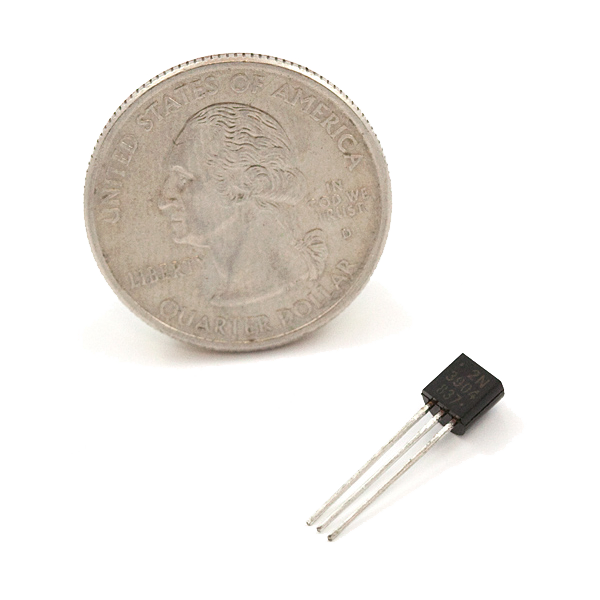 BJT Transistors - NPN 2N39041 个
 1/4 瓦电阻套件1 套件
 电解电容套件1 套件
所需工具:
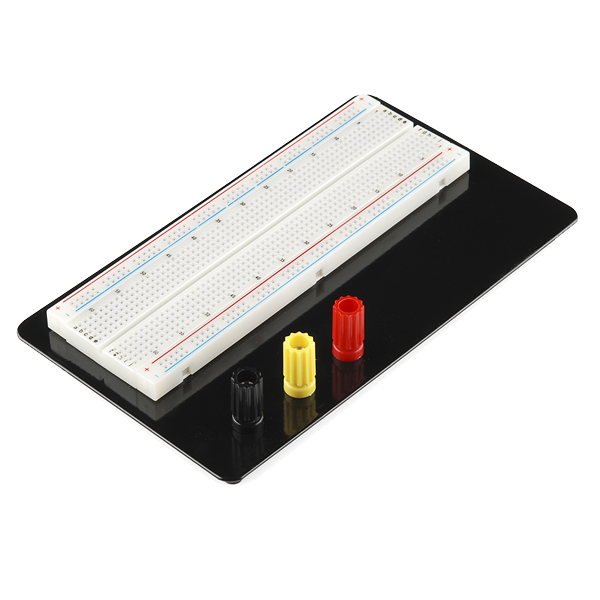 Breadboard - Classic
 DDS 信号发生器
 数字示波器
数字示波器 台式电源
台式电源 实验室级数字万用表
2
2
Take the capacitor out
Take the capacitor out
Remove the emitter bypass capacitor so the emitter resistor is in circuit for signal. You have just closed a feedback loop: the emitter voltage follows the output current and opposes the input.
Re-measure. The gain has collapsed to roughly the ratio of two resistors - and now it does not move when you warm the transistor, and the sine wave on the scope is visibly cleaner at large signals. Same parts, one component moved.
此步骤所需材料:
1/4 瓦电阻套件1 套件所需工具:
Breadboard - ClassicDDS 信号发生器数字示波器实验室级数字万用表3
3
One over beta, four benefits, and the thing Black tried first
One over beta, four benefits, and the thing Black tried first
正在加载 Jupyter 笔记本…
所需工具:
 台式电脑
台式电脑4
4
Compendium: the patent nobody believed, and the minus sign
Compendium: the patent nobody believed, and the minus sign
The British Patent Office initially treated the application the way they treated perpetual motion machines, on the reasonable-sounding grounds that an amplifier whose output opposes its input cannot amplify. It is a fair objection and the answer is that it does not amplify - the LOOP does, and what the loop delivers is not gain but accuracy. Black's US patent 2,102,671 was filed in 1932 and granted in 1937, ten years after the ferry. Bell System repeaters using it went into service in the 1930s and the same equation now sits under every operational amplifier, every switching regulator and every servo in this batch.
The minus sign is worth being careful about, because it is only a minus sign at low frequency. Every real amplifier adds phase shift as frequency rises, and at some frequency the feedback that was subtracting arrives 180 degrees late and starts adding instead. If the loop gain is still above one when that happens, the amplifier oscillates. More feedback makes every static property better and moves that frequency closer, which is why the Bell amplifiers with the most feedback were the ones that sang - and why the next two blueprints exist.
所需工具
6- Breadboard - Classic10% 佣金$9.40
- 占位符
- 1 vendor sell this, none ship to you yet占位符
- 占位符
- 占位符
- 占位符
估计总额
制作者买了什么。未标价的材料,在你购买的地方获取。
相关蓝图
这些蓝图共享知识——技术、材料或原理

CC0 公共领域
此蓝图以 CC0 协议发布。你可以自由复制、修改、分发和使用此作品,无需征得许可。
通过购买蓝图中的产品支持创客,他们将获得 创客佣金 (由供应商设定),或创建此蓝图的新版本并将其作为连接包含在你自己的蓝图中以分享收入。