艺术
美容与健康
工艺
文化与历史
娱乐
环境
食品与饮料
逆向工程
科学
体育
技术
可穿戴设备
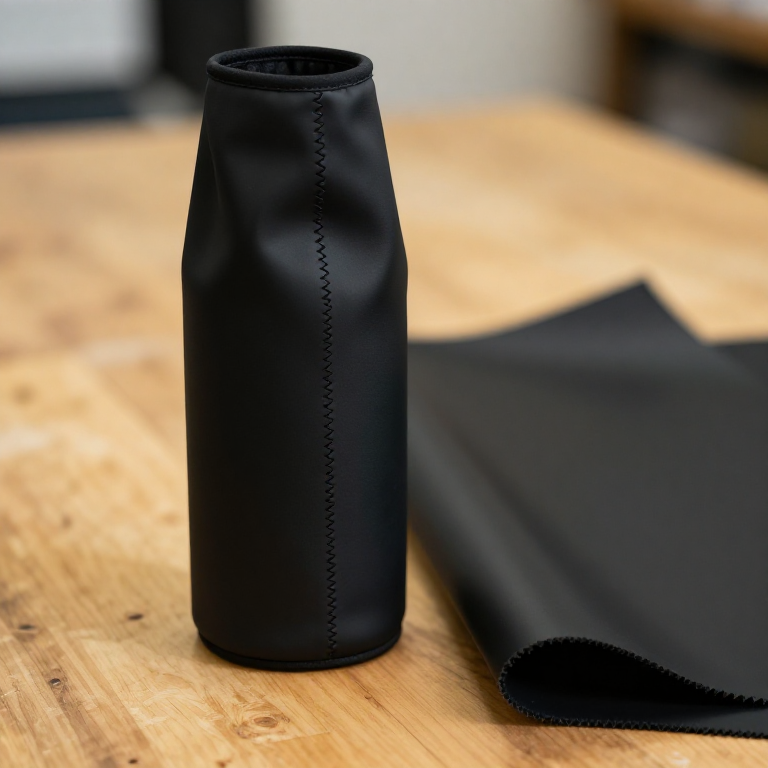


Neoprene
Natural rubber swells and softens in oil and cracks in sunlight. In April 1930 Arnold Collins, working in Wallace Carothers' group at DuPont, isolated chloroprene - a close relative of the isoprene in natural rubber, with one chlorine atom in place of a methyl group - and found that it polymerised by itself into a rubber-like solid. DuPont sold it from 1931 as DuPrene and renamed it neoprene in 1937. It was one of the first commercially successful synthetic rubbers, and its selling point was exactly what natural rubber lacked: resistance to oil, weather and heat.
**No patent number is cited here**: the chemistry is well documented and dated, but no single patent was verified as covering neoprene itself, so none is claimed.
**You make a snug neoprene sleeve with a glued-and-stitched butt seam, then test the claim** - a strip of neoprene and a natural rubber band in mineral oil for a day, measured before and after.
初学者
2 hours plus 24 h soak
说明
1
1
Size the sleeve
Size the sleeve
Measure the bottle diameter. Run the notebook's sizing cell for the cut width and base disc.
所需工具:
 6 英寸数显卡尺
 直尺
直尺2
2
Mark the pieces
Mark the pieces
On 3 mm neoprene, chalk a rectangle: cut width x 200 mm tall. Chalk the base disc beside it.
此步骤所需材料:
 氯丁橡胶面料1 张
所需工具:
 裁缝划粉直尺
3
3
Cut
Cut
Cut the rectangle with the rotary cutter against the ruler, one firm pass. Cut the disc with fabric scissors.
所需工具:
 轮刀与切割垫套装
 裁布剪
裁布剪4
4
Cement the edges
Cement the edges
Brush a thin coat of contact cement on both 3 mm long edges, using the brush in the can lid. Leave until touch-dry, as the can directs.
此步骤所需材料:
 万能胶10 毫升
所需工具:
 秒表
秒表5
5
Butt the seam
Butt the seam
Roll into a tube and press the edges face to face, no overlap. Contact cement grabs on touch - align the top first, then close downward. Clip and leave 10 minutes.
所需工具:
 大号长尾夹
大号长尾夹6
6
Stitch across the seam
Stitch across the seam
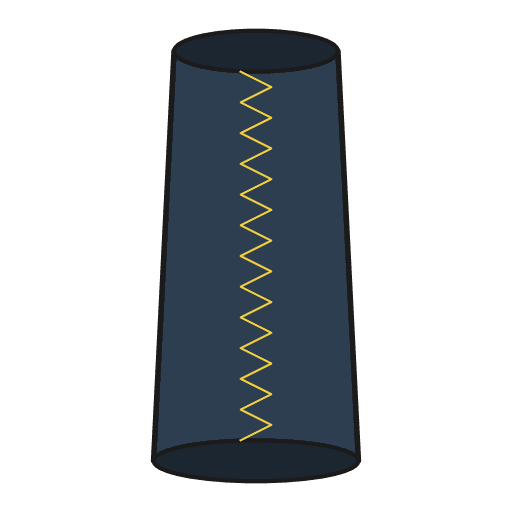
Zigzag across the glued seam, stitch width wide enough to bite both sides. Stretch slightly as you sew so the thread gives with the fabric.
此步骤所需材料:
 涤纶线5 米
所需工具:
 缝纫机
缝纫机7
7
Close the base
Close the base
Cement the disc rim and the tube's bottom edge, press together, then whip-stitch round by hand.
此步骤所需材料:
万能胶5 毫升涤纶线2 米所需工具:
 手缝针
手缝针8
8
Set up the swell test
Set up the swell test
Cut a 50 x 10 mm neoprene offcut. Cut open a rubber band to a 50 mm strip. Measure both. Submerge in mineral oil in a lidded jar for 24 hours.
此步骤所需材料:
 食品级矿物油100 毫升
 橡皮筋1 包
所需工具:
 玻璃罐6 英寸数显卡尺
9
9
Measure again
Measure again
Blot the strips dry and measure their lengths. Enter all four numbers in the notebook.
所需工具:
6 英寸数显卡尺10
10
Chlorine, swell and sizing
Chlorine, swell and sizing
正在加载 Jupyter 笔记本…
11
11
History & Context
History & Context
Neoprene grew out of Julius Nieuwland's acetylene chemistry at Notre Dame, which DuPont licensed; Collins' chloroprene came from that work in Carothers' laboratory, the same group that produced nylon.
Its limits are the other side of its strength: it costs more than natural rubber, is less springy, and stiffens in deep cold. The sheet you used is almost certainly closed-cell neoprene FOAM laminated to nylon jersey - the form wetsuits made familiar - where trapped gas cells add insulation that solid neoprene lacks.
此蓝图制作
相关蓝图
这些蓝图共享知识——技术、材料或原理


CC0 公共领域
此蓝图以 CC0 协议发布。你可以自由复制、修改、分发和使用此作品,无需征得许可。
通过购买蓝图中的产品支持创客,他们将获得 创客佣金 (由供应商设定),或创建此蓝图的新版本并将其作为连接包含在你自己的蓝图中以分享收入。