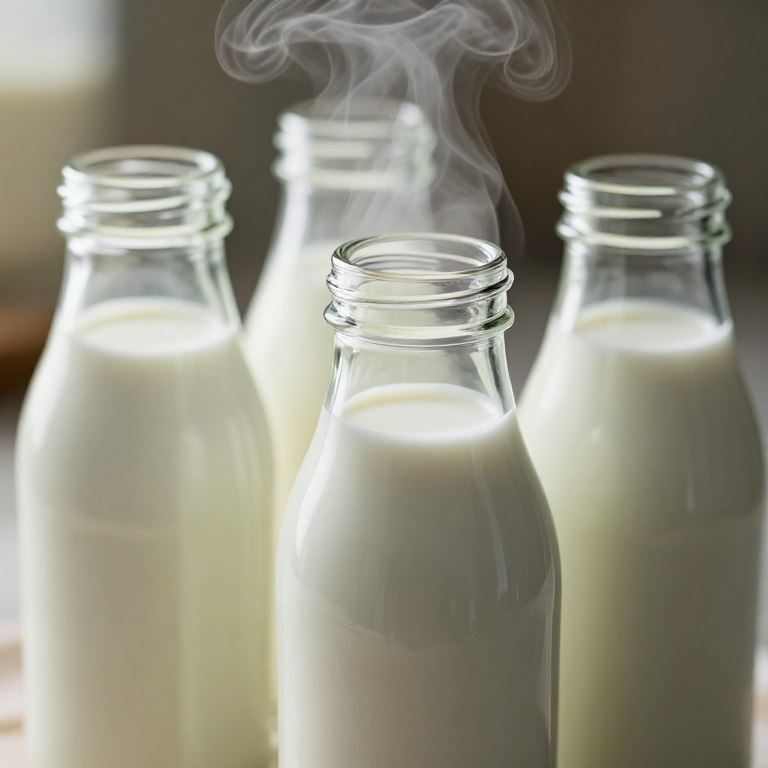


Pasteurising Milk and Wine — Gentle Heat That Kills the Germs Without Cooking
In the 1860s Louis Pasteur proved that the spoiling of wine, the souring of milk, and many diseases were all caused by the same thing: living micro-organisms too small to see. From that insight came a simple, world-changing technique that bears his name — pasteurisation. Heat a perishable liquid just enough to kill most of the microbes in it, but not enough to cook it, and it keeps far longer and becomes safe to drink.
The trick is restraint. Boiling would sterilise milk but ruin its taste; pasteurisation instead holds it at a modest temperature — around 63 degrees for half an hour, or 72 degrees for a few seconds — which destroys the dangerous bacteria while leaving the flavour and most of the nutrition intact. Cool it quickly and seal it clean, and you have a product that is both safe and good.
Pasteurisation does not make food immortal — some spores survive, so pasteurised milk still needs to be kept cold. But it made milk safe for children, ending much of the tuberculosis and infant death that raw milk carried, and it let wine and beer travel the world without turning to vinegar. It is one of the quiet triumphs of public health.
说明
Understand germ theory
Understand germ theory
Choose the liquid
Choose the liquid
此步骤所需材料:
 新鲜牛奶2 升
Set up a gentle heat bath
Set up a gentle heat bath
所需工具:
 水浴罐装锅
水浴罐装锅Heat to the target temperature
Heat to the target temperature
所需工具:
 室温计
室温计Hold for the set time
Hold for the set time
Watch the thermometer
Watch the thermometer
所需工具:
室温计Cool quickly
Cool quickly
此步骤所需材料:
 榨汁机2 公斤
Seal in clean containers
Seal in clean containers
此步骤所需材料:
 带盖玻璃瓶4 个
Know its limits
Know its limits
Compare with sterilisation
Compare with sterilisation
Verify it worked
Verify it worked
所需工具:
 土壤检测套件
Appreciate the impact
Appreciate the impact
相关蓝图
这些蓝图共享知识——技术、材料或原理


CC0 公共领域
此蓝图以 CC0 协议发布。你可以自由复制、修改、分发和使用此作品,无需征得许可。
通过购买蓝图中的产品支持创客,他们将获得 创客佣金 (由供应商设定),或创建此蓝图的新版本并将其作为连接包含在你自己的蓝图中以分享收入。