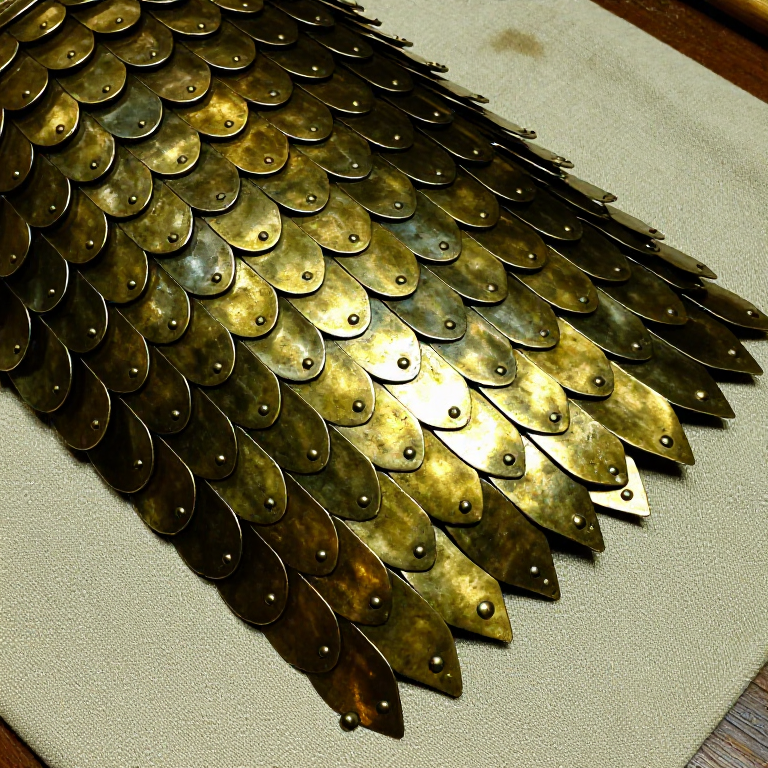


Riveting Lorica Squamata Scale Armour — Roman Scale Mail
说明
Cut and Shape Individual Scales
Cut and Shape Individual Scales
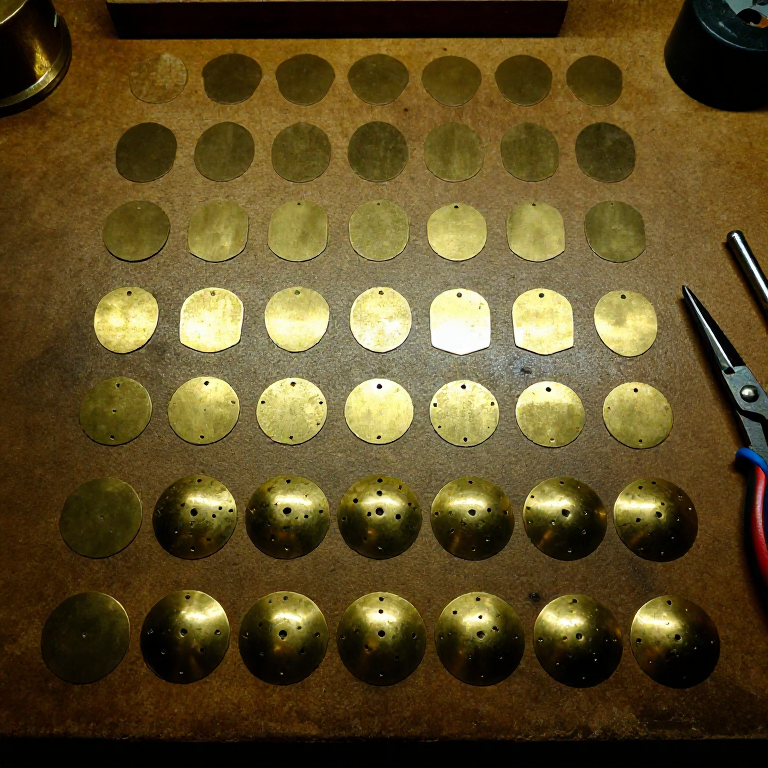
Cut the metal sheet into rectangular blanks approximately 1.5 cm wide and 2.5 cm long using tin snips or jeweller's shears. File all edges smooth to remove burrs that could cut the backing fabric or the wearer. Shape each scale by rounding the bottom edge with snips and file to create a gentle U or pointed leaf shape — surviving Roman squamae vary in shape from rectangular to rounded to pointed, depending on the unit and period. Slightly dome each scale by placing it on a leather pad and tapping the centre with a ball-peen hammer. This doming causes the scales to overlap more snugly and adds rigidity. Punch two holes near the top edge of each scale, spaced approximately 5 mm apart, and one hole in each upper corner, for a total of four holes per scale.
Prepare the Backing Fabric
Prepare the Backing Fabric
Cut the linen or leather backing to the shape of the armour panel being constructed. For a simple demonstration piece, a rectangle approximately 30 by 40 cm is sufficient to practice the technique. Mark horizontal guide lines across the backing at intervals equal to approximately two-thirds of the scale length — this determines how much each row overlaps the row below. For 2.5 cm scales, mark lines every 1.5 to 1.7 cm. These lines ensure straight, even rows. If using linen, fold the edges under and stitch a hem to prevent fraying. The backing must be strong enough to support the weight of hundreds of metal scales without tearing at the attachment points.
Attach the First Row of Scales
Attach the First Row of Scales
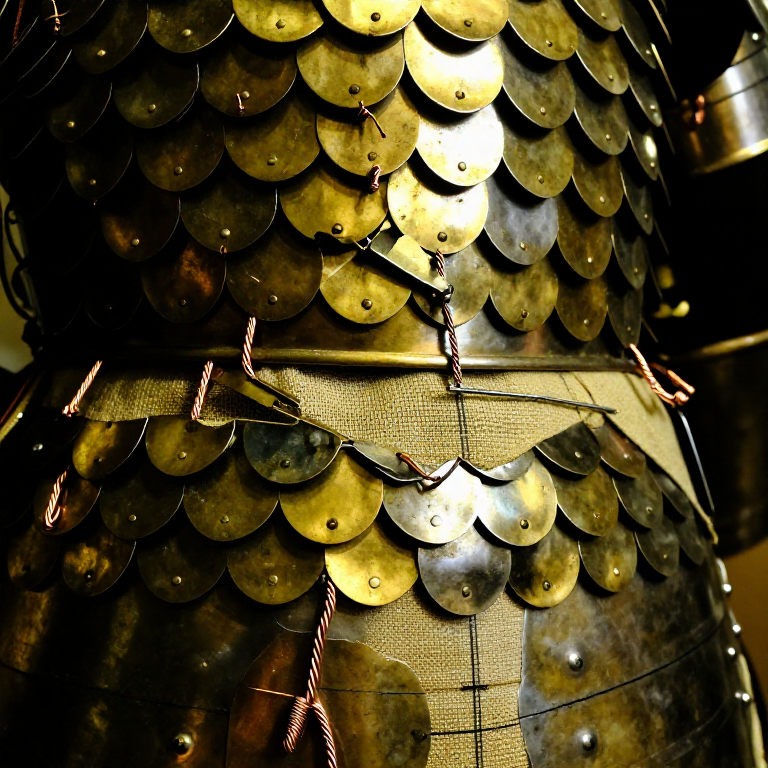
Begin at the bottom of the armour piece and work upward, so that each successive row overlaps the tops of the scales below. Thread a length of copper or brass wire through the two top-centre holes of a scale, pass the wire through the backing fabric at the bottom guide line, and twist or loop the wire on the reverse side to secure it. Alternatively, use a separate short wire for each scale, passing it through both holes and the fabric, then twisting it flat on the back. Place scales side by side along the row so that their edges just touch or overlap by 1-2 mm. The corner holes are used to wire adjacent scales to each other horizontally, linking them into a continuous row. Complete the entire bottom row before moving to the next line above.
Build Successive Overlapping Rows
Build Successive Overlapping Rows
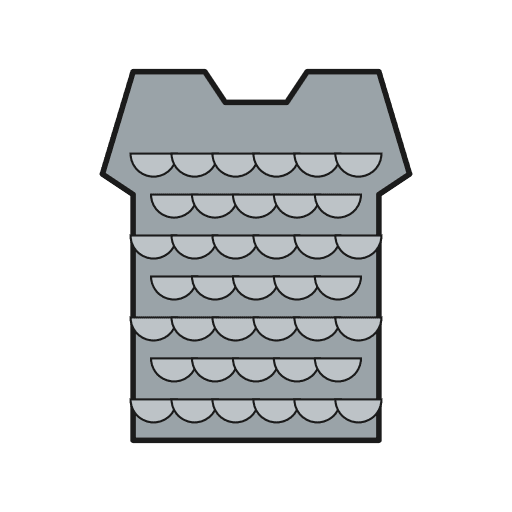
Attach the second row of scales on the next guide line up, offset by half a scale width so that each scale in the upper row covers the vertical gap between two scales in the row below — this is the same bricklaying offset pattern used in fish-scale roofing. The upper row's scales should overlap the lower row by approximately one-third to one-half of the scale height, covering the attachment wires of the lower row. Continue wiring scales row by row, working upward. Each new row hides the attachment points of the row beneath, producing a clean exterior surface of overlapping scales with no visible wires on the outside. Check periodically that the rows remain straight and that scales lie flat without bunching.
此步骤所需材料:
 低碳钢板enough for 400-600 scales 个
 铜线50 metres 个
Finish Edges and Inspect
Finish Edges and Inspect
At the top edge of the armour piece, fold the last row of scales' upper portion over a strip of leather or fold the backing fabric over the top scale edges and stitch through to create a clean, finished border that will not snag or cut the wearer. Bind the side edges similarly with a leather strip sewn over the exposed scale ends. Turn the piece over and press all wire ends flat against the backing, filing any sharp points smooth. Flex the completed panel — properly made lorica squamata should drape and move with the body, each scale sliding slightly over its neighbours. The finished armour provides effective protection against slashing cuts while the overlapping layers can also deflect thrusting attacks to some degree, though it is less effective against direct thrusts than solid plate or mail armour.
材料
5- enough for 400-600 scales 个占位符
- 50 metres 个占位符
- enough for 400-600 scales 个占位符
- area of armour piece plus 5 cm margin 个占位符
- 1 个占位符
此蓝图制作
CC0 公共领域
此蓝图以 CC0 协议发布。你可以自由复制、修改、分发和使用此作品,无需征得许可。
通过购买蓝图中的产品支持创客,他们将获得 创客佣金 (由供应商设定),或创建此蓝图的新版本并将其作为连接包含在你自己的蓝图中以分享收入。